Showing posts with label aortic valve replacement. Show all posts

Saturday, August 2, 2025

“Heart Sisters”

Heart disease is not something to muck about with ... Sometimes, you live with it for a very long time, and sometimes you have no idea you have it until it’s too late ... The silent killer as they say ... 


I knew I would have heart disease one day because of my FH diagnosis at the age of 8, and because my doctors were savvy enough to know the potential damage that the cholesterol was causing my arteries would eventually end me in the operating room. If I was lucky. 


Because I knew the risk, I could watch my heart over time and see the progress of the disease before it was too late to do anything about it, and luckily, before it caused an event like a heart attack or cardiac stop ... 


I met many heart patients on my journey with FH and heart disease. I have met so many special women, especially, that have gone through so much more than me. I feel connected through some invisible thread with all of them. We are all different and all alike in some ways. And in many ways, we get each other at a deeper level. 


The one thing that you’ll learn when you’re an open-heart surgery patient is that no two journeys are alike with this disease and with surgery. We all have different thresholds of pain, we all have slightly different surgeries, and we all have different anatomys. Two heart-valve surgeries are never the same: mechanical valve vs bio valve; aortic valve vs mitral valve; one valve surgery, vs multiple valve surgeries; valve replacement vs valve repair; bypass surgery vs endarterectomy; stent implantation vs bypass surgery; aneurysm repair vs aorta transplant ... 


Surgeries can last 2-3 hours or 10-13 hours. You can come in and out of anesthesia or you can feel like you took the longest nap of your life and not remember a thing. Some people see “a bright light” while they are on the heart pump machine, others see nothing. Just peaceful sleeping ... Some feel like they left their bodies and are looking down on their surgeons from the ceiling, other patients think this is all imagination and too many horror movies watched... 


How we heal, how fast and how well, and what life-long side effects we are left with (because there will always be those) are all different from one person to another, too ... 


We are taught, as heart patients, to never look at others’ progress in recovery and wish we were them. To just focus on us, to be in tune with our own bodies, to listen to them, and to focus on getting our own bodies better ... 


And yet, despite so many differences and nuances because we are all different people, there are so many similarities between heart patients ... The scare, the dread of being opened up, the pain, whatever its level, the up and downs in the ICU, the nightmares, the confusion, the low pulse followed by tachycardia, the high blood pressure followed by deadly low numbers, the lung damage, the dreaded spirometer challenge (Gosh, I hated that thing!!), the experimenting with pain killers (one minute you want to OD on them they are so good for pain, the next you want nothing to do with them ‘cause they make you lethargic or make you throw up) - I have experienced all these and so have many of my heart patient friends ... 


I have been lucky to be close to my friend Kate, that I met through the website of a heart valve surgery support group during my surgery and the subsequent recovery, 9 years ago. We are of similar ages, and have known for a long time about our heart disease. We have been pen pals (do people even know what that means anymore?) ever since. We exchange notes and horror stories about doctors, frustrations with our recoveries, and complications from our continuous disease, but also successes and small victories (that are monumental to us). 


Kate is also my hero and my role model because she has had open-heart surgery now three times ... She just got out of her third one, to replace both her aortic and mitral valves. Although I have coronary artery disease and valve disease and she has multiple valve disease (this is the difference), our journeys have been very, very similar in a lot of striking ways (this is where we are alike). 


She just left the hospital today, after 12 days for this third surgery and she sent me a picture of her leaving the hospital. My heart jumped when I saw it. Because this was almost exactly the picture my husband took of me when I was leaving my hospital after my surgery 9 years ago. The resemblance simply made my heart skip a beat ... And all those similarities between Kate’s and my journey came rushing back ... 


2 August 2025 - 19 February 2016


All I could think about is: WOW! This is THE picture! This is the picture one takes after they survive the worst - hugging the heart pillow and smiling, high on the notion that we are still walking the earth with foreign materials in our chests forever and God knows what else ahead of us. Smiling because we’re alive. Because we cannot believe we’re breathing and on “the other side”. 


I am sure everyone will see something different in these pictures. But what I see is all the similarities that bring us closer together as time goes by. That heart pillow alone and how we're clutching to it - it is your survival security blanket; it helps you breathe without pain and the only thing that stabilizes your (still) very "crunchy" chest that feels like puzzle pieces not yet glued together.


Kate, too, like me, knew she had bad valves quite early in her life, in her late teens. And she stuck with it, too, and she watched it and she did something about it before it did something more awful to her  ... 


I also see in this picture both of us surviving despite the many shitty prognoses; surviving despite the inability to tell yourself one more time “it’s gonna hurt; it’s gonna be hell, but I gotta do it to live to see another sunset and get another kiss from my cat (or dog), to live to jump on another plane one day to see my earthly paradise (we all have one), far, far away, to make love one more time; gotta do it!” ... 


We’re both still weak in these pictures, we’re in the passenger seats, we relinquished the reins, we are being cared for (how lucky is that alone?), and we are weak-looking, but there is fire behind those eyes and there is resilience and there is grit. 


I am sure she’ll have stories to tell after her third visit in there, going through the deep, deep darkness of literally being put to death and then brought back again. This is how I feel when I look back on my surgery: they literally stop your heart that has no blood going through it for a while, and then they magically make it beat again. The next thing you know, you walk out of the hospital and you go home with a new lease on life ... Sounds simple, and trust me: both for Kate and I, this journey from when you go in till you get out felt like at least 10 years ... But that smile says it all ... 


When it comes to life’s challenges, open-heart surgeries are quite up there in kick-butt-ness, in my book. Every surgery has a risk, sure. Every paper cut can give you a lethal blood infection. But there are few things in life for which you have to die (like open-heart surgery) to get better... And we did it willingly. Thank goodness we knew ahead of time that we needed it ... And thank goodness that for heart disease there are ways to manage it. 


I can’t think of anything more humbling than being sick and coming back to life. I can’t think of a more character-building experience than going through what Kate has gone through, not once but three times ... She is not 50 yet ... 


The title of this blog belongs to Kate, hence the quotes - this is what she said when she saw these pictures: “Heart sisters foreva”. I could not agree more, and I could not feel more honored and proud to have her say that ... We may be different people, we may live 2000 miles apart, but we have this invisible bond that connects us across miles and time zones, and although every muscle hurts different for her and I, our hearts still beat to keep us alive, despite the different kinds of ordeals that they have endured, despite the different number of times they went silent. Our hearts are ultimately stitched up and broken just the same. And that will connect our lives and our stories forever ... 


Speedy recovery, my favorite warrior and welcome home! And I’ll leave you with the advice my own surgeon gave me 9 years ago, the day after my surgery: “It’s up and at ‘em from here out!” I have no doubt about it! 


Saturday, February 11, 2023

It’s Been 7 Years!

There is something magical about number 7. It’s not my number (that would be 9), but it’s magical. I am not going to get into all the symbols of number 7 in all the cultures and throughout history. This is not about numerology. This is about the fact that 7 years ago today I got a new heart and a new lease on life. This is about reaching this milestone and being grateful.

7 years ago, in a hospital in the obscure (to those outside of the US) state of Utah, in a small town of barely over 100,000 people called Provo, I was getting my heart stopped, cut open, and I was having my aorta and aortic valve replaced with man-made parts. Then, I was having four bypass surgeries around four major coronary arteries that were between 90-99% blocked, and several endarterectomies to clean out the incredibly heavy amount of plaque that my 40 year-old body had accumulated due to this little known rare disease called Homozygous Familial Hypercholesterolemia. Are you awake yet?! 


I documented my surgical journey of 8 days in the hospital here (https://livingwithfh.blogspot.com/2016/02/open-heart-surgery-day-1-to-8.html), for those who want all the details. Several years of cardiac rehab followed, all with ups and downs. This entry, is about the lessons I have learned in all the years that followed that day.


After that massive surgery, along with my body not feeling like my body anymore for a while,  several things transpired. I am guessing if you ever go through a similar journey, you might encounter these learnings, too, so I am sharing:


  1. You might shamelessly, unapologetically fall in (platonic, respectful) love with your surgeon. My own surgeon reminded me that it was not only him, but the whole team (three surgeons and three cardiology surgical PAs) that gave me the miracle of a better-working heart, but I know he was the leader of the pack. The mastermind. The true artist. The guy with all the guts to reshape a heart so sick in just one, long (13+ hours) surgery, just because he made a commitment to himself that “he never wants to look at my heart again”. He made sure I never have to have that surgery more than once. How can you fall in love with the person who mended your broken heart? Literally?! I do not know how.

  2. Even with a fixed heart, you can still have a heart attack - as my body proved just a week (7 days!) after he closed me up. This added insult to injury, let me tell you, but I was glad I was still in the hospital for it, with all the specialists around me. I survived that, too, although my heart is still reeling from the damage that attack did to my left ventricle.

  3. You will re-learn your heart, its new antics, and your whole body after a shake-up like this! You will have new sensations in your chest, new symptoms of chest pain and dizziness, new types and intensities of tinnitus, and so much more! Nothing will feel the same as before the surgery. And it’ll take a couple of ER visits to learn that a heart palpitation might not always mean that you’re having another heart attack - sometimes, it’s just your blood pressure being low and asking for you to lay low for a spell! And the ER staff will give you a bag of salty chips to get the pressure back up and send you home. True story! 

  4. You will learn that Coumadin will not kill you by making you bleed out! You’ll manage it, by fits and starts, and you will become begrudging roommates in this newly renovated body of yours. In the end, it’ll become like the rascal little brother that you sometimes love (it keeps you alive by preventing your new mechanical valve from clotting), but it annoys you sometimes when you can’t get a handle on what it decides to do one day (like make your INR twice as high as it’s supposed to be just because you exercised too much one week or your dad passed and you’re under too much stress). 

  5. You will really learn the truth about what initially will feel like a cheesy cliche that “once a heart patient, you’re always be a heart patient.” This is, scout’s honor, the honest truth! There is no “cure” from heart disease, really. There is managing it, staying on top of it, but there is no “forget about it. This was in the past.” The disease will stay with you and it will morph into something else every year. Every month. Every day, even! There have been some big wins, for sure: my valve is very healthy and not leaking; my ejection fraction is healthy, around 50%. But there have been setbacks too: my smaller arteries which were too small for bypasses or endarterectomies have gotten sicker and possibly more clogged and continued to damage my heart muscle. My heart muscle, especially my left ventricle, is now stiff and my heart is in the beginning stages of heart failure (with preserved ejection fraction, which is the more rare and harder to treat version, so I have learned in the past year). The annual tests, and the quarterly cardiology visits continue and will continue for the foreseeable future. 7 years later. Indeed, I will stay a heart patient as long as I live. Some old symptoms are here, but changed. And new symptoms have popped up. But this is you now. And this is your reality. And this is OK. Have gun, will travel! You have the tools, the knowledge and the experience, and most importantly: your heart is still ticking - you learn to trust and move on. Being a patient is far better (sometimes), than being dead! And having a disease you can manage is a blessing! You will learn this to be true. I sure, we all want to be fully healthy. But if you were to have a disease, better have one you can manage.

  6. You will learn how to be happy and feel safe in this body. Broken, scarred and winded, you will learn what it wants and move on. Take that trip you always wanted (I always wanted to go on a cruise. I went on two during these past 7 years), climb that mountain that you think it’s too much (I remember how I felt like I was going to die before I reached the top of Ensign Peak in Salk Lake City, but it felt like I conquered the world when reaching the top and taking in the view of the Salt Lake and the valley), fly across the world again, even alone. It’ll be scary, but you’ll do it. I (along with millions like me) had the unique misfortune to hit the Covid years during these last 7 years and that “stole” a couple of years of my life. But I learned how to travel locally and how to be careful and still found some joy in the temptations that were close-by. The world is beautiful even outside your front door. And I am glad to see another day to enjoy it.

  7. You will learn how to advocate for yourself even more than before. There will be a time when you might have to change doctors - because your original “dream team” that first diagnosed you, babied you before and after your surgery won’t be available - because you’ll move or they’ll retire. The new people won’t listen to you, will assume you don’t know much about medicine or about what really happened during that surgery - but you’ll have to learn that your voice carries and you can always scream louder. You will make them listen, or fire them. And they will, eventually, keep you alive. But you will know that the force is in your lungs. 

  8. You will learn to be humble. First off, you will learn to love your body again and thank it for carrying you through another day. I used to refer to my heart after surgery as "oh, my stupid heart", and I don't do that anymore! That was insulting to it. It was demeaning. Now, I cherish it and thank it for every beat, every single second. I bow to it with humility! It does such hard work and it's been through hell. You will learn the miracle of good days, of the days when you don’t feel like an elephant is taking a seat on your sternum, and you will feel grateful to the miracle of medicine that’s helping you through. 

  9. You will absolutely become some kind of a germaphobe! No doubt about it! Bacteria and viruses will scare the crap out of you, especially when you read about folks getting sick with endocarditis and having the valve replacement surgery redone because no antibiotics worked to cure the heart infection! It will scare you witless, I guarantee it! 

  10. You will learn abbreviations and acronyms that you never thought you’d learn in your life: OM, LAD, CVD, CAD, AHA, EF, HFpEF or HFrEF. No dictionary needed here!


If there is just ONE thing that I could share about how you make it through the hell of open-heart-surgery and heart disease and back is this: don't think too much of the future. Not necessarily in deep, fine details, anyway. Give yourself bite-size milestones to reach every day: today, you might focus on breathing better; tomorrow - on eating more properly; the following day on walking a few feet further. Whatever it is. Focus and do it with all your might, energy and heart. Keep moving forward through your everyday milestones and one day, you'll look back and be amazed at what you've been through, how much you've accomplished, and how strong you are as a result. Telling yourself "I want to climb Mount Everest 6 months after my surgery!" when you still have tubes going through your ribs and you can't take one breath without screaming in pain is nothing but demoralizing. Tell yourself you will kill that tube beast soon; focus on learning how to breathe with it; allow you body to heal and get strong by paying attention to it every day, and Everest will wait for you at the end of that journey. I promise it!


I think the one thing most dear to me that I cherish today is that I am still here. Today, while I am thinking of all the hardships I have overcome with gratitude, I am definitely not thinking about the ones that still lie ahead of me. If I do the work of today, I know I'll be as prepared as I can be for tomorrow's challenges. I have to trust that. Today, I am mostly taking a minute to be grateful. Today, I am thanking my team, my family (my husband is my Guardian Angel, my nurse, my psychologist and so much more!), God, and my body for being here for me through it all. To paraphrase Anne Lamott, "life is such a show-off".


Again, like I said above: I am humble. I know there are forces bigger than me at play. I am merely a raft on the angry ocean, being pulled away, and thrown ashore, but still intact. Damaged, and full of weeds, but still afloat. I’ll cheer to this and hope for at least 7 more "magical" years! 


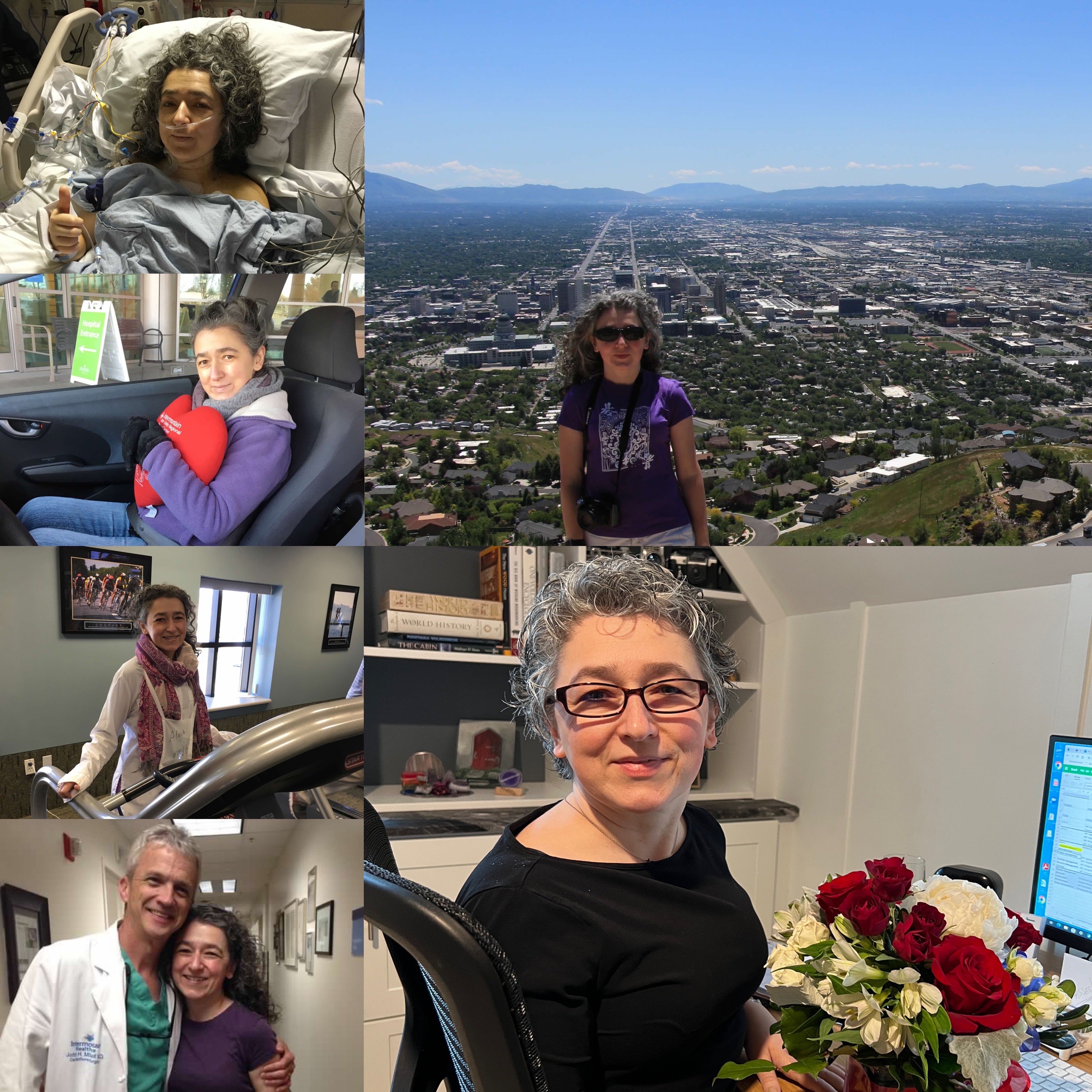
A journey in time: from the day after the surgery, going home after the heart attack, happy in cardiac rehab, with my amazing surgeon, Dr. John Mitchell, at the top of Ensign Peak a year later and today - 7 years later! (you may click the picture for a larger view)

Friday, February 11, 2022

After 6 Years

It’s hard to believe that it’s been 6 years since my open-heart surgery. In some ways, that seems like a blink of an eye. A 6 year old would barely be even fit to start real school yet! But in the measurement of the time that open-heart surgeries recoveries are measured by, 6 years seems like a lifetime. 


February 11: 2016 (right before they rolled me into the OR) - 2022

I hated having such a huge surgery in February - my least favorite month. The month that, historically, has gotten people sick and killed among my loved  ones. A cruel, cold, dark (albeit short) month that’s not always been kind to me. But it had to be in February, because at the end of January, the month before, they found two arteries blocked in my heart (the LAD was at 99%, another one - an OM - was at 90%). The aortic valve was failing, in severe stenosis, and the aortic arch had an aneurysm. The cardiologist wanted the surgery done even sooner, if he could get me and the surgeon aligned on a date. 

I documented my surgery day, step by step, here: https://livingwithfh.blogspot.com/2016/02/open-heart-surgery-day-1-to-8.html.

And the day before the surgery (the “pre-op” day), here:

https://livingwithfh.blogspot.com/2016/02/the-day-before-open-heart-surgery.html

If you ever have time to read it all, you will see that what was said the day before, what they prepared me for, mostly came true, but there were a few surprises. When I came out of the surgery, everyone who came into my room, ICU nurses, several surgeons who assisted me during the actual surgery (12+ hours), all the three PAs, breathing and physical therapists, and even my rock, my husband - all of them reminded me that I “had just been hit by a Mack truck.” You cannot possibly be very well hit by a Mack truck and expect every single thing to go “according to plan”. You cannot be hit by a Mack truck and plan for it, step by step, then hold God and the world accountable for every one of those steps. You are bound to be surprised, and thrown off the rails, and, oh, yeah, even shocked. 

The day of the surgery was a pretty peaceful day for me, consciously. Yes, my body went through hell; yes, it got killed, drained from all the blood, frozen for more than half an hour, and was brought back to life. But, mercifully, I don’t remember any of it. Sometimes I hear about people remembering bright lights and seeing their lives flash before their eyes, or floating above their bodies in the OR, but I experienced none of this. 

As peaceful as that day was, the days in the hospital that followed were intense! Just full of emotions, but more than anything full of new sensations, of discovering new parts of my body I didn’t know I had or parts that I didn’t know could hurt - my skin hurt. I could not wear ribbed tees or feel the creases in my hospital bed sheet because my skin felt like it was completely burnt ... The two days after the surgery, it took all I had to just stand up, held up by the nurses, beside my bed. Forget walking and balancing on my own. That didn’t come till it was almost time to go home, more than a week later ... I don’t think I ever walked during the hospital stay without holding on to the back of a wheel chair. And the breathing! Oh, my word! I could not breathe! I could not speak, I’d whisper. They wanted me to blow into this plastic tube and felt like that was my last breath, there it went into that stupid tube. At the end of that effort they’d all look disappointed because I never could blow strong enough for them! It was horrible. My lungs took such a beating! Even after three months of recovery, when I went back to work finally, my coworkers were saying that they could never believe I could speak so quietly. I don’t have a big voice to begin with but after the surgery, it was nothing but a whisper. 

Once I got home, the life “after OHS”, the life on my own, without hospital care and around-the-clock medical staff explaining every new symptom, started. I was terrified! Again, I had to relearn my body! I had to learn how to sleep again because no position felt comfortable. No bed or chair. I had to learn how to cough and laugh and sneeze again so as not to let my chest come loose ... I had to build an appetite again although nothing sounded good. I had lost 10% of my body weight in that surgery and I didn’t have that much to lose to begin with: I was 95 lbs at my lightest. 

I went through ER scares when I became too dizzy and light-headed, or when I cut my finger chopping veggies and was scared that the Coumadin might make me bleed forever ... I went through years (not even sure that’s even over yet!) of being scared that my INR will be too high (I’ll bleed to death) or too low (my mechanical valve would clot and I’d die of an embolism or something). Although I manage it better than ever before now, it is still a challenge to keep it tightly in my range, especially when seasons change or when I travel and add unusual, unfamiliar stress to my daily life. 

I went to physical therapy twice, first to build strength in my upper body, right after surgery, and almost two years later to build stamina to be able to walk for a mile at a time without my chest hurting too much and without feeling like I was going to faint from light-headedness. 

I stopped traveling the year of the surgery because I was afraid of getting an infection on airplanes. That was when my immunity was still fighting to heal my heart. I stopped traveling again for the past two years because being a cardiac patient with very high cholesterol for the rest of my life puts me in the “high risk” group for people who might get more severe or possibly lethal Covid. 

I do get out some and I meet with friends and even saw family across the country and in Canada last year. But I limit who I see and if I can’t meet people mostly outside I put it off for later. I am still nervous to fly. Maybe this coming summer ... We’ll see ... 

As much as I hate putting my life on hold, going through that surgery to rebuild my heart, with all its complexities, and then going through years of recovery to function somewhat normally again and being rewarded with a good life, all things considered, seems like the most precious gift. I don’t want to throw myself willingly at risks that are not absolutely necessary for survival, to endanger this beautiful gift. So, I’d rather wait out the pandemic, or not expose myself to other sources of more sickness or things that could damage my heart (or valve) again. In the whole scheme of things, it’s a small sacrifice.

I’ll have to say this though: my journey has been more lucky, more blessed than I have ever hoped for. So much more blessed than others’ paths - although there is no comparing journeys here. Everyone’s path is different and everyone feels pain and blessings at different temperatures. However, I can say, I am lucky to not have had too many complications in these past 6 years of renewed life. 

I wish I can tell you that the minute you walk out of that hospital after your heart surgery you’ll never look back and you’ll be as good as new with not a worry in the world about your health. But I’d be lying.  You will never be the same person you were before. In some ways you’ll be worse and in some ways you’ll be better. In some other ways, you’ll be much, much better. In almost all the ways, you’ll just be different. A different “you” that you’ll need to get reacquainted with. You’ll maybe be more hopeful, more appreciative of your health, with more respect for what your body can do and for its ability to miraculously heal, even after being hit by that Mack truck! 

I can tell you, though, this, for myself: I have zero regrets for anything related to this surgery. There has been no question in my mind that I needed this surgery. This was not elective: this was a surgery to save my life. My aortic valve had only a 0.49 cm opening, it was almost closed. My arteries were stenotic. My chest pain was constant. My ability to walk and exercise was very much reduced. I am very grateful that for my condition there was a course of action. There are so many afflictions out there that have no cure. So many diseases that come with a stopwatch that is set to expire in months, some in weeks or days. This was not the case with my heart disease: there was something they could do. I am grateful for that. 

I am also grateful for my team of doctors in Provo, Utah, at the Utah Valley Regional Medical Center. My cardiologist and my surgeon are my heroes, my true soldiers who fought as hard as me to get me back to “normal”. But the other members of the team, the PAs, the other surgeons, the medical staff, the technicians, and then the cardiologist I have had in North Carolina, after I moved, not to mention my family, my husband first and foremost (who tied my shoes and put on my socks after I got out of the hospital and when I could not bend over; who clipped my nails because the neuropathy in my hands could not work the clippers), my sister who is my biggest cheerleader - they all made me who I am today, when it comes to my heart and overall health. 

I have noticed that I can walk further and faster than ever before and that my stamina has improved little by little every year. I can now walk even in cold temperatures (30s-40s) or hot ones (80s) and can go longer than before. I walked a mile and a quarter last night in low-50s temperatures (with wind in my face that made it feel like the 40s) without even breaking a sweat. I used to be out of breath walking from my car to my office in 40F temperature before my surgery. Inclines are still a challenge to this day. I live in NC now and boy, there is not one street that’s not on some sort of a hill. Day to day, the progress you notice might be imperceptible, but when you look back at all these years, and compare what you could do then and what you can now, it’s pretty amazing ... 

A month ago my INR was 3.1 (too high since my range stops at 2.5). This past weekend it was 1.7 (within range but a little too close to my bottom of 1.5 for comfort). But I have learned how to live with this ever-swinging pendulum. I have bought a CoaguChek machine that measures your INR and I check it myself as many times a week as I want to just to know how to adjust my food accordingly. I usually check it once a week if no changes in diet, exercise, or stress level have occurred. I take it with me when I travel because it’s harder to plan for your food when you’re not home. This brings me a lot of peace of mind.

I have never, not once, regretted my choice of valve. It took sleepless days of reading just about everything there was to read on the internet about all the possible valve options that I had and when I found the On-X mechanical valve and learned about the benefits and came to peace about living on Coumadin (if you ever do!), I never looked back. I love knowing that at least if everything goes according to plan and I avoid infections and clots, my valve will outlive me and I won’t have to have my chest cracked open again. At least not for the valve, anyway. 

I got all sorts of other “work” done with my OHS: I had a quadruple by-pass, as well as endarterectomy of all the four arteries that they bypassed, and a new, grafted, ascending aorta. I also had an aneurism repair and additional endarterectomy of my aortic arch ... I get a yearly echo for my heart and both the current cardiologist and the surgeon read it and so far it all checks out, thank goodness. My ejection fraction is lower than before the surgery, but at 55% is still pretty good, considering. I still have high blood pressure, but we try to keep it under control with medication and exercise. The coronary artery damage that I might still have in my heart is believed to be in my very small vessels (which cannot be properly diagnosed with an echo; an angiogram is required for that and I am not due for a new one for another 3 years or so, barring any new symptoms, like acute chest pain, dizziness, collapse, etc). As long as I keep active, the belief is that I’ll help my body create new blood vessels that would build a natural bypass for any vessel that might clog in the future ... So far, every year I have been able to exercise more and more ... I am not a marathon runner, far from it, but my stamina has improved so much!

I look back on every anniversary and thank God, life, and the universe for the inspiration they all had to keep me in the light that fateful (in a good way!) day of February 11, 2016. Every day on this day, it’s my “other” birthday and I am grateful when I add another one to my heart age. I think my sister once said: “you are almost 47 in human years, but your heart is only 6.” That’s right! My heart, the engine of my body, is barely even old enough to go to school! Oh, the possibilities! 

Maybe having my Heart Day during Heart Month (February) was not a coincidence after all. I have made peace with that. 

Happy Heart Month to all the heart warriors out there! Embrace your body, embrace your heart and keep fighting the good fight. It’s always a good one when you keep that engine running! 

Much health to everyone! 

If you’d like to see my journey in pictures from my heart surgery day to today, you can do so here: https://wanderworldpics.shutterfly.com/22602

Monday, February 11, 2019

"Up and At'em!" - Thoughts on My Third Anniversary Since My Open Heart Surgery


Up and at'em!” - is what my surgeon said to me the day I came out of ICU, two days after my surgery. Three years ago tonight I came out of my open heart surgery with a new mechanical aortic valve, a new aorta, a repaired arch and four bypasses on four major arteries in my heart. About a week from that day, I had a heart attack while laying in my hospital bed waiting to be released.

But two days after the surgery, the surgeon said that once I would leave that hospital the sky will be the limit for me (“It's up and at'em from here on out!” - he said). Well, as those of you who have been through this already know, it takes a lot more work than this to be “up and at'em” again. But also as many of you know, it's not impossible.

I have been so blessed to have three more years added to my life, three years that now, looking back, I am not sure if I would have had, and not sure what they would have looked like if it were not for this surgery. I have had set backs and doubts that my heart is fine, I have felt and will always feel like a permanent heart patient, I still have regular appointments, take drugs and still manage the complications from the surgery daily. But … I have also lived a full life, too. I have worked full time since three months after surgery. I have traveled, I have camped, and climbed mountains, I have played with my nephews, and went on my first cruise. I have seen The Grand Canyon and walked Venice Beach and Sunset Boulevard in LA. I walked the streets of New York City in 100F weather for four days straight and did not pass out.

This past year, I landed back in the cath lab, for my new cardiologist to try to diagnose my angina and shortness of breath. Then, I landed back into cardiac rehab from there, which didn't help much this time around, except for giving me the confidence to exercise, angina and all. But I have had a good third year, too: this past year was the first one when my husband finally “freed” me to travel by myself. I jumped on a plane by myself and went on four business trips, one of them for two weeks all alone. No one to ensure I breathe in the middle of the night, and no one to help me store my luggage in the overhead bin.

What I know for sure now is that the journey is long, but it's so sweet and worth having. Every day that I see the sun, every flower that I see sprouting in my yard every spring, every humming bird that comes and visits our feeder in the summer – I am grateful I get to see it all and enjoy it all. Every morning that I open my eyes and I feel the rise and fall of my breathing chest, every click of the mechanical valve that I hear, I am in awe of how amazing this life and medicine is and how humbled I am that I have benefited from it all. I am amazed at how resilient, we, as a species, are, and how much power to fight and rejuvenate we have.

I am here to tell you that this journey is ultimately so worth taking. I know it can seem daunting if you are coming just now to the edge of what seems to be a bottomless precipice, right before you have to face that cold room where your heart will change forever. But trust me: the desire you have to live and get better, the power and energy you are equipped with to fight through any setback are stronger than any fear you might feel right now. I know you might not see it, but trust me – it's there.

Whether you do it for your kids, or for your significant other, whether you do it for yourself, or your pet, whether you do it so you can have one more taste of your favorite food or to cross those 100 things on your Bucket List, whether you do it just because you're stubborn and want to kick some heart disease butt (like I am), or for those two cute Canadian nephews that you want to see grow up and get married one day (like I did), whatever your reason – know that you will go through it and see your life's dreams come true one day. Just keep at it. Pray. Trust in you and your team and give it all you've got. When you wake up on the other side of that precipice you'll be glad you jumped and the beautiful journey will just then begin!

Nowadays, medicines, doctor appointments, and all, I am happy to be living and to be looking forward to more life. I am glad and grateful that what was once very wrong with me is patched up to the best of our abilities and will allow me to be here, to be present, and to give myself to this life.

After three full years where I have had to re-learn who I am really and I have had to re-learn to be grateful and patient, I am finally able to say that “up and at'em” it is.

Onward, you all! May your journeys be smooth and rewarding. May your gaze be steady and your soul open to receive healing.

For those of you reading here who know me from the Heart Valve Surgery Site (https://www.heart-valve-surgery.com/), happy anniversary to all of you in the 2016 class that supported me and carried me through my darkest days after surgery. Your sharing your stories with me has been a precious gift for which I am forever grateful. I wish all of you, in every stage of recovery and healing, much health and many blessings ahead! And for those of you just beginning: trust and look up! The light is yet to come...


Sunday, July 8, 2018

Then and Now. A Path to Recovery


I have been pondering upon life and the resilience we have, the stubbornness we have come equipped with from birth to embrace it. To fight on. To stay on the path of making ourselves stronger and to live.

This piece is for all the people out there who are just now finding out they have to have surgery, or for those who are about to walk into the pre-op appointment tomorrow and are wondering how will they ever come out of this daunting experience. And also for those who have put the surgery behind them but are now going through the hard first days and weeks of finding their new normal. This is also for everyone who, I know, can relate. This is for you all.

I was thinking recently about what all happened to me in early 2016 when I had my surgery. I walked into that hospital in Utah on my own two legs. I was rolled into the anesthesia room at around 7 AM with a smile on my face. They gave me that first (I think) IV shot of whatever … and I slipped away into the big slumber (I think, as I cannot remember anything till the next day around 2 AM when I woke up in the ICU with what seemed like a whole army of nurses around me).

I was thinking the other day about what all happened to my body in those hours, and it made me stop in my tracks. This really did happen. They took me to the OR and they stopped my heart. They cut my chest open, then my heart open (I think). They sunk me in buckets and buckets of ice to “freeze” me during the circulatory arrest procedure they had to do to trick my brain that it did not need that much oxygen to survive. They put me on this machine that pumped the blood and breathed for me for many hours. They removed my aortic valve, and then they removed my ascending aorta. At this point, there was no life-giving blood flowing through my arteries. Only some flowing through my veins, tricking my brain that it was OK not to breathe.

They replaced my aorta with a man-made graft and did the same for my aortic valve and root. They “cleaned out” (cut into the walls and removed the bad tissue of) my aortic arch which was thick with plaque. They “un-froze” me next and then started working on my by-passes. They removed veins from my left leg and sewed them onto my heart and did the same thing with the arteries from my chest – to bypass sick arteries. Somehow, through another big miracle, after they stopped the heart and lung machine my heart jolted itself on its own back into beating and making me a whole person again. Later on, my lungs started breathing on their own.

In essence, I was dead, really, if that machine would have stopped and the three surgeons, one anesthesiologist, one “heart-and-lung machine guy” (as my surgeon called him), three PAs and the army of nurses and other staff would have walked away on me. But they didn't. And I was breathing on my own by the time my husband saw me, in the middle of the night, and then when he left to go home.

When I got home from the hospital, after having a heart attack while in the hospital, 8 days after the surgery, I could not do a lot of things that are routine for any normally functioning human being. I could not open doors that were too heavy, including my refrigerator door. I could not tie my own shoes – I could not bend over at all. I could not clip my nails, because of the neuropathy in my fingers. I could not put on my socks. I took them off with my other foot. I could not wear a seat belt nor carry my purse on my shoulder or on my back. I could not wear a bra. I did not sleep on my back or my side; I slept sitting up for six months. After three months of medical leave, I went to work pulling a dolly that carried my purse and my lunch bag. I snuck into the building and in offices behind someone that would open the large, very heavy doors for me. I learned pretty fast where all the doors that let you push them open, rather than pull are, because I was afraid my chest would pop open if I struggled to open them myself.

Most of all. I was tired a lot. I was tired even after not doing anything at all. I was drained. I did not sleep well, but I watched a lot of TV, spent a lot of time on social media, and read a lot. I was not able to even cook, as a pot of water was too heavy to carry. I just rested. A lot. Well, I laid there – it did not feel very restful at all.

I remember writing during those early days of recovery that I cannot imagine being normal again, traveling, going about my normal life. And someone, a kind soul, told me that then I was praying for “good hours, but in time they will become good days and later good weeks.” I was dubious. But those words turned out to be true.

In the past two years and almost 5 months, I slowly grew stronger, just like that kind person predicted for me (or rather shared from experience). I started taking trips by plane again after a year. I visited three countries and went on a cruise a year after the surgery. This year, I flew across the ocean and visited my family in Europe. I carried my carry-on and my heavy backpack during security check-ins and switching gates in several airports. I drove across the USA last year, all by myself, when we moved from Utah to North Carolina. I did wear a seat belt with no trouble then.

I just took my first trip alone for a week, for work. I packed my carry-on with clothes, shoes, toiletries and gifts for a week, and had again a very heavy backpack with my purse and computer in it. Carried them all on my body, and lifted the heavy carry-on above my head and put it in the overhead bin with no problem, not even a sweat. My husband and I just finished staining our screened-in patio a couple of weeks ago on a Saturday. We worked together, side by side. We did about the same amount of work, although he did most of the “up high” areas, and I did the floor and the lower areas. It was 95F and about 70% humidity that day, and about half of that day we were in direct sunlight. I did fine.

I remember I did not plant a garden the year of my surgery because I could not sit or bent over in the sun at that time. Sunny days (even with no humidity) tired me so easily. While staining my deck I was in awe at how much different, stronger, my body has become in just two years and a little bit … I never hoped I could come this far. And I am not perfect, and there are still things I am working on two years and five months later, but I know one day I will reach most of them, just like I did all these other milestones …

If I have learned anything from this experience is that we are strong. We are built to fight, and we should give ourselves and our bodies more credit than we are inclined to to begin with. Thinking back at all these things that happened to my body and knowing how I feel today fills me with humility and gratitude!

I wish everyone happy summers, strong recoveries (they can be only as fast as you are comfortable with), and the faith that one day you will be whole again. I am just one living example that that is possible …

Much health and … keep on ticking!


Friday, December 23, 2016

A Challenging and Blessed Year


Two years ago, right before Christmas, my cardiologist at the time called me to share with me the results of my latest yearly echo. Things were starting to get worse. My aortic valve was still shrinking, and it was 1.1 cm2 in area now. I remember his words: “I am not sure when you're going to have surgery, but if it dips below 0.9 cm2, it will be time. You're very close to that.”

My aortic valve was born healthy, but years of calcification from FH caused it to collapse and shrink and become dysfunctional.

A year went by, my cardiologist then retired and referred me to a new one. So, last Christmas, the new cardiologist calls me with the yearly echo results, around December 20th and says: ”It's time. Your aortic valve is now 0.4cm2, and we must operate to replace it as soon as you can. Don't wait for longer than 3 months. Tops.” I requested a repeat of the echo just to make sure they measured right. The repeat echo was done on Christmas Eve of last year. The second echo confirmed the findings: the area of the aortic valve was too small to be deemed safe, so surgery was imminent.

I am sure a lot of you who have been faced with heart surgery can relate to what was going on in my heart (literally and figuratively) around Christmas last year. I was scared. I was in a lot of ways hopeless and very, very afraid. I live in a small state (barely 2 million people), with very rare good medical care. I didn't know where to go and how to ensure I'd have the best surgeon, the best nurses, the best care possible. I didn't want to travel for this surgery, because I wanted the people who operated on me to be close by, during my recovery. I was terrified. How I didn't go into the abyss of some sort of depression is beyond me. Christmas and New Year were bleak last year. I know I was supposed to be hopeful, and part of me knew this was coming for most of my life, but this was right in front of me, staring and in the way – I could not divert it or go around it any longer. This was it.

When it was finally time for surgery, they found out from an angiogram that my heart was even in rougher shape than they initially thought: on top of replacing my aortic valve, they have repaired my aortic arch as well as replaced my ascending aorta. And if that was not enough, they also did a quadruple bypass on the left side of my heart. It felt, for a while, like my heart was hit by a Mack truck. In essence, it was! But the name of the truck was 'cholesterol' instead. 

This is an X-ray of my heart, in a lateral pose. You can see the artificial parts inside the heart, as well as the steel wires that helped my sternum heal. 

I won't go into the details of my past year – you can always read my past blog posts to find out how it went down. But I am sitting here today, typing this and, for the first time in a long time (2 years) I feel like the monkey on my back has taken a hike.

I can now make plans, and actually enjoy Christmas and New Year's without wondering what the monkey will do to me if I don't 'feed' it. It's an incredible feeling of peace and gratitude.

The tech from my last year's echo said: “It's pretty bad, but you have to wrap your head around this huge surgery a little bit, and then, you'll bounce back after a short time. I see people do it all the time.” I honestly thought she was on crack: how the heck do you 'wrap your head' around your heart being stopped and being cut in two, and parts of it being removed and replaced with God knows what? And how the double heck do you 'bounce back' from that?! Looking back at this year shows me that she was mostly right.

What cholesterol does to us in unequivocally bad. When I hear people say that watching your cholesterol and how it can affect your heart and brain is a myth, I just want to jump right out of my skin and give them a good shake. Cholesterol damage is real and I have this past year to prove it. Send me a note and I'll ask my surgeon to call you and tell you what state my heart and aorta were in at only 41 years of age. And this is also after 20 years of medication for lowering cholesterol. I am not sure what state they would have been in without medication.

I visited with my surgeon this past week. He got together with my cardiologist and they both read my latest echo together. The surgeon called me this week with his interpretation of my results, which, he said, agree with the cardiologist's opinion, too, for the most part: my replaced On-x aortic valve is doing great and he said “it will last you for the rest of your life, as long as you don't clog it.” It does still have a leak, more than what he normally sees on these types of valves, but the leak is trivial. He is not concerned about it. He said it all comes down to how I feel, and I feel great. My left ventricle (on which he placed 4 bypasses and which had an MI while I was recovering in the hospital right after surgery) is “incredibly strong” and my ejection fraction is back to around 70% which he says it's almost the number for a “healthy heart”.

I still have a very low systolic BP, which he cannot positively diagnose. He says as long as I am not dizzy and otherwise feel OK, the number won't matter much. I know the cardiologist is concerned about the number, but I have felt great, too. I do have occasional spikes in BP which I also had before the surgery, but they are short lasting. Alcohol seems to cause this sometimes, too. But that is something easy to live without, or with very little of. It is a miracle to me to not have angina anymore. I believe my first bout of angina was when I was in college at 21 and it was happening weekly, sometimes daily (depending on what I did) for 20 years now, before my surgery. I have not had that since surgery. This tells me my heart is now on the mend and has been freed to work as it should.

I have been lucky beyond belief that I have managed to go back to work after 3 months of medical absence and I have not taken many sick days since (7 months ago). Ironically, the only sick leave I took after the surgery was for stomach flu. I have had only one ER visit (for low BP and dizziness), and only one Urgent Care visit to stop a bleeding finger which I chopped while cutting up onions. I have been incredibly blessed with not only good doctors, but a great family and husband who has done pretty much everything around the house so I can rest and take it easy.

I have taken this past year “off” from traveling which I love, just so I will be gentle to my heart. We did take road trips but I have now flown. Being 'grounded' was not all bad. I have gotten more in touch with my crafts and they have helped me lift my spirit. I have also spent some time learning and finding new beautiful places around our home, which I never would have made time for otherwise.

My surgeon was shocked that I have not flown yet. He said: “Go out there, and live your life! This is why we did this, so you can have a good, happy, meaningful life. Go and enjoy!”.

It felt so freeing to hear him say that. And as a good patient that I am, I am about to follow orders.

As you all know, I have a new life and new routine after this surgery. I watch what I eat constantly, and I am hooked up with apps that tell me how much Vitamin K is in anything. Both my doctors always tell me that the only ONE thing that I must ensure I do to protect the valve is to 'not clog it.' I have other food allergies, too, and watching what I eat and where I eat it is almost second nature now. I don't think about having to think about it. It just happens as routine. I have 10 medications I have to take every day, for the rest of my life. This includes prescription and non-prescription drugs and supplements. I have one shot I take for cholesterol, every two weeks. I go to the clinic for my INR check every month now, and I check it at home about every week. I have a cardiologist appointment every 3 months (for now), and I meet with the surgeon after every echo (about 6 months now). It's all in my planner and every “thing” I have to do is just part of my daily routine, like brushing your teeth or doing your laundry.

My regimen of drugs and doctor's appointments include a double focus nowadays: the cholesterol numbers as well as how the 'repaired' heart is doing. Cholesterol has always been in the front and center focus, but now, the heart is very much there, too, as you can imagine. We're no longer trying to prevent affecting the heart with what the cholesterol is doing. That's already happened and has had some mending. Now, we're watching how the mending is doing as well as whether there is further injury to it from the still slightly elevated cholesterol. My new numbers (http://livingwithfh.blogspot.com/2016/09/numbers-come-back-to-their-normal.html) look pretty close to normal, however, and I am hoping that I can keep taking the new PCSK9 drug I am on. Its affordability, though, is a huge challenge at this time. As long as my cardiologist can supply me with samples, I pray that this will help the numbers stay low.

One thing that still worries me about caring for my heart, are infections, because we have so little control over those. I have had an infected tooth for a while (doctor doesn't know how long, because it has not really hurt, so I didn't complain about it). They have treated it for now, to let me go through the holidays, but I must have the tooth pulled to prevent the infection for really drilling into my sinus and spreading in my body. I am more vigilant now, when it comes to my teeth – I go to the dentist for every new throb, or pain, or sore gum. I just don't want to risk some pesky bug going into my blood stream.

But outside of all these, which are truthfully my new normal, I am happy and I feel complete, and so lucky. I thank God every day for giving me such a challenge. I never knew I could do these things before I had to do them, and coming out on the other side of it is like being born again, truly. You know how a puppy scared of water feels like when you throw him in the lake and he realizes he can swim and he'll be fine, after all?! That's exactly how I feel.

For Christmas this year, I feel peaceful and healthy, despite all the limitations that I was left with after surgery (consult previous posts here, too). I feel ready to enjoy my family, my memories and my foods and to plan for what it is ahead. After all, planning the rest of my life is quite a chore.

Merry Christmas to all and much health and strength in the new year!

And lastly, I am sharing with you my “Open Heart Surgery Year” album – there are pictures in here when I am at my worst (not awake yet from surgery) all the way to the newest picture which I took about 2 weeks ago, with our Christmas tree. If you hate bruises and cuts, maybe it's not for you: https://wanderworldpics.shutterfly.com/22602

Sunday, November 13, 2016

Nine Months and Counting

Two days ago I celebrated 9 months since my surgery and things are well. I have no idea where all this time has gone! I know I was home for three full months after surgery, which (for someone who has never had medical leave before and never took more than 3 weeks of vacation at a time) seemed like an eternity. But now, I can hardly remember ever being home. I have been back to work for 6 months now, and it's all a routine again. 

I have no words to describe how incredibly grateful and humbled I am that I am here today, typing this. Although I am not the same person, physically (in so many ways) that I was a year ago, I feel well, and I am adjusting to my new reality. Living with Coumadin is not as scary as it was in the beginning. I go to the clinic every month and I take my INR myself at home, about 2-3 times in-between my clinic appointments. My INR is usually either within the range, or  higher. My range is only 1.5 to 2, so when it's 2.3 or 2.1, it doesn't concern me that much. 


My left arm has been numb since the surgery, and it's actually getting worse, for some reason. Only the pinkie and the 2 next fingers were numb, and now my whole hand and wrist are numb. No idea why. My breathing is shallow (see previous post for details), but I am learning to live with it. 


Believe it or not, I still have "pump head". I have days when words just don't come out of my mouth. I KNOW what I want to say, but I cannot say the words - and it looks like I am stuttering. I read that this could last for 5 years in some people. 


We are trying to make some plans for a cruise or some tropical vacation for later this winter, and I am a little nervous about flying again and going into different territory, outside the range of my doctors, but ... life is short. And I want to live it. And God has been so generous so far, that I feel encouraged to put this new lease HE has given me to good use.
I already started  shopping for Christmas, and we just remodeled a couple of rooms in our home. In other words: life is moving on, even after heart surgery. 9 months ago I could not have conceived I would be doing all these things in this much time. But life's a living surprise. And I am so amazed and in awe of it all! 


I asked one of my friends who has had his aortic valve replaced too about 6 years ago when will I just go through ONE day without thinking about what's going on in my chest. He said to give it at least 3 years. So, I'll try to be patient and still obsess over my heart, BUT ... I want to do things, too. So, I'll push through each day, one foot in front of the other. Worry or without. 


Another friend of mine asked me if I am going to yell at my surgeon when I see him next time (next month) for messing up my breathing and my arm, but IS SHE KIDDING??? The man practically killed me and brought me back to life in one piece! He gave me a functioning and better heart, and probably added years to my life. I have no words for the gratitude I owe him forever. I truly hope he lives forever and he gets to help many, many people. And I hope God is really good to him! I would not be here much longer if it were not for people like him, brave enough to fix hearts! 


I pray for all of the people who have to face heart surgery and are in some leg of this journey. I hope all of them have smooth rides, good teams and a lot of hope and faith! You all can do this. Medicine is amazing nowadays. Much health, strength and hope.

Monday, October 10, 2016

Eight Month Valversary


Tomorrow marks my 8 month aortic valversary. I have no idea where the time went!
As some of you already know, I have been back to work for about 5 months of those 8, and I have built up my hours to where I work about 9-10 hour days now, including the one hour commute I have every day. If you had told me this when I woke up in the ICU, I would have thought you were crazy talking. But, taking every day one at a time, with its very own challenges, and putting one foot in front of the other, I have somehow made it to 8 months. Only by His Grace, I tell you! We, humans, are small miracles.

Today was my 3 month appointment with my cardiologist and I had a followup echo, too. He did followups every 2 weeks after the surgery, then spaced them out to a month, then to three, so now, he'll do every 3 months for a bit, and then go to 6 months where I was before the surgery, so I guess that'll be back to normal.

My On-X mechanical aortic valve is still in mild regurgitation, but I'll take that over 'severe'. My surgeon said at some point that it will always leak, but as long as it stays mild or even moderate to not worry about it. Since it's a mechanical valve, the area of the valve (1.6 cm2) should not ever decrease. It was 0.4 cm2 when they called for surgery, so, again: I'll take this!

My cardiologist is much more cautious and he wants to see the regurgitation go away for good. But I'll take what I can get. My left inferior ventricle is hypokinetic, which means it does not squeeze as hard as it should – the left ventricle was the place of my heart attack, way back when I was still in the hospital, after surgery. So, that part of my heart has been slowly healing, but it's still “lazy”, for lack of a better word. I am convinced that NOTHING about our hearts is lazy. They are industrious little machines!! My ejection fraction (which was knocked down to 55% right after the heart attack) is now between 60-65%.

My blood pressure is still weird: he got a 140 over 60, and he said the gap between the two is still too large, and he's concerned about it, although he's not sure what makes it so, outside of the regurgitation in the valve. He, again, asked me if I am dizzy and I am not, so he will let the BP be for now. He told me to drink plenty of water and call him or go to the ER if I get dizzy when my BP is weird.

I have had some weirdness breathing lately. Not sure why, but I feel like my lungs “forget” to breathe and I need to push them to breathe for me. Has anyone experienced this before? And not right after surgery, but after 6-7 months after the surgery? He is puzzled, but he ordered an X-ray and a pulmonary function test to figure out what it is. It happens at rest, too, but it's more evident when I want to sprint walk, or run up a set of stairs, for instance. I feel like I am not getting enough air in my lungs and I have to make an extra effort to inflate them and release the air. It's nothing like the chest angina that I had before the surgery, though, so I am really happy about that.

Outside of all this, my left arm, which was left numb after surgery (probably from the nerves they damaged trying to pull an artery out of my chest to do the quadruple by-pass), has been feeling even worse. I am not sure if it's worse, or just different. Only 3 fingers and my left wrist were numb, but now, my whole palm, all 5 fingers, and the wrist are numb. Also, the “frozen” feeling from before has been replaced with a “wet hand feeling” now. I feel all the time, like I have cold water on my entire hand, when it's actually bone dry.

I have managed to walk up to 3 miles in a day, and do fine. But I have to stroll, not sprint. Sometimes, altitude (I do live in the Rockies) is a problem and makes me more tired, and more out of breath, even by just sitting there. Heat and altitude together have been a problem for me, this summer, but I heard from many other patients that that is something that happens to many.

I want to ask someone, anyone (doctors, patients) … at which point I stop thinking about this monkey … in my chest and just be. And just live. And just not worry about “oh, my God, is the stuff they rewired attached properly, or will it come apart any minute?! What would I do if that happens?” I want to know when I can feel 100% safe again to truly go off the grid for a whole weekend, or to jump on a plane to a foreign country and not worry that I might not get the right care (or any care at all) should I need it when I land there … I guess only time will tell, and it's going to be different for all of us.

As another heart patient on this support forum I follow was saying the other day, there are no guarantees, and we have to make a judgment call and just live life to the fullest – whatever that means to all of us. I tell you: even with good news from the doctor, I still worry. I still monitor myself closely. I still go through the motions of did I take my Coumadin? Did I eat too much salad today? Did my Indian food have too much turmeric in it? Did my cold meds or my allergy meds mess with my BP? And will I have another heart attack? Or did the bypasses take care of all the blocked arteries for a while? And what's that “while”? Another month? Week? Year? 10 years? It would be nice to know, but boy, so ungrateful and self important, too, to want to know.

My mom says “no one can add days to our lives. Only God.” To say the biggest understatement of the year: I am grateful beyond belief for the days He has given me so far. I will try, hard as it may be for this control freak, to leave the day count up to Him, and just worry about my next step. One foot in front of the other. 

Many GOOD days ahead, you all! Much health and hope!