Showing posts with label ANGPTL3 inhibitors. Show all posts

Saturday, October 18, 2025

Repatha, Evkeeza - New Experiences and Numbers

As I mentioned in my July post (https://livingwithfh.blogspot.com/2025/07/the-end-of-era-good-bye-praluent-hello.html), my insurance decided to stop paying for Praluent and instead force me to switch to Repatha, the other PCSK9 inhibitor drug on the market. 

I tried to dissuade them to switch me, quoting concern for developing pre-diabetes (a known side-effect of Repatha) but I got turned down. Not sure by whom, honestly. The nurse at my doctor's office said originally that no, if they require me to be on Repatha, there is no going back to Praluent. Then, when I pushed with "but I have a very large, well-documented family history of diabetes and the doctor promised that he would support my case for sticking with Praluent", she shut me down almost immediately with "Well, we asked, but unless we try it and prove your sugar is going up, they won't budge." Doubtful. When did they ask? In the literally 20 seconds between her firm rebuttal and her mention of asking? But sometimes you choose to not fight every battle and give it a shot. 

I had other concerns too, that Repatha might not be as effective for me as Praluent was, or that it might have other side-effects Praluent never had. I also wondered if Repatha might, in any way, interfere with Evkeeza, my infusion drug for HoFH. 

I still don't know if it does or not. But since July when I switched to Repatha, I noticed a couple of new things. First, Repatha is not as painful to inject as Praluent was. Maybe the needle is not as large, or maybe the amount of the drug is not as much - I don't know. But it doesn't hurt as it goes in. However, it hurts a lot worse than Praluent after it's in. The injection spot hurts for a couple of days after I take it and my entire leg hurts for a few hours, too. Sometimes till the next day.

I am not sure if this is Repatha or not, but since I switched to it, my LDL numbers went up first, and now, after about 3 months they are just starting to come back slowly. But is that Evkeeza or Repatha's doing?  

I was told that I'll see the full effect of Evkeeza at about a year since the start of the infusion. After a year and a month, my LDL was the lowest it has ever been in my life, at 58 mg/dl. Just think about this, for a patient with HoFH that comes from an LDL of close to 600 mg/dl. But then, right after I added Repatha, it starting going slowly up. 

After I started Repatha, I also noticed a change in the side effects I feel after the infusion. I have always felt tired the day of the infusion and the next day. For about 24 hours, I feel like I have mild symptoms from taking a vaccine or something. I was used to this. But after starting Repatha (my pharmacist thinks it might be related), I also started feeling very hot and tingly while the Evkeeza solution goes in my vein. And about 48 hours after I take the infusion, my sense of taste is altered. A lot of things taste rotten or putrid. It's like some people report from having Covid. Even my favorite foods, like fish and potato chips taste bitter-rotten of sorts.

I mentioned this to the pharmacist who works with my cardiologist and ordered these prior-authorized drugs for me, and she said there are certain things they can try: they can give me benadryl before the infusion or they can slow down the infusion. 

I chose to skip adding yet another drug to my limitless cocktail, so they increased the time. They used to time it for an hour, and now it's timed for an hour and a half. The hot and tingly feeling is much reduced, if at all present. The taste alteration is still there after the infusion but not as long-lasting nor as strong. 

I still cannot quite tell whether the change in symptoms to begin with was from any or all of these drug changes or just a coincidence? Nor if the adjustment made any difference or that, too, might have been just a fluke. 

The truth still remains that I am still very scared of what Evkeeza might do, apart from truly keeping my LDL levels low. The drug definitely seems incredibly potent for LDL cholesterol, even as stubborn as mine has been historically. But it just got approved for kids as young as 1 year olds (look it up, please!), so here's  hoping that they have enough strong, pertinent research to make such a groundbreaking decision (some countries don't even approve statins for kids under 18 and we feel like we know everything there is to know about them) . I am also scared of Repatha too, because it is relatively new (only 10 years old) and it's new to me. So, I am sure there is a lot more room to learn here.

For now, I am enjoying the lower numbers, hopeful that they will protect my arteries for a little while longer. I am also happy so far that my sugar has not increased, yet. Still watching it like a hawk, though, and asking for a test for it every chance I get. 


My levels as of October 2025
Click the picture to see a larger view


Tuesday, March 18, 2025

It’s a Numbers’ and a Guessing Game

As I am watching the splash-down of Crew 9 coming back from the orbit back to earth on CNN (Suni Williams and Butch Wilmore), I am thinking: my cholesterol levels did a bit of a go-up-in-the-stratosphere-and-come-back-to-earth trip in the past few months, as well. 


To recap: I added Evkeeza (https://evkeeza.com/s/) to my drug therapy in June 2024. At that time, my LDL cholesterol was 238 mg/dl. After several months of treatment, the LDL went down to 67 mg/dl (and no, I am not making this up). Evkeeza’s site boasts around a 50% reduction in LDL cholesterol. Mine was 71%. My target LDL is 70 mg/dl or lower. I was at target for the very first time in my life. 


At that time, I was taking:


  • 80 mg/ day  of Lipitor (a statin)

  • 10 mg/ day of Zetia

  • 150 ml/ twice a month of Praluent (an injection)

  • Evkeeza (a monthly infusion) (the amount is based on your weight at the time of the infusion)


Because we saw these amazing results, my cardiologist believed that we could take away some of my other medications that might not be as effective and see if we could keep the low number on fewer drugs. He suggested that I would take just the following:


  • 40 mg/day of Lipitor (eliminate 50% of the Lipitor I was taking)

  • 150 ml/ twice a month of Praluent

  • Evkeeza infusion (monthly)

  • He eliminated Zeetia completely. 


And this is when my LDL cholesterol promptly took off back in space, as it were, climbing all the way to 142 mg/ dl (more than doubled) in two months. (https://livingwithfh.blogspot.com/2025/01/here-we-go-higher-again.html


So, we assessed. I increased the Lipitor back to 80 mg, but that only got the levels down to 121 mg/dl after a month. We then added back the Zetia and after one more month we got back down closer to my target (which is 70 mg/dl) to 74. 


So, the conclusion of this little experiment was that the magic sauce is in the combination of all the drugs together that makes a stronger difference. So, we are back on the same therapy we started with in June 2024. 


This is what FH is: a numbers’ and a guessing game. A trial-and-error adventure. And you must. Never. Ever. Give. Up! 


The biggest compliment I have ever received was from my heart surgeon earlier this year. He was pleased with my heart condition (after 9 years since surgery) and with the way I am managing my cholesterol. He said: “The main contributor to your health is only one person: yourself. You followed through. You looked for answers. You never stopped. Congratulations.” 


I felt so humbled! 


I think the world of this man, and of a handful of people in my medical team. I think the world of so many people who coached me through my journey (including The Family Heart Foundation - https://familyheart.org/, and friends who worked for drug manufacturers, my parents who had limited resources but taught me a healthy way of living, despite their own poor choices), so for a medical professional that I respect to share this was incredible! 


And this is what I want to tell you all who are managing this disease or who know of someone who does, from the bottom of my heart: never give up. Always look for answers. When you don’t like your doctor, change them. When the insurance says “no”, appeal their decision. You might have to do it multiple times, but don’t give up. When one medicine doesn’t work, look for alternatives. I have been at this for 42 years now and I have seen so much progress in medications that are allowing us to live longer and healthier lives. It’s possible and you can do it!  


My most recent journey of roughly 9 months (almost the same amount of time that Crew 9 spent on the ISS in orbit) is finally over and it is pictured below. And I hope it stays down on earth for a while. 


A former astronaut said on the TV tonight that the most he missed in orbit was the color green and everything about it - the trees, and the grass, etc ... I like to see myself back in the green too.


Tuesday, January 21, 2025

Here We Go (Higher) Again!

Happy New Year, everyone! 


I wish and sincerely hope that you are all having a good year so far and that 2025 will bring you everything you set out to achieve - healthwise, and otherwise. 


To be honest, they always tell us that “less is more”, don’t they? I have always struggled with this saying and I have always believed it’s such a pile of nonsense. But for the case I am about to talk about here, less is indeed more. Unfortunately. Less drug means more cholesterol. 


My journey with Evkeeza has been great so far, at least from a standpoint of what my cholesterol levels have been - levels so close to my target of 70 mg/dl and even lower. In November, my LDL level was 67 mg/dl which is lower than my target. This is stuff which dreams and fantasies have been made of, for me. I never in 42 years did I dream that I would come anywhere close to my target (my “natural” LDL would be somewhere around 475 mg/dl). But there we are. Or rather, there we were in November. 


In December, at my last cardiology appointment, the doctor decided to reduce some of the other medication I have been on for years (https://livingwithfh.blogspot.com/2024/12/the-importance-of-advocacy.html) on the account that Evkeeza does more than it’s been expected to do. So, since November, I have stopped taking Ezetimibe and I have cut the Atorvastatin in half (40 mg, instead of the 80mg that I have taken for 20+ years). 


But at my January Evkeeza appointment, the numbers didn’t look so good anymore, as you can tell below. The LDL more than doubled (since November), to 142 mg/dl. 


Click on the picture for a higher view

(insert your losing move jingle here)


I typically get my infusions on Fridays, because I am usually tired the following day and I want to have the weekend to get some rest afterwards. So, Friday evening when the numbers were posted on MyChart, was followed by two non-working days where I could not reach my doctor. 


I made the decision on my own to double my Atorvastatin back up that Friday night. And I did. First thing on Monday, I emailed my cardiologist and told him that given the latest numbers, I would like to go back to my “usual” 80 mg of statin. He replied that he too was very disappointed to see the numbers creep up and that his advice is too, to double the Lipitor back up. 


So, here we g(r)o(w) again back to “the maximum tolerated (and allowed) statin dosage. 


It’s a guessing and a trial-and-error kinda game - managing this disease. I wish I can tell you that after 42 years of managing HoFH I got a handle on it and I have it under control, but I don’t. Dosage adjustments, trying new medication, trying combining new and old meds all the time, getting tested and then going back to square one, or making 2 steps in the right direction and one step back - it is all part of the lifestyle. 


The target is always: keep an eye on the numbers and adjust what you can regularly. That is all. I have not gotten discouraged because I am used to meds not working for me. My goal is to try the most of what I can try and tolerate and I have access to and just keep at it. The rest is up to whatever my body decides to do. I do my part. The rest is left to science and luck. 


For most of my life, I was not anywhere near “the target”. So, not hitting that is not proof of failure to me. Even with a small dip in the numbers, I am happy that it happened and I am always moving forward. I have learned that there are always things to try and always options. And when I hit a wall and there are none, all I have had to do was to wait for a few months or years and something else will pop up. And if I am really lucky, I might still be around to take advantage of it. 


I am just happy and have been lucky that there is research out there to always seek more ways for us to control this. 


Looking forward, hopefully, to the next blood test which will be sometime in February and which might show a more hopeful story. 


I wish you smooth journeys, full of silver linings out there! And make it a great 2025! 


Tuesday, December 17, 2024

The Importance of Advocacy

It’s been a roller-coaster of a year, so no wonder I have not visited this site since August. But I do hope to fix that in the coming months (I hope I didn’t just jinx myself). 

I tell you what: it pays off to be stubborn!

I wanted to write a word about the importance of advocacy and most importantly, the importance of advocacy for yourself. I have written quite a bit about this. In fact, if you do a simple search for “advocate” or “advocacy” on this blog, you’ll be able to find quite a bit on this subject.


There is no one in the world that knows your body and you better than yourself. You should always advocate for you. What I have found out after 41 years of being an FH patient is that doctors will fall into roughly three categories:


  1. They will have no clue what to do with you. They will shrug and tell you, “well, this is genetic, so there is not much we can do to fix this. It is what it is. Go about your life as you normally would.”

  2. They will have a god complex and declare that they know exactly what to do about it and they will apply all treatments “by the book”. Or so they say: they will start with changing your lifestyle, your diet, your exercise routine, then they will give you the drugs they have available, start with the least “scary” ones perhaps (like a bile sequestrant or a Zetia - both that trap the cholesterol you get from your bad diet into your GI tract), then with statins, if you’re lucky, and maybe they will add some other drugs when those won’t work. They will expect each drug to work according to its literature and with what they learned in school. They will expect each drug to have exactly the side effects listed in the paperwork that comes with them. If you bring on your own side effects, and if your numbers don’t match the predictions on the prospect, they will ask you if you’re taking them according to the right schedule, or if you know how, in fact, to inject your own drug (in the case of injections), etc ... They will just assume you’re doing something wrong, instead of having the wisdom to know that you are unique and each drug should work uniquely to every individual, instead of knowing that any drug is not a “one size fits all” experience.
    I call this category of doctors,  “doctors that treat me by the book, and never look at me for the unique individual that I am with a unique make-up and history". They think they know, but what they know is a template. This is the most dangerous category of doctors, I think, and they can do the most damage. 

  3. Finally, there will be the doctors who both know what they are doing and listen to you as an individual. They look at your unique case and treat you according to your type of elevated lipids, according to your body type, family history, and medical history and sensitivity to drugs and other things. This category is rare and you’re lucky to find them. 


In all these cases, however, the specialist remains the same: you! Although they can be  the guide, you should be the specialist and you should work as a team of equals. You know how your body responds to new medicine. You know whether your body takes lower doses or is slower to respond to a medicine. You know how much you can take of what. And you should feel empowered to guide them, as well. 


Here’s my case. I was diagnosed with FH when I was 8. I have seen all the specialists you can see that (typically say that they) can manage this disease (endocrinologists, lipidologists, cardiologists). Since 1983, I have been on almost all medications that have been available on the market since then till now. No matter what the drug paperwork says, I can tell you with mathematical accuracy that: 


  • Niacin absolutely makes me nuts. The flushing is so intense, I literally feel like I am about to die burning in flames. And no, there are no secrets or tricks for me that work to actually make it possible for me to stay on it. Not for me. 
  • Bile-acid sequestrants make me gag and give me terrible stomach acid. I do believe this has caused and even chronicisized my GERD, although I stopped taking this type of medicine in my teenage years.  
  • Zetia gives me gas so painful I want to punch something. When I first started taking it, I cried myself to sleep at night, it was so intense. I got used to it over time, but it took years. 
  • Nexletol upsets my liver enzymes and elevates my uric acid. The elevated liver enzymes are only casually mentioned in the literature and for a relatively small percentage of patients. They also say they will come down over time. I took Nexletol just fine for a couple of years and only after that, they started climbing.
  • Outside of the cold-like symptoms that Praluent gave me in the beginning, it is virtually side-effect-free now, after 8 years and it did the most good for me until recently when a yet newer drug worked even better. But not before I had to fight for it with two cardiologists. 


This year, as you might remember, I changed my cardiologist (who also manages my cholesterol). The old one took over two years to figure out how to give me access to Evkeeza, a new infusion drug especially approved for Homozygous FH patients. In the end, he failed, and although I had a long history of seeing him, I left and found a new doctor. 


The new cardiologist describes himself as not only a lipid, but also an FH specialist. He has lots of patients on LDL Apheresis at the only LDL Apheresis center in my state (I believe). When I walked into his office my total Cholesterol was 307 mg/dl and my LDL was 238 mg/dl. At the time, I was taking Lipitor, Zetia, and Praluent. I came to him because I had wanted to try Evkeeza (https://www.evkeeza.com/s/) since 2021. 


The cardiologist told me he would prescribe Evkeeza for me but that will not be enough. He insisted that I need to wrap my head around apheresis (which I have refused to do even before my open-heart surgery and before getting a mechanical aortic valve which are making it more hard now to get a port) and I will absolutely need to only take Evkeeza to supplement a weekly apheresis treatment if I want to see my LDL anywhere near 70 mg/dl (which is my target). He said with Evkeeza alone I could maybe get as low as 110, but never around 100, much less lower than that! 


He told me that approving Evkeeza would be lengthy, because of the prior authorization process, but in the meantime, he could schedule me for apheresis right away. I think I spent an hour in his office trying to explain to him that I will not, under any circumstance, do apheresis - it’s a matter of personal choice and I have said “no” to it for close to 30 years. He insisted that he will be the first doctor who will crack this stubbornness and will get me to do it. I left on a promise to think about it, but only after he would help me to do the minimum of 6 months of Evkeeza treatments and proved that it won’t bring my numbers low enough. 


His office was better than he gave them credit for, and they approved my Evkeeza almost right away. I started the infusion almost a month to the date from my first appointment with him. The drop in numbers was immediate. After just one month of treatment, my LDL dropped to 100 mg/dl. (remember when he insisted that even after a full treatment of 6 months it might just get closer to 110, but definitely never lower?). After 6 months, I am at 75 mg/dl. And this is with no Ezetimibe (which he discontinued because he now believes Evkeeza works better than expected for me) and with half the strength of Lipitor that I was taking before (I was taking 80 mg when I saw him first, and I am taking 40mg now). 


At my last appointment he said: “You convinced me. I am not ashamed to admit that you were right and I was wrong. You proved me wrong. And I thank you for it. No more talk of apheresis. You proved that this new drug works.” 


I, of course, have no merit in this, other than I just wanted to try a new treatment. I know that drugs work for me. I have seen them working at various efficiency levels. I have met a lot of folks on Evkeeza who describe LDL levels of 50 mg/dl. Even people with HoFH with higher levels than mine describe unbelievable results. I didn’t know if it would work this well, but I knew I wanted to try it. I am glad I didn’t let my guard down and I didn’t sign up for apheresis like the doctor so strongly pushed for it.

There is nothing wrong with apheresis per se, of course, but it is just not my personal choice. There is a certain trauma and invasiveness that I associate with apheresis and I would rather avoid it at all cost, if possible. There is a certain commitment to it, and I travel too often and too much to commit being tied to a hospital bed for at least half a day every week. Now that I am very concerned with clotting and infection (because of my mechanical valve and my blood thinners), I do not want a port implanted anywhere in my body, unless there are literally no other options. And I truly wanted to try something less invasive (if you can call a once a month infusion “less invasive”) that could actually work better for a longer period of time than a week. I just knew my limits and what I can and cannot commit to. And I knew my body. Praluent worked so well for me, from the beginning, that I knew another “new” drug might too. 


The mechanism of each of the drugs I was taking at the time is completely different, but I have just seen that newer drugs do work better for me. So, I wanted so badly to try it. And I am glad I pushed and held my ground. 


And of course, I am lucky and grateful that I found a doctor who would actually listen to me. He did dig his heels a bit in the beginning because of his many years (probably as many as my whole life) of what he perceived to be a tried-and-true treatment that he is very familiar with and with which he has seen results, but my perseverance won out. It’s a two way street - and I am glad we met in the middle. 


My new cardiologist has a favorite phrase when we discuss treatments and numbers and drugs. He often congratulates me for my knowledge of FH and treatment options (most of my knowledge comes from self-teaching since the internet is such an exhaustive source of information now), but also from following and advocating for the Family Heart Foundation (https://familyheart.org/) - their webinars and knowledge sharing of the newest findings in treatments is invaluable) and then he says “we’re on the same page”. 


I am glad that about this treatment we finally managed to meet  ...  on the same page. 


My most recent numbers, after 6 months of Evkeeza


Sunday, July 14, 2024

“Help. Thanks. Wow”

This past week I have had a “Help. Thanks. Wow” moment, to paraphrase one of my favorite writers, Anne Lamott. You might remember that I have fought and fought with a former cardiologist to get the Evkeeza treatment. I did that for more than two years, after which I had to admit that he was not right for me and we had to part ways. 


Since May of this year when I started with a new cardiologist who thought it was “criminal” (his word, not mine) to keep me away from a very effective treatment that would easily be approved for me when my LDL cholesterol was hanging out at 238 mg/dl (a continent away from my 70 mg/dl target), things have moved pretty fast: I have been approved for Evkeeza and I have already gotten two infusions - in June and July. 


This past week, it was already time for my second infusion. It went with a bit of drama, because it is me, and because I am never easy. The nurse asked me if I had any reaction after the first infusion. I told her that it was not a huge one but that I did have a massive headache that lasted for more than 24 hours. She was all worried that because of how this drug works it might cause a stroke (because of the already existing plaque in my arteries). 


Because the “massive headache” is not one of the “normal” side effects listed in the drug’s prospect papers, she needed someone to verify that it would be OK to continue with the treatment. So, she had to call my pharmacist, her pharmacist, my cardiologist, and I called my Regeneron contact - to ensure it’s safe for me to get the second infusion. After waiting for about two hours, we got all the clearance from everyone and she did the second infusion. 


Getting the second infusion, after the "drama" was over

I will need to remember that the protocol is always the same for each infusion: they will do a pregnancy test before every one of them, then they will draw blood ordered by the doctor. Because my liver has been super sensitive when I have added drugs to my regimen in the past, I always want to keep an eye on my ALT and AST values when I introduce anything new. The doctor had requested only a direct LDL cholesterol level and a lipid panel and I had to do some convincing that she always needs to order a liver panel, too. She eventually found a way to order a CMP (Complete Metabolic Panel) which looks at kidneys, liver, and some other things. 


They will do the lipid and LDL cholesterol every time, before each infusion, to see if the medication works. But she said I will need to talk to the doctor (which I did twice but it didn’t “take”, apparently) to also add a liver panel. We’ll try again. 


Later the same day, I got my results in MyChart and I just about fell off the chair I was sitting on when I saw them: my calculated LDL is now 100 mg/ dl (or my direct LDL is 96 mg/dl) from 226 mg/dl a month ago. 


The lowest value I have ever had was 107 mg/dl about three years ago and that was while I was also taking Nexletol, and it was more of a fluke because it immediately jumped back up to around 120 mg/dl . But I had to stop the Nexletol, because it was causing elevated liver values. After I stopped the Nexletol, the LDL went up to anywhere between 220-280 mg/dl (taking the outlier months out here, when it was even higher, in the 300 range). 


Please click the picture for a larger view


Given that this is just one infusion so far, I do hope that this is just the beginning of an ever-descending trajectory. I cannot explain the feeling of happiness and gratitude that I feel to see that I am moving closer to a “normal” range for something that has been deemed abnormal my entire life! 


I am grateful that I was able to switch doctors, and that this doctor understood the urgency of getting on this treatment and he worked so incredibly fast to get me to it. It’s a great thing when everything lines up. I am also grateful to Regeneron and to my insurance who are helping me pay for this. Although I don’t know how much the “shelf” price is for Evkeeza, I am positive I would not be able to afford it otherwise ... 


I am still in shock, but so elated. 


What I can tell you is this: never ever settle. Never accept “no” for an answer and always look for the right doctor, the right team who will partner with you to give you the best care! 


And just ... “WOW”! 


Much health, everyone! 


Tuesday, June 11, 2024

A Giant Leap for Me ...

My First Evkeeza Infusion

It’s been a long time coming. I remember hearing about this new drug called Evinacumab (or Evkeeza) sometime in the fall of 2019 when attending The (then) FH Foundation’s yearly Summit (now, The Family Heart Foundation). One of the HoFH advocates at the event was participating in a clinical trial for it. I was terrified, but I think the world of people like her who are willing to put their body through anything, to navigate the unknown or the little known, in the darkness, it seems, to give us all better treatments. My words cannot be enough to express the gratitude for such people! 


In February 2021, Evkeeza was approved by the FDA for use in the USA for adults with HoFH, in addition to other cholesterol-lowering therapies. Two years later, the FDA approved it for children also. 


Around May 2021, I participated in a brainstorming session that Regeneron (the inventor of Evkeeza) organized with HoFH patients and medical professionals to test their marketing materials for Evkeeza on us. Amanda Seef-Charney, a Regeneron patient advocate, said at the meeting: “We must listen to and learn from individuals who so intimately know what it means to live with a rare disease. Only then can we begin to bring meaningful change ...”. This stayed with me. It’s so unusual when we have this almost invisible, rare disease to actually feel like you’re being heard. 


My own cardiologist did not hear me, when I asked whether I could be considered to be treated with this new drug in July 2021 (https://livingwithfh.blogspot.com/2021/07/who-knows-more-about-fh-you-or-your.html). He had no idea what I was talking about and the reason I went to him in the first place (starting with 2018) is because he advertised himself as a cardiologist specializing in lipid-lowering therapies. By November 2021, he started to look more closely into it and researching what we needed to do in order to get me approved. It was not until December 2023 that I actually got him to prescribe it and get it approved with my insurance. My first appointment was set for some time in February 2024, but the infusion center of his medical system had not heard of the drug and did not know how to order it. I knew I had to change course. 


So, I changed cardiologists and medical systems altogether. I started seeing my new cardiologist at the beginning of May 2024. Today, June 11, 2024, I finally got my first infusion of Evkeeza. It’s been such a long time coming (it'll be 3 years next month since I first asked my previous cardiologist if I can be on this) that it feels surreal to even believe I got it! 


The prior authorization was approved in less than two weeks, and the appointment was secured in two more weeks. As it turns out, this new (to me) medical system has an infusion center right here, in my small town - I usually have to travel at least 40 minutes one way to go anywhere from where I live. But only 12 minutes for the infusion center. It’s like Christmas. 


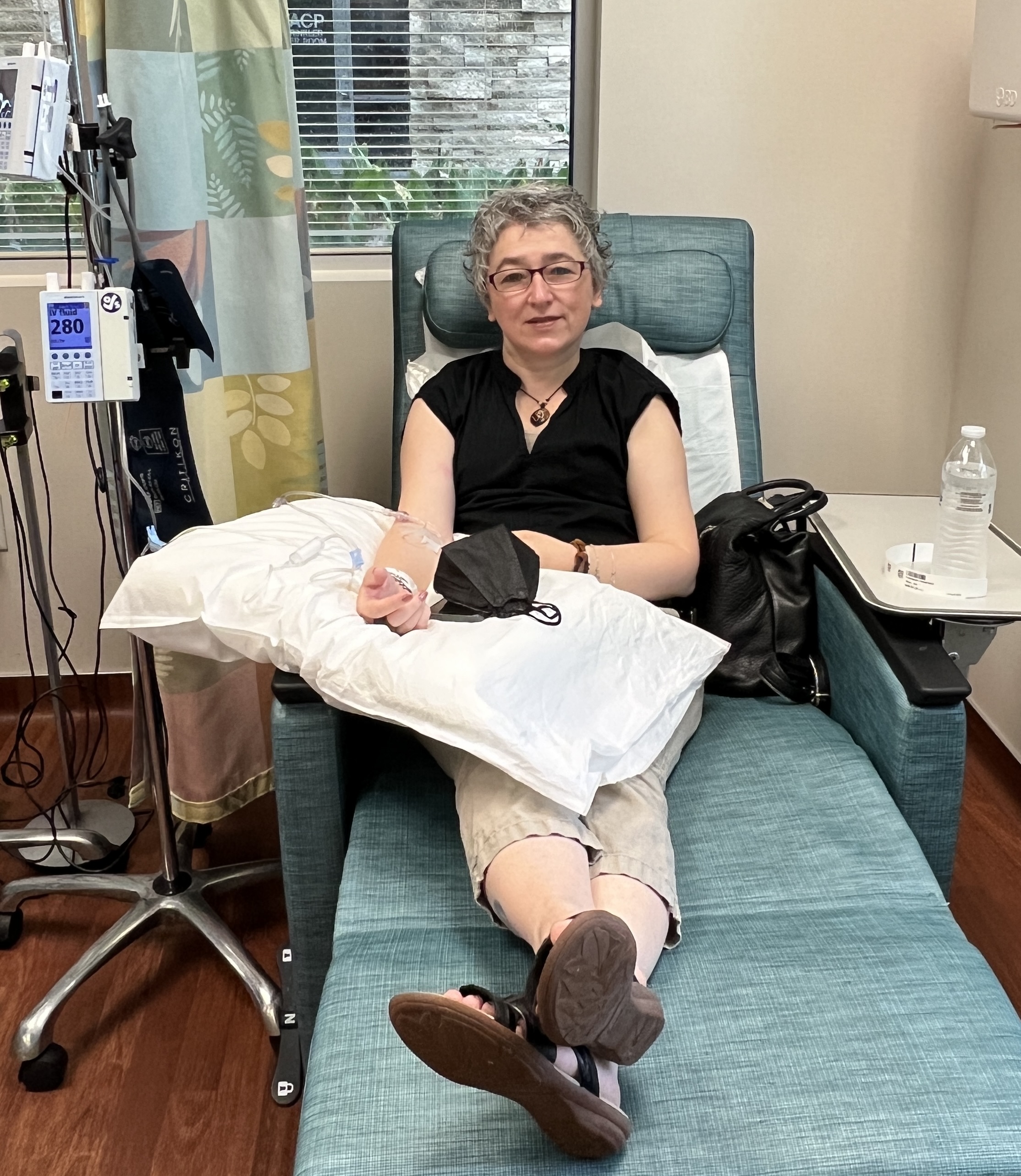
The appointment was early this morning (scheduled for 8AM). It was the first time in my life that  I stepped into an infusion center. Most people there were getting cancer treatments, but there were other folks with iron infusions and some other restorative medicines. The place had about 8 chairs that I could tell and they were all full. It felt packed and tight. No one was wearing a mask, including the staff, but my husband and I were. 


They weigh you just as soon as you get in because the infusion dosage is based on your weight. Then, because I am considered a woman of child-bearing age and with all my reproductive organs intact, I had to take a pregnancy test which is a urine test. They cannot give you the infusion if you are pregnant. They also drew blood for cholesterol levels which my doctor scheduled in advance. 


After all that and after the IV needle was in, they attached the IV bag. I took a picture of my first bag like it was gold! I hope it works! 


The IV lasted exactly one hour. After that, I waited for another 30 minutes to see if I had any reactions to it - mostly because this was my first time and we didn’t know. We scheduled three more appointments after this, as they like to schedule in advance to keep you on the one-month schedule that this drug is given by. 


During the IV, I felt dizzy a couple of times, but it was hard to tell what from. I do get dizzy occasionally, pretty much daily, and this felt no different than my usual dizzy spells. I also had this taste and smell of chlorine in my mouth and nose which was bizarre but it didn’t last too long. I got light-headed a few times, also and this was new, but not unmanageable. 


I came home right after it and I am taking the day off to just take it easy. So far, I have not felt anything unusual except for some light-headedness, or rather heavy-headedness as I feel like my head is too heavy and swimmy ... I also feel random tingling in my lips and palms, but it kind of comes and goes. No hives (they asked me to look for this), no swelling of the mouth or tongue. I also have a strange mild headache at the back of my head. This is unusual (my headaches are usually in my forehead and temples), and I think it’s what gives me the heavy-headedness, if you will. But, again, it’s totally manageable. The side-effects of a Covid shot are 1000 times worse than this! 


My husband came with me today because we didn't know what to expect from this drug. But I am sure that going forward, I will just go in by myself, barring any new developments in my overall health.


The infusion nurse said they will repeat the blood tests (for cholesterol levels) at every appointment. I asked if the liver function will also be monitored and she said she doesn’t believe so, but to call the doctor and ask that they add it. I know that it takes a full course of 6 infusions (6 months) before we see the full effect of Evkeeza, but the first rung on that ladder is now behind me after today. 


During the whole day, I have been hearing my late dad’s voice in my head. When I was 8 and they discovered that I had “a very severe form of familial hypercholesterolemia” (my total cholesterol was 734 mg/dl), I remember him saying: “one day, far, far away into the future, when you’ll probably be old or even after you’re gone, they might discover some kind of a miracle drug that might cure what you have. But it won’t be for a while. And it might be too late for you.”

When I was 8, they also told me I will not make it past my 25th birthday if I was lucky. I have been looking for this drug for only 3 years. I have been looking for an efficient treatment that will stop the progression of this disease for 41. 


Today is a huge milestone for me, in my journey, to add to the string of all the other milestones throughout my life: the first day that they discovered that I had familial hypercholesterolemia (when I was 8), the first day I took my first statin, or the day I learned without a shred of doubt that I have homozygous FH (I was 41), or the day of my open-heart surgery (I was 40). This is yet another milestone. What I hope for with all my heart is that this drug works. That it works so well that we’re done searching for more therapies. I hope that dad’s dream will be fulfilled and that, in fact, it’s not too late for me ...