Showing posts with label stenosis. Show all posts

Saturday, June 14, 2025

Yearly Carotid Ultrasound and New Numbers

Part of the FH and heart-disease journey is to familiarize yourself with a life peppered by doctors’ appointments. And yes, that is not a typo: there will be many doctors, many specialists, and many tests during a “normal” year of your life. 

Most of the time, I see these appointments as routine. I still chuckle when a coworker takes a whole day off for a stress test and is incredibly fearful when their doctor orders an EKG or a heart echo. There is no comparison in medical journeys, and I am going to be the first one to admit that.


But I only speak for me, now; and to me, these are “the easy” tests. In fact, I have met more doctors that agree that stress tests are a waste of time and money and they are seldom accurate or reliable. So, if they allow me the privilege to choose my test (which most of my doctors do, for whatever reason), I usually skip the stress test, and go for something more invasive even but hopefully more accurate. If, that is, my insurance also affords me this luxury. 


You will find sometimes that the insurance demands a lesser (even non-conclusive) test to be performed if it’s cheaper rather than approve a more costly but a more accurate test. No, the business of medical care, especially in this country, but we are not alone, is not a fair game. 


So, this month, it was time for my yearly carotid ultrasound. Ultrasounds are not invasive, by the way, and still believed to be the first in line for basic imaging.


The results of this test used to be a little worse every year back when my LDL cholesterol was hanging out around 250+ mg/dl. But since I started taking Praluent (in 2016) which brought my LDL down to 150 mg/dl (twice the target, but still much lower), the carotid ultrasound results have been pretty stable, or stationary, showing a buildup of plaque hovering around 50%. They have been so stable in fact, that some doctors argue that I don’t have to do this test every year anymore, that my plaque seems stable and with this amount, there are no interventions recommended. So, they say, we should move the test to every 2 or 3 years. 


So far, I have not been convinced that we should do that. I have seen cardiovascular disease go downhill in less than a year with FH, so I don’t trust my body that it will ever - regardless of how well the drugs perform - stabilize in such a way where I won’t have to watch what the disease is doing to me ... So, I insist we do the tests. 


Also, the impetus of my insistence on this particular test has been my symptoms. No amount of medical science and no amount of doctor “smarts” can convince me of something my own body flags as “not right”. 


For years, I have had numbness and tingling in both my arms, all the way down to my fingernails. It is worse with exercise and it is worse in my left arm. With exercise, my shoulder, and left arm, as well as the left side of my neck become numb, almost like a huge claw squeezes every bit of blood drop out of them! 


I bring these symptoms up with every cardiology (and vascular specialist) appointment and they take notes, but offer little in return. Others venture a guess of “well, that could be neurological”. And I did have neurological studies done to both my arms (I would not recommend them to my worst enemy) and although there were some findings (ulnar nerve neuropathy in my left arm and carpal tunnel in my right), the symptoms from these afflictions are different than what I feel when I exercise. The level and the place of the numbness is different, and the feeling of the “huge claw” only comes on with effort. 


Over the years, although my carotids have been more or less stable, some of my other arteries have started to see signs of more advanced atherosclerosis. Usually, they give me a percentage of the stenosis or plaque. This year, they spelled it in no ambiguous terms: “subclavian stenosis”. Not once, but several times in the test findings they emailed me. Some branches of the carotid artery (like the right external carotid) also appear stenotic, but the subclavian is pretty much stenotic, with no doubt. No other approximations or guesses of what the percentage might be. 


In full disclosure, these are the findings from the carotid ultrasound:

  1. Left subclavian artery flow appears stenotic.
  2. Right CCA demonstrates significant plaque.
  3. Right ECA appears stenotic.
  4. Right ICA stenosis less than 50%.
  5. Right subclavian artery appears stenotic.
  6. The Left ICA stenosis less than 50%.
  7. Flow in the right subclavian artery appears stenotic.
  8. Flow in the left subclavian artery appears stenotic.

**PSV is 125-180 cm/s & ICA/CCA ratio >2.0 is also consistent with 50-69% stenosis.

**Comments right side: PST noted throughout the CCA.


My doctor is yet to reply to all this. I will wait for another week or so and then reach out for more details from him, although I am not too hopeful he’ll recommend any course of action. I have been told time and again that without close to a 100% stenosis or an aneurism, there is not much they would want to do, regardless of the symptoms (which they are more than happy to just medicate, much to my dismay!), because there are too many risks involved in performing a bypass on the arteries or even more in adding stents. 


But this is why I insist on repeating the test every year: what if, from one year to the next, we go from "stable" to an aneurysm, or even a tear? What if, like this year, we go from “50% to stenotic”. 


In lieu of a doctor’s feedback, I, of course, turn to the internet. And this is what the Cleveland Clinic says about the symptoms for subclavian stenosis:

  • Muscle cramps when you use the affected arm.
  • Arm pain or tiredness when you use the affected arm.
  • Tingling or numbness (paresthesia) in the affected arm.
  • Dizziness
  • Fainting
  • Vertigo 

I have experienced all of them for years, except for the last 2. My dizziness occurs daily now. And most if not all of these are not related to ulnar or carpal tunnel neuropathy.


As I understand (and as I have lived) it, stenoses (many of them everywhere where there is an artery) are a byproduct of FH. Just the normal collateral damage that years of high cholesterol has done to your blood vessels. 


The little bit of a good news this month has been the continuing dropping LDL numbers (thanks to the new Evkeeza infusion which seems to be going well). 
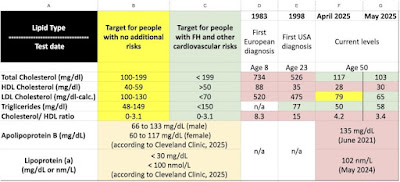


I have to literally pinch myself every time I get the new values after my infusion treatment that shows my LDL in the two-digit range. As you can see, I come from a (“natural”) LDL of 520! I still cannot believe the LDL of 65 mg/dl is mine! I wonder every month if they got my blood mixed up with someone else’s. 


I cannot thank medical research enough for the advancements they have made during my lifetime. This disease that was nothing but a death sentence to me, when diagnosed at 8, has become something I can manage now. This is why it is so paramount that we encourage medical research going forward. It gives not only hope, but literal life to people!


The hope is that I am not adding more damage to my arteries by adding more cholesterol to what has already accumulated there for the past 45+ years. But there is plenty of damage done already and with an aging body and inevitable hormonal changes, I must still continue to stay vigilant and repeat these yearly routine tests, just to understand what is still going on and to have a chance to plan, if faced with an ultimatum. And as I have known several times in my life - ultimatums do happen ...


In this scope, regardless of doctors’ orders, I will continue to fight to know more and not less; to stay on top of every change and progression, such as it will be. 


Thursday, November 18, 2021

A Mixed Bag: Some Good Things, Some Bad, and a Whole Bunch of Guessing, as Usual

Today was an odd appointment with my cardiologist, to say the least. It was my 3-month appointment (this is routine for me), where we were supposed to discuss the recent tests that he had ordered (a heart echo, a carotid ultrasound, recent blood work, and the results of my neurological tests) and, as always, assess if there are any changes needed in medication.

Right off the bat, he admitted that he didn’t review my tests before he walked in the room. He said he did see them when they were done (in September), but he had not reviewed them this morning before he walked in the room (intern in tow) to see me. So, he needed a minute. (My appointment was at 8:40 AM and he was already an hour late, so I guess: busy morning!)

My cholesterol went up slightly, as you can see below, but he said he will consider it a “lab error”. Well, which one was the error: the last one that showed it the lowest I have ever had it? Or this time, which is more in line with everything else we’ve done for the past year? No answer.


My AST (a liver enzyme) is elevated but only slightly (43 U/L and it’s normal between 15-41 U/L). But I have had it as low as 26, so … there is some reason for concern there. He said to repeat it in 3 months before our next appointment. We repeat the same tests before every appointment: a lipid panel, a liver and renal panel, a uric acid (because of the Nexletol/ bempedoic acid which elevates the uric acid and because in my 20’s I used to have gout attacks frequently).
 The AST is part of the liver panel. He asked me if I want to do an extra measurement at 6 weeks but he said “he didn’t care; it was up to me”. OK, then … let’s just do them all at the same time which is in 3 months. (I love when he says “he doesn’t care” or “to him it’s six of this or half a dozen of the other”. Sounds so reassuring!)

My heart echo write-up mentioned for the first time “diastolic disfunction”. I asked him about this and he explained that what this means is when the heart fills up with blood, it increases in volume but it should not increase in pressure. In my case, there is some pressure that is measurable, but that it is “mild”. He said this is “normal” and “almost expected” in my case, having had a heart attack, open-heart surgery, and coronary vascular disease for many years. He said he is not extra concerned about it, as long as my aortic valve is clear (which it is) and my ejection fraction is good, which at 55% it is.

The narrowing of all my carotid arteries is increased compared to the measurements of two years ago, but the percentage is all the same – between 50-69%. This seems like a huge range to me, but that’s where they place my numbers.

For those more curious, here are my measurements for both the right (first) and the left (second) carotid arteries:

MEASUREMENTS – Right/ Left
------------------ -------------- --------------

Central Carotid Artery
CCA Proximal 249/ 19 cm/sec - 216/ 23 cm/sec
CCA Mid 168/ 21 cm/sec - 230/ 23 cm/sec
CCA Distal 141/ 19 cm/sec - 199/ 24 cm/sec

Internal Carotid Artery
ICA Proximal 136/ 24 cm/sec - 191/ 22 cm/sec
ICA Mid 189/ 36 cm/sec - 134/ 21 cm/sec
ICA Distal 160/ 30 cm/sec - 157/ 22 cm/sec

CCA/ICA Ratios 1.340 - 0.960

External Carotid Artery
ECA 550 - 260
Vertebral 93/ 16 cm/sec - 115/ 15 cm/sec
Subclavian 305 - 327

He said that the worst narrowing is in my External Carotid which is of least concern, because it’s the one that vascularizes the face which gets blood supplies from a “million other places” (his words), so there is no concern for no blood supply there.

I have an appointment with a vascular surgeon and he asked me to follow up with him for a second opinion on the carotid findings.

If it were not for me to mention the neurological test that he ordered to diagnose peripheral neuropathy, he would not have discussed it. I told him that the test showed that I did not have peripheral neuropathy. He was glad about that. He had suspected there was something neurologically wrong because my dizzy spells. Well, not sure what worked, but my dizzy spells are very mild now and very infrequent, and my muscle spasms and cramps are also much better, too. The dizziness definitely does not last for a whole day anymore. I started taking CoQ10 (my decision) which I guess must have made my muscle cramps less frequent, but I don’t think that it had anything to do with fixing the dizzy spells. In addition, my primary doctor diagnosed me with possibly anemia (low red cell count) and a B12 deficiency, so I started taking B12 vitamin supplements at about the same time as the CoQ10 – about 2-3 months ago. He agreed that this deficiency and the anemia could have caused the dizziness for sure. So, we’ll just continue with this treatment and the regular doctor is planning to check the B12 levels again at our 6 month follow-up.

We also talked about the heart symptoms: how’s the blood pressure, how’s the chest pain, how is the shortness of breath? How do I get along with the newest drug he put me on to treat all these (Amlodipine). I told him that the chest pain and shortness of breath are stationary, but I have more stamina when I walk (I can go further and on steeper inclines through the shortness of breath and the angina because I feel like my heart is getting enough blood supply). My neck still cramps, but after a longer walk. The blood pressure is medium-high (in the yellow-orange range on the machine) a lot more often than mostly high (red range), like it was before the Amlodipine. My gums are still very sensitive because of the Amlodipine but I am working with the dentist to use softer brushes, better paste to not irritate them too much.

After the physical consult, he said he thinks “I have more fluid than what he would like for me to have” and to back off the salt. This is the first time in my “heart-patient career” that anyone has said anything about salt, because typically my fluid is under control. He said my legs look fine but that my chest shows signs of too much fluid. He gave no reason as to why all of a sudden my fluid retention is higher, and no recommendation on what to stop or start doing (other than salt intake) to help with this.

As for the FH treatment, he said he would like to try the “twice a year siRNA PCSK9 inhibitor which might come out in the US sometimes next year” – his guess -  (he was referring to Inclisiran - https://www.novartis.com/news/media-releases/novartis-receives-eu-approval-leqvio-inclisiran-first-class-sirna-lower-cholesterol-two-doses-year) to replace the twice-weekly Praluent injections that I take now. I have asked him again (http://livingwithfh.blogspot.com/2021/07/who-knows-more-about-fh-you-or-your.html) about adding Evkeeza to the current treatment and he said “that would be another option as well”, but he made no recommendations about it. About this, I am puzzled: my LDL is nowhere near the “target” number of 70 mg/dl or lower, but he did not recommend adding anything else to my current drug regimen.

So, a mix of findings and if I were to summarize, I would say:

-          Heart function is stationary (no idea what the coronary arteries are doing because we would need a cath angiogram for that)

-          Arteries are showing advancing disease

-          Cholesterol (LDL) is still elevated, not at ideal levels for my disease and my history

-          Liver function a bit modified

-          Quality of life/ symptoms (dizziness, muscle cramps, chest pain and shortness of breath) somewhat improved.

I walk gently towards The Holidays with kind of a mixed bag and lots of unanswered questions. But … it’s better than six years ago when I was walking in with “you must have open-heart surgery in one to three months at the longest.” So, I’ll take it.

Friday, September 24, 2021

The Faces of My FH

 FH has many faces and many stories. I have homozygous FH (HoFH) which means that I inherited it from both my parents. As a matter of fact, both genes that came from them are the same exact gene, although my parents are not related, in any way, by blood.

My grandparents all came from huge families (think 10+ children). My parents have so many cousins they have not met all of them. This also means I have a lot of people on both sides of my family who have FH. And every one of them has a different story. A different story of their diagnosis, of their treatment, or lack thereof, of what the disease ultimately leads to. There are no two stories alike, and there are no two people that chose the same path in managing this disease (or not).

I see a lot of people with FH who are asking good questions about what to do when they are diagnosed; people who display all sorts of emotions, from sheer panic and depression to a nonchalance that I envy, in some ways, although I know that is not the proper course for a healthy and good-quality life when you have FH.

FH has been in my family’s life for generations – no one is shocked when they are diagnosed anymore. We’re all pretty much aware of what it is and what it can do to us: many of our aunts and uncles have suffered heart attacks, strokes, angioplasties, complications from diabetes and fat liver disease. Although we know all these things all too well, not all of us choose to receive treatment. More in the notes I drew below about my immediate family and their individual, unique stories.

My grandfather

Current age: deceased at age 65

Diagnosis age: as a young adult, after several of his older relatives and brothers and sisters were formally diagnosed with FH. At that time, they just spoke of “familial hypercholesterolemia” and did not dissociate between the HeFH and HoFH types. We believe he had heterozygous FH (HeFH).

Cholesterol levels: no one remembers for sure, but my parents think the total cholesterol stayed between 300-400 mg/dl.

Treatment: reduced fat diet; no drug treatment was available for cholesterol in Romania before 1990 when he died.

Complications: first stroke at 48, major stroke at 50 which left him paralyzed in one half of his body. He died at 65 after a massive stroke after having lived bed-ridden since he was 50 with the effects of the stroke and complications from diabetes. He also had coronary artery disease and high blood pressure.

My aunt

Current age: 71

Diagnosis age: as a young adult. At that time, they just spoke of “familial hypercholesterolemia” and did not dissociate between the HeFH and HoFH types. We believe she has HeFH.

Cholesterol levels: currently, the total cholesterol is between 200-300 mg/dl.

Treatment: no special diet, no treatment, by choice.

Complications: angioplasty (stent placement) in her thigh and upper-leg arteries in her 50’s; massive small-brain stroke at 67; high blood pressure, a-fibrillation, tachycardia.

My father

Current age: 69

Diagnosis age: in childhood, due to the fact that his father already knew about his diagnosis, my father was a sickly kid, and his mother (my grandmother) was a registered nurse who tested him for everything. At that time, they just spoke of “familial hypercholesterolemia” and did not dissociate between the HeFH and HoFH types. We believe he has HeFH.

Cholesterol levels: currently, his total cholesterol is 326 mg/dl.

Treatment: no special diet, no treatment, by choice.

Complications: several mini-strokes starting in his 40’s. High blood pressure in his 40’s. Diagnosed with coronary artery disease, peripheral atherosclerosis, peripheral neuropathy in his 50’s. His condition is further complicated by diabetes.

My mother

Current age: 68

Diagnosis age: 63. My mom’s cholesterol levels were in the upper 200’s all the way into her 50’s. She maintained that her cholesterol is not genetic, like my dad’s and it’s caused simply by bad eating habits. When she was 63, I had a genetic test that confirmed that I had Homozygous FH (HoFH). This was the clear indication that she, too, must also have FH. She suspects she inherited it from her father who died when she was 7. She had no further relationships with his surviving family, so the knowledge on her side of the family is very limited.

Cholesterol levels: currently, her total cholesterol is 313 mg/dl.

Treatment: no special diet, no treatment, by choice.

Complications: aortic valve stenosis, coronary artery disease, stroke at the age of 67. The cause for the stroke was unclear as she was also undergoing chemo treatment for lung cancer at the time. The doctor could not determine the cause of the stroke for sure – whether it was vascular or a complication of the chemo. She suspected it could be either one.  

Myself

Current age: 46

Diagnosis age: 8. My pediatrician felt an enlarged liver when I complained of pain in my upper abdomen. She sent me to get a complete liver and lipid profile, also knowing my family’s history of FH at the time. My mother found out the cholesterol level, as a hospital biochemist. At that time, they just spoke of “familial hypercholesterolemia” and did not dissociate between the HeFH and HoFH types.

At age 40, following a genetic test, I was diagnosed with HoFH.

Cholesterol levels: currently, my LDL is 107 mg/dl (the lowest it’s ever been). Before I started drug therapy at the age of 23, my LDL was 475 mg/dl. My total cholesterol was 526 mg/dl.

Treatment: no fat, vegan + fish diet, Lipitor, Zetia, Praluent, Nexletol.

Complications: diagnosed with tachycardia and arrythmia in my early 20’s; coronary and carotid artery disease at age 30; aortic valve stenosis at age 36. Open-heart surgery at age 40 to replace the aortic valve, ascending aorta, repair the aortic arch and repair and bypass four main coronary arteries.  

My sister

Current age: 43

Diagnosis age: 38. Although she knew her cholesterol was elevated, my sister did not get officially diagnosed and treated until this age. This was after my open-heart surgery which rang a bell of alarm for everyone in the family, I think.

Cholesterol levels: currently, her LDL is 108 mg/dl (total cholesterol is 201 mg/dl).

Treatment: low fat, white meat and fish diet, intense jogging (she is the runner in our family as she has been spared heart disease so far), Lipitor.  

Complications: no complications so far.   

My nephew

Current age: 10

Diagnosis age: 7.  

Cholesterol levels: last test showed an LDL of 170 mg/dl.

Treatment: all-inclusive diet, with less fried foods and lower fat, white meat.   

Complications: no complications so far.   

Whatever your story may be, what I believe firmly is this: it all starts with awareness: knowledge is power. You may choose not to do anything at all, but at least you know about the train that’ll be coming rather than one day be caught completely by surprise, way too late, when there might not be anything left to do or know anymore.


To honor the FH Awareness Day, these are the faces and stories of my FH family. What are yours? Do you know?!

Happy health, you all!


Sunday, June 20, 2021

A Visit to the Lipidologist

It’s pretty unusual that I have had a rare lipid disorder all my life and although I have had more doctors and specialists than I can count, none of them was technically a lipidologist. I have seen cardiologists, endocrinologists, cardiac surgeons, vascular specialists and vascular surgeons who could manage lipids, but never a lipidologist.

Because I am constantly trying to learn more about my specific type of HoFH and because I have some concerns that some people on my current heart team have some gaps in understanding the risk factors for cardiovascular disease when it comes to FH, I wanted to get an expert’s opinion about my case and to confirm that the plan of action we have is appropriate.

The new doctor was a great combination of informed-aware-familiar-with-FH, as well as empathetic and down-to-earth. I felt like he listened, he followed my history closely, and he gave me his opinion about things I have tried in the past, things I am doing now, and painted a tentative picture of what he thinks my future might hold, if one can get so close as to predict that.

To make a very long (the appointment took two whole hours! Longer with new blood tests.) story short, these are some of the learnings from this visit:

  • He agrees that given my cardiovascular history and the fact that I still have progressing disease (in the form of increasing stenosis) at least in one area of my arterial system (abdominal aorta), I need to do more to lower my LDL number as well as my apolipoprotein B number (which goes hand-in-hand with the LDL number). Lowering the numbers to the lowest possible for me (we’re shooting for under 70 mg/dl for the LDL) should hopefully stop the progression of atherosclerosis. He very clearly said he is in the business of “preventing and diffusing the bomb” and not in the business of “cleaning up the mess” after the bomb (usually a heart attack or a stroke) has gone off - which sometimes is the business cardiologists and vascular specialists are in. He advised to rather not wait for new symptoms be them in my heart or carotids, or abdominal aorta, but to be proactive about bringing my LDL (currently 125 mg/dl) down more. My vascular specialist believes that we need to wait for an abdominal aneurysm or inability to eat before we can address the stenosis in the abdominal aorta.
  • He thinks I am on the right combination of drugs at this point in time. He thinks I am on everything that is on the market and successful for HoFH and as a bonus, I seem to respond well to this cocktail (Lipitor, Zetia, Praluent, Nexletol). He would add Juxtapid, which I have denied accepting due to severe side effects (https://en.wikipedia.org/wiki/Lomitapide) and possibly a new drug that’s coming out of Regeneron, approved earlier this year (https://www.evkeezahcp.com/). We'll wait to see about this last one for a bit, because no one seems to know what the process for administering it and approving it seems to be right now.
  • He explained that I am somewhat of an anomaly:
    • According to the genetic test I had done, I have a pair of the same exact bad gene to account for my HoFH (https://livingwithfh.blogspot.com/2017/08/the-long-journey-to-hofh.html) . He said more common, you see two bad genes that are different and both “bad”, but mine are two identical bad ones which makes me a “true homozygous as opposed to a complex heterozygous case.” Apparently my case is much rarer than the “one in 250,000 people” which is what the frequency of HoFH is estimated at.
    • Because of this profile, I should not (research shows) respond as well to statins or any other medications as I do. It is strange/ unusual that I respond as well as I do, but obviously, this is my lucky card in the bad hand I drew at birth.
  • He is puzzled as to why I don’t show a corneal arcus which is common for people with HoFH and with higher level of cholesterol (https://en.wikipedia.org/wiki/Arcus_senilis). I have never had one. He did find Achile’s tendon xanthomas and a xanthoma on my left eyelid which are on par with the manifestations of the disease.
  • He explained the importance of the Lipoprotein (a) and apolipoprotein B in the cholesterol profile and his opinion is that these particles are as important as the level of LDL in understanding the cholesterol profile as well as the level of risk for cardiovascular disease. He repeated the tests to measure both – just to get a baseline. He advised that we should always measure the Lipoprotein (a) in nmol/ l instead of mg/dl, as the first unit of measure is more today’s standard. He did say some labs (the one my cardiologist has been using included) are slow to follow the new standard (nm/l) and the conversion (from mg/dl) doesn’t always work.
  • He congratulated me for a lifetime of not smoking, saying that is one of the most common things people with heart disease do not understand: how dangerous smoking can be for CV disease. I told him that people in my own family with the disease don’t get it either.
  • He is also concerned about the inflammation that I have in my body, which no one seems to correctly diagnose. We know there is inflammation but we don’t know what kind. The tests are inconclusive, but the symptoms (rashes, hives, joint pain) are indicative of it. He said whatever I do to keep inflammation down is a sure benefit for CVD. For this, I mainly watch what I eat, am on a vegan diet with just occasional cold-water wild fish.
  • He ultimately did not change anything in my current regimen, but he underlined the importance of staying on top all the “vascular beds” (he called them) that show advanced disease (the heart, the carotids, the abdominal aorta, and the peripheral arteries in the legs). My cardiologist is monitoring the heart, legs, and carotids, and I am yet to find someone who can monitor my abdominal aorta which is stenotic.

The results of the tests he did when we visited came back a couple of days ago and the levels for the “other” lipids are both elevated:

  • Lipoprotein (a) = 88 nm/l (it is normal up to 73nm/l)
  • Apolipoprotein B = 134 mg/dl (it is normal up to 110 mg/dl, or up to 80 for people with additional risks for cardiovascular disease).

He admitted  that he expected at the very least that the apolipoprotein B to be elevated because that usually goes hand-in-hand with the levels of LDL and we already know that is elevated. It made me wonder if this is the reason why a regular doctor (like my PCP or cardiologist) never checks this fraction of cholesterol. The fact that my Lipoprotein(a) is also elevated adds yet another risk factor (in addition to elevated LDL) to my CVD. The drugs I am on should affect the numbers of the LDL and apolipoprotein (B), but there is no known therapy for lowering the Lipoprotein(a) yet. A regular doctor would never order these cholesterol fractions as a routine. I have had them checked before when someone suspected FH, but not as a routine blood check that you do when you have your physical once a year. From everything I have read and from what the lipidologist said, it is important to know the level of Lipoprotein (a) as this is a standalone risk factor for cardiovascular disease, just as important as elevated LDL which is something checked routinely.

As a conclusion – I did get some new learnings from this visit, even if it was just a new perspective and a new way to look at the numbers. I always strive to learn as much as I can from as many specialists as I have access to, to ensure I have the best possible plan of action in place. I have said it before and it is a platitude nowadays, but … knowledge is power. Not just the knowledge one can find on Google, but that of a person who dedicated their research and professional life to bettering the lives of people with a disease such as ours.

In the end, I made the decision to stay with the current cardiologist as it seemed that the course of action the lipidologist would follow would be identical to the one I am following now. Transferring the drug management which includes at least a couple of preapproval processes (for now, maybe more than two in the future) for drugs that I am on is a bit of a pain in the American medical system. My cardiologist has the preapproval process down to a science, and this offers some peace of mind, for sure. Of course, validating that he’s on the right track with the current regimen he’s had me on by comparing his course of action to that a lipidologist would follow, is also reassuring. With my heart history, I could never give up the cardiologist, either – so, this way, I feel like I get good care in both lipid and heart management.

I am still looking for a specialist who can monitor my progressing disease in my abdominal aorta. Even with lowered numbers (granted, not ideal), the stenosis seems to be advancing (https://livingwithfh.blogspot.com/2021/04/educating-doctors-visit-to-my-vascular.html) from one year to another. So, onward we go.


Thursday, February 11, 2021

On the Fifth Anniversary of My Heart Surgery

Hard to believe that five years ago today I was getting a new heart. They call it an open-heart surgery (OHS), but for all intents and purposes, it was really a rebuilding of my heart: a Bentall graft implanted in the place of my aortic valve, root, and ascending aorta; an aortic arch endarterectomy (repair), several endarterectomies of several main arteries in my heart, and four by-passes. My surgery is documented here: https://livingwithfh.blogspot.com/search?q=day+1+to+8 .

Just like every year on this date, I will read the surgery report and just wow myself into stupor. How much can a body take? Hours on the heart-lung machine, circulatory arrest flirting with the limit allowed, heart attack following the surgery, neuropathy for years after that, closed up by-passes years later, pump head that’s lasted now into my fifth year … But also, how brave and certain and a little crazy can heart surgeons be to have the courage and the firm hands to do it all?! The depth of human knowledge and curiosity and bravery to push boundaries never cease to amaze me.

The surgery was still the hardest part of this journey, I won’t lie to you. Just the thought of what the body went through, the risks, the pain, the sheer demolition of every nerve I was ever made of. Everyone told me right after surgery that my body got hit by a semi and I need to take it easy, and that was not a joke. Like I said before; I  felt like my body went to war. And it lost.

But also, the faith, the amazing knowledge of the Utah Valley Regional Cardiac Surgery team were humbling and awe-inspiring, to say the least.

The recovery, little by little, revealed new surprises every year. Every day. I had to learn how to function with neuropathy in my left hand and leg first, as well as how to breathe with neuropathy in my diaphragm, when my lungs were not getting a full load of air. In time, they all cleared up except for my pinkie and ring fingers – they are still full of needles.

I had to learn how to exercise again, a little bit at a time, after two bouts with Cardiac Rehab, a year and a little bit apart. Like a vet that comes injured from war and has to learn how to walk again, one small achievement at a time, I had to learn things and learn my new body. I was amazed how much it felt like I did get a new body, when in fact only the engine was replaced.

I had to learn new ways of monitoring my health, like managing my INR – and how not to freak out every single time the numbers are too high or two low … This, too, this scare and worry (because it’s still here and it’s constant), must be your friend, because it’ll never leave you … You just need to tell it some days: ah, well, we’ll try better tomorrow! Just chill!

Same goes for not freaking out when you accidentally cut off a piece of your cuticle while chopping veggies and then you can’t stop the bleeding. You learn about the amazing power of coagulating bandages that grow a scab for you when your body can’t.

You have to get used to new blood pressures and pulses. New, more difficult ways to get an accurate echo of your heart or even a good cath – because that Bentall graft is in the way. Catheters have a hard time getting through it to look at the really small vessels and it casts a shadow on your valve and heart and they’re never too sure what they see anymore … Much trust.

All such memories now, but also all part of the new me and new normal. You have no choice but embracing the new-ness. It is the new you. It is the better you. I feel different today and in some ways I feel like I exchanged old problems for new ones. But, believe it or not, the new ones seem more manageable than the old ones. My aortic valve is not two thirds shut anymore. My LAD is not 99% occluded anymore. My stamina for lengthy exercise, albeit slow to moderate, is much better.

Some things are different but still there, like the chest pain and the neck pain from the stenoses in my carotids. A lifetime of echos, ultrasounds, and MRIs is still the norm.

Although I took things easily right after surgery, little by little life became more normal: I started travelling, first by car, then by plane. Within a couple of years I found the courage to fly to Europe. I have been there twice since the surgery. I have been on two cruises (before Covid, obviously) and several times to Canada. I also traveled across the country by myself several times for work. It was, again, like learning baby steps. But it is possible. I can tell you I am in touch with every sensation in my body. If something is “off” I feel it right away. This has not stressed me as it’s made me more curious to learn more.

I have also learned so much from other patients. I have made friends during this journey that I would not have made otherwise,  people like me that share freely, honestly, vulnerably their own journeys. Their stories make me so much stronger and make me believe that there is so much strength in us. All I have to do is learn courage from them and find it in me. We all have it. Of that I am sure.

I have also become so much more grateful for every good day. Every day when my tiredness is not too much, I am grateful. I have become more grateful for my family. Every day that my husband does something for me to help me through – I bless him and people like him, those who truly have helped me through this, without whom I would not be here today. Of that I am also sure.

For those out there contemplating whether they should have OHS, I hope you find the strength to do it, and the faith that it can improve your life. I also hope you find the strength in your family and a great team of doctors to walk hand-in-hand with you through this journey. All I know is: you are never alone. You are the main hero of your destiny, of course, but there is a web of little helpers out there that will carry you through. To all of those little elves, starting with my surgeon and ending with my husband, my tireless caregiver – I owe them my life. And I humbly thank them.

Happy journey to all and Happy Heart Month!

On the left: February 11-12, 2016: the day of the surgery, before they wheeled me in; the day after surgery.
On the right: February 11, 2021

Monday, December 23, 2019

The Stroke Family


How FH Has Affected Four Generations of Our Family

When some people are first diagnosed with FH, they have a hard time believing that they must be on medication to ensure protection of their arteries. There are folks coming to FH groups in disbelief, asking “if I don’t take my statins, or some other therapy, will I really get a heart attack? Will I really get a stroke? Will I be young when these things might happen to me?” Wouldn’t it be nice to know these things regardless of our diagnoses? Life, unfortunately, doesn’t work this way.

I, for one, can only tell you what has happened to the people in my own family who lived with untreated FH. You can view this information however you choose. I am not making a case for medications one way or another, here. I am just sharing what we have been witnesses to as a family. From what I have learned in the past few years, the story of my family repeats, more or less, in every family touched by FH. So, I am adding my voice to the chorus of folks that speak from experience here, in hope that this will be helpful to putting things into perspective for some.

I’ll start by saying that I have seen FH in my family with my own eyes for four generations now. It started with my father’s father and it stops, for now, with my nephew who is almost 9. I have been the first one to be medicated for it, but I started treatment when I was 23. Because I have Homozygous FH, however, even with all the medication available, my numbers are still out of the normal range and you might as well consider me an unmedicated Heterozygous patient now. So, what happened to the generations before me?

I was 3 years old when my grandpa, my dad’s father, had his massive stroke. He was 53. Before then, he had a smaller one, about 4 years prior, before I was born. When he had his first stroke, they learned that it happened because of his cholesterol which was at that time in the lower to mid 300’s. His first stroke was not debilitating, but the second one was. At 53, he was left bedridden from this second stroke. Half of his body (I can’t remember whether it was the left or right) was paralyzed. He walked around the house with a cane, and he never left the home after that, till he died from his last stroke at 65. During the time he was sick, he had many mini-strokes. My grandma being a nurse provided around-the-clock care to him and brought him ‘back’, she used to say, ‘many times.’ By bringing him ‘back; she meant she was doing everything she could to exercise various parts of his body that were becoming weaker and weaker with every stroke.

During all these years that he was sick, his brothers and sisters kept getting older and sick, as well. Out of the 10 living siblings he had, he had 5 affected by FH. He was the sixth one. Out of the 9 people who have passed so far, four of them died from complications from FH (strokes and heart attacks) and two of them died from a combination of complications from FH and diabetes. All of them died in their 50’s and 60’s. For the most part, all their cholesterol levels were in the lower to mid – 300’s, so as far as we can suspect, they all had Heterozygous FH. Most of them, like my grandpa, were not overweight. Grandpa was this stringy man, about 6 feet tall and maybe 150 – 160 lbs. He had been a construction engineer and he spent all his life on construction sites. His specialty was mountain access roads, viaducts and tunnels. He loved the mountains and being outdoors. I learned from my dad that my dad’s grandfather, grandpa’s dad, also died in his early 60’s from a stroke.

My dad’s cholesterol has always been, as far as he can remember, in the upper 300’s and lower 400’s. Grandma, his mother, did not have high cholesterol at all.

My dad’s first signs that something was wrong was in his 20’s. He had heart palpitations, high blood pressure and very elevated liver enzymes. He was diagnosed with a fatty liver at that time and high blood pressure. He refused any kind of medication until he was in his 50’s. And even then, he only started taking medicine for his heart, never for cholesterol. Being of old school upbringing and in a country where little is talked about cholesterol and its management, he does not believe in any of the cholesterol lowering drugs we have available here.
10 years ago, the lower extremities of his legs turned pretty much black from poor circulation. He was 57. He went to see a vascular doctor who determined that his arterial peripheral circulation was extremely poor, and he should probably have surgery to insert stents in his legs to open up the arteries. At that time, his blood pressure was something like 200 over 150 – and it stayed this way till very recently. He chose not to have surgery because he didn’t feel like his heart was going to be able to take the anesthesia.

About 15 years or so ago he had a minor stroke. He had minor symptoms of a stroke and when he saw a neurologist they confirmed that he probably had a stroke. This year, he had a second one. He is 67 now. This time, he has little feeling in his arms and legs, barely feeling the pedals under his feet when he drives and not feeling too sure he can safely shift gears. He gets very dizzy and has fallen several times even when just walking around the house. He is very stubborn to press on and he drives the car in this state and moves about town although not daily anymore. He is taking new medication now for better circulation as well as for improved nerve function. His cholesterol was in the upper 300’s last time he checked, and his liver functions are very high.

Dad’s only sister’s cholesterol has always been in the upper 200’s and lower 300’s. She had stents inserted in her legs about 10 years ago and her lower circulation improved after that. She had a stroke three years ago, when she was 66 which visibly slowed her down.

Dad also has another cousin whose father was grandpa’s brother. She had a significant stroke when she was in her 40’s. Like grandpa, half of her body was paralyzed, but in her case only the upper part. Her legs are still mobile, but one of her arms, her neck and half of her face were very affected by the stroke. Like dad, she also has a fatty liver.

Weight does not seem to be a factor in this disease, at least not in my family. Dad used to be very skinny until way into his 40’s. Now, dad and his sister are overweight. But his cousin is a 5ft – 110 lbs. woman and has been even lighter in her younger years. As I mentioned, grandpa was never heavy. I knew two of his brothers affected by FH and one of them was skinnier than him.

As far as everyone has been told so far, all the events happened because of atherosclerosis caused by FH. 

We did not find out for absolute sure that my mother also has FH until I was diagnosed with Heterozygous FH thanks to a genetic test at age 40. Her cholesterol has always been in mid to upper 200’s and she always compared her numbers to dad’s and mine and she decided hers are probably because of a poor diet. She was not overweight till she reached her late 50’s, so she never really looked into any medication for cholesterol. Thankfully, she has not had any events yet, but she does have a calcified aorta and aortic valve. She is taking a statin now with Ezetimibe to control her cholesterol. Because her mother did not have high cholesterol, we suspect that hers came from her father. He died when she was 7 from lung cancer and her mother never kept in touch with his family, so we don’t know what FH did on that side of the family.

My sister’s cholesterol is in the low to mid-200’s normally, but now she takes a statin and has brought it closer to the normal range. Her 9-year-old son has an LDL of 148 mg/dl with a total cholesterol of 223 mg/dl. They live in Canada and although they measure his cholesterol frequently, they don’t recommend that he should take a statin yet. We try to educate him as much as we can and even at 9, he reads labels and knows what foods are healthier to eat. Neither my sister nor my nephew is overweight and they are both extremely active. My sister is 40 and thankfully has had no events so far.

Another FH “marker” are xanthomas, but just like the varying weight, they are not 100% present in all of us. Grandpa, dad, mom and myself all have had xanthomas, but my aunt, my sister and my nephew do not.

You know my history, or can look it up on this blog to see when my complications appeared and what my levels are … All I can say is that complications from cholesterol do appear. That is a fact, as far as I can tell from my own experience and that of my own family. The ages at which some of them may appear may vary from one person to another. I do believe lifestyle has something to do with how well you manage those complications. I had a pretty massive surgery and an MI after that almost 4 years ago when I was 40. But I manage to stay pretty active after all that. I think a healthy diet and staying active helped me bounce back as much as possible (never fully) from all that.

If I could share a piece of advice at all, I would say: know your numbers and your heritage, learn from previous experiences and read the research and the testimonies. Always remember that there are not two people alike. So, whatever happens to one person might not happen to you. But I have found that learning from one another, from my family, and from the research available prepared me better for what did happen eventually. The rest is fate, luck, and the big unknown and there is a little bit of all of these in each one of us …

Stay healthy, you all! And make it a great Holiday Season!

Sunday, May 26, 2019

“FH Is a Pain in the Butt. Literally.”


The title needed quotation marks because it was suggested by my husband after my latest appointment with my cardiologist. I hope after reading this post you will concur with its appropriateness.

As we all know, managing FH is a journey of discovery. You have the condition, and then you have the complications. You have some treatment and then you have some side effects that also need to be managed. Some drugs work, some don’t, some drugs work for a while and then stop. And then they need other drugs to help them up and then their little helpers stop working … After 20+ years of managing this disease with drugs I am still puzzled about what does work and why. And about what makes drugs (or other things, like diet, my body and its hormones and its natural disposition) stop working with me to keep the numbers low. I am always learning and always starting over, it seems.

I know that a lot of people who are just now being diagnosed want to know the magic trick or cocktail they need to be on that will ensure they can manage the numbers and prevent events. But the truth is, as I have found it: there is no silver bullet. It’s what works for you, and that answer can take a while to figure out. Just make sure you get good doctors that understand the disease and why and how it should be managed differently than regular “high cholesterol” and try what is available out there (there are lots of options now!), and learn your body along the way and know what works for you. That would be my advice.

And with that, yes, I am myself still looking for that magic trick that would make my numbers normal – which has happened just once since I was first diagnosed 36 years ago. As you can see below, somehow, and we don’t know why, my total cholesterol and my LDL (which is more important) were within normal ranges once in September 2018. But since they, they have been going back up. Since January of this year, we have been trying to figure out why this is. In the words of my cardiologist, “I wanna know what happened to those 60 mgs of LDL! I wanna give them back!” – but we have not managed to find a reason for this.


We know that the numbers dipped to normal levels only after we added the Praluent. So, naturally, we think the Praluent might also be responsible for the numbers going back up, somehow. We went as far as contacting the Praluent manufacturer, but we have not gotten very far with them. In the beginning they said there is no known evidence that a patient could build resistance to the drug, but the second time (more recently) when we contacted them, they said there is a very small margin for resistance (I cannot remember if they said there is 0.3 or a 0.03% chance of building resistance – is what their research shows. They said “it is not zero, but it is very small”.) The course of action now is to go to the clinic and have the nurse inject the Praluent instead of me doing it on my own, just to ensure that I am administering it correctly. They also asked me where and how I inject the drug, and I told them: I have been doing it the same way, in the side of my thigh, alternating legs every 2 weeks about the same time of the day for 3 years now. Now, the manufacturer rep said it needs to be injected in the top (not side) of the thigh, so we will try that for a while and see if the numbers change. Again, a word of caution for folks out there: the cardiologist and the manufacturer both told me again that the drugs work best when injected in a muscle and not in a fat tissue; so, not in your stomach, but in your thigh or upper arm, where there is more muscle. At least, this is the advice they gave me.

I am not aware of any other changes that could trigger these numbers to go the other direction for me, and the cardiologist did not suspect anything else to be the culprit. So, we will see. Maybe it’s time to try Repatha instead?! Not sure …

In addition to this journey, there is the parallel journey of making sure that my heart and my arteries stay healthy, or whatever “healthy” means to me. So, to ensure that, the cardiologist ordered for the first time ever a complete body scan (with contrast) of all my arteries. I say “all”, but I mean only the arteries in the trunk of my body, if you will: from my neck to my pelvis – so, no brain, and no legs.

His idea was that if the damage in the arteries in my heart was so severe three years ago when I had my surgery, then he is wondering about the status of the rest of my arteries in my body – is there an aneurism anywhere else like I had in my aortic arch? Are there any blockages that need to be opened up like the four that needed bypassing in my heart?! What exactly is going on?!

The test showed, as you would suspect, atherosclerotic disease of various severities pretty much in every artery scanned. Very few had mild disease, but most of them had moderate, or moderate-to-severe disease. The worst (moderate to severe) are my thoracic and my abdominal branches of my aorta, where “the infrarenal abdominal aorta in particular is severely narrowed down to a minimum cross sectional diameter of 0.6 x 0.6 cm just above the takeoff of the inferior mesenteric artery.” I am told that this diameter would be equal to about a 70% blockage. The severity seems to match the one in my carotids, which is between 65-75%. Just like the carotids, the course of action here is to do nothing right now, and just to repeat with an ultrasound every year and ensure that the blockage does not become bigger. If it gets closer to 90% then surgery for a graft or a stent might be recommended.

The doctor said that if this blockage would cause symptoms, because of where it is located (right after the aorta leaves the kidney area and before it splits to go to my legs), I would notice a sharp pain in my buttocks. I don’t notice that, but I do have pain in my calves when I exercise – he said he doesn’t think that pain is related to this, because my buttocks would also hurt in this case. Hence, the title of this blog.

So, as of right now, these are the things I need to watch pretty much every year for as long as I live:

  • Cholesterol numbers (every 3-6 months, typically, but we’re doing them more often now because we’re trying to figure out why they have gone back up)
  • Liver enzymes (every 3-6 months)
  • INR (weekly) for the health of my mechanical aortic valve
  • Heart echo (yearly)
  • Carotid ultrasound (every 2 years)
  • Thoracic and abdominal aorta ultrasound (every 1-2 years – this is new and the cardiologist will confer with a vascular surgeon before he sets a definite schedule).

Of course, at any given time when a new symptom comes up, he orders other tests, as well.

Some might say that FH and all the complications that come from it is a full time job. I prefer to look at it as a life style: it is part of our bodies just as much as the color of our eyes. We, people who have it, learn to incorporate all this knowledge and all the tests in our daily routine. We need to know that along with vacation once a year, we need to make time for a couple or three echos and 3-5 blood tests. Plus, daily medicine and a healthier than average lifestyle. Knowledge is power and knowledge and taking advantage of the medical developments out there will give us a healthier and fuller life. None of us have control over the length of our lives, but I at least try to have some control over the quality of what I have left.

I am grateful that we have the tools that allow us to know and manage this disease. We can be mobile, aware, and do pretty much everything we want to do in and with our lives. There are millions of patients out there suffering from so many other afflictions that do not get this lucky.

Onward, all! It’s the only way …