Showing posts with label symptoms. Show all posts

Saturday, June 14, 2025

Yearly Carotid Ultrasound and New Numbers

Part of the FH and heart-disease journey is to familiarize yourself with a life peppered by doctors’ appointments. And yes, that is not a typo: there will be many doctors, many specialists, and many tests during a “normal” year of your life. 

Most of the time, I see these appointments as routine. I still chuckle when a coworker takes a whole day off for a stress test and is incredibly fearful when their doctor orders an EKG or a heart echo. There is no comparison in medical journeys, and I am going to be the first one to admit that.


But I only speak for me, now; and to me, these are “the easy” tests. In fact, I have met more doctors that agree that stress tests are a waste of time and money and they are seldom accurate or reliable. So, if they allow me the privilege to choose my test (which most of my doctors do, for whatever reason), I usually skip the stress test, and go for something more invasive even but hopefully more accurate. If, that is, my insurance also affords me this luxury. 


You will find sometimes that the insurance demands a lesser (even non-conclusive) test to be performed if it’s cheaper rather than approve a more costly but a more accurate test. No, the business of medical care, especially in this country, but we are not alone, is not a fair game. 


So, this month, it was time for my yearly carotid ultrasound. Ultrasounds are not invasive, by the way, and still believed to be the first in line for basic imaging.


The results of this test used to be a little worse every year back when my LDL cholesterol was hanging out around 250+ mg/dl. But since I started taking Praluent (in 2016) which brought my LDL down to 150 mg/dl (twice the target, but still much lower), the carotid ultrasound results have been pretty stable, or stationary, showing a buildup of plaque hovering around 50%. They have been so stable in fact, that some doctors argue that I don’t have to do this test every year anymore, that my plaque seems stable and with this amount, there are no interventions recommended. So, they say, we should move the test to every 2 or 3 years. 


So far, I have not been convinced that we should do that. I have seen cardiovascular disease go downhill in less than a year with FH, so I don’t trust my body that it will ever - regardless of how well the drugs perform - stabilize in such a way where I won’t have to watch what the disease is doing to me ... So, I insist we do the tests. 


Also, the impetus of my insistence on this particular test has been my symptoms. No amount of medical science and no amount of doctor “smarts” can convince me of something my own body flags as “not right”. 


For years, I have had numbness and tingling in both my arms, all the way down to my fingernails. It is worse with exercise and it is worse in my left arm. With exercise, my shoulder, and left arm, as well as the left side of my neck become numb, almost like a huge claw squeezes every bit of blood drop out of them! 


I bring these symptoms up with every cardiology (and vascular specialist) appointment and they take notes, but offer little in return. Others venture a guess of “well, that could be neurological”. And I did have neurological studies done to both my arms (I would not recommend them to my worst enemy) and although there were some findings (ulnar nerve neuropathy in my left arm and carpal tunnel in my right), the symptoms from these afflictions are different than what I feel when I exercise. The level and the place of the numbness is different, and the feeling of the “huge claw” only comes on with effort. 


Over the years, although my carotids have been more or less stable, some of my other arteries have started to see signs of more advanced atherosclerosis. Usually, they give me a percentage of the stenosis or plaque. This year, they spelled it in no ambiguous terms: “subclavian stenosis”. Not once, but several times in the test findings they emailed me. Some branches of the carotid artery (like the right external carotid) also appear stenotic, but the subclavian is pretty much stenotic, with no doubt. No other approximations or guesses of what the percentage might be. 


In full disclosure, these are the findings from the carotid ultrasound:

  1. Left subclavian artery flow appears stenotic.
  2. Right CCA demonstrates significant plaque.
  3. Right ECA appears stenotic.
  4. Right ICA stenosis less than 50%.
  5. Right subclavian artery appears stenotic.
  6. The Left ICA stenosis less than 50%.
  7. Flow in the right subclavian artery appears stenotic.
  8. Flow in the left subclavian artery appears stenotic.

**PSV is 125-180 cm/s & ICA/CCA ratio >2.0 is also consistent with 50-69% stenosis.

**Comments right side: PST noted throughout the CCA.


My doctor is yet to reply to all this. I will wait for another week or so and then reach out for more details from him, although I am not too hopeful he’ll recommend any course of action. I have been told time and again that without close to a 100% stenosis or an aneurism, there is not much they would want to do, regardless of the symptoms (which they are more than happy to just medicate, much to my dismay!), because there are too many risks involved in performing a bypass on the arteries or even more in adding stents. 


But this is why I insist on repeating the test every year: what if, from one year to the next, we go from "stable" to an aneurysm, or even a tear? What if, like this year, we go from “50% to stenotic”. 


In lieu of a doctor’s feedback, I, of course, turn to the internet. And this is what the Cleveland Clinic says about the symptoms for subclavian stenosis:

  • Muscle cramps when you use the affected arm.
  • Arm pain or tiredness when you use the affected arm.
  • Tingling or numbness (paresthesia) in the affected arm.
  • Dizziness
  • Fainting
  • Vertigo 

I have experienced all of them for years, except for the last 2. My dizziness occurs daily now. And most if not all of these are not related to ulnar or carpal tunnel neuropathy.


As I understand (and as I have lived) it, stenoses (many of them everywhere where there is an artery) are a byproduct of FH. Just the normal collateral damage that years of high cholesterol has done to your blood vessels. 


The little bit of a good news this month has been the continuing dropping LDL numbers (thanks to the new Evkeeza infusion which seems to be going well). 
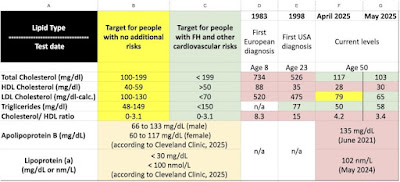


I have to literally pinch myself every time I get the new values after my infusion treatment that shows my LDL in the two-digit range. As you can see, I come from a (“natural”) LDL of 520! I still cannot believe the LDL of 65 mg/dl is mine! I wonder every month if they got my blood mixed up with someone else’s. 


I cannot thank medical research enough for the advancements they have made during my lifetime. This disease that was nothing but a death sentence to me, when diagnosed at 8, has become something I can manage now. This is why it is so paramount that we encourage medical research going forward. It gives not only hope, but literal life to people!


The hope is that I am not adding more damage to my arteries by adding more cholesterol to what has already accumulated there for the past 45+ years. But there is plenty of damage done already and with an aging body and inevitable hormonal changes, I must still continue to stay vigilant and repeat these yearly routine tests, just to understand what is still going on and to have a chance to plan, if faced with an ultimatum. And as I have known several times in my life - ultimatums do happen ...


In this scope, regardless of doctors’ orders, I will continue to fight to know more and not less; to stay on top of every change and progression, such as it will be. 


Tuesday, June 11, 2024

A Giant Leap for Me ...

My First Evkeeza Infusion

It’s been a long time coming. I remember hearing about this new drug called Evinacumab (or Evkeeza) sometime in the fall of 2019 when attending The (then) FH Foundation’s yearly Summit (now, The Family Heart Foundation). One of the HoFH advocates at the event was participating in a clinical trial for it. I was terrified, but I think the world of people like her who are willing to put their body through anything, to navigate the unknown or the little known, in the darkness, it seems, to give us all better treatments. My words cannot be enough to express the gratitude for such people! 


In February 2021, Evkeeza was approved by the FDA for use in the USA for adults with HoFH, in addition to other cholesterol-lowering therapies. Two years later, the FDA approved it for children also. 


Around May 2021, I participated in a brainstorming session that Regeneron (the inventor of Evkeeza) organized with HoFH patients and medical professionals to test their marketing materials for Evkeeza on us. Amanda Seef-Charney, a Regeneron patient advocate, said at the meeting: “We must listen to and learn from individuals who so intimately know what it means to live with a rare disease. Only then can we begin to bring meaningful change ...”. This stayed with me. It’s so unusual when we have this almost invisible, rare disease to actually feel like you’re being heard. 


My own cardiologist did not hear me, when I asked whether I could be considered to be treated with this new drug in July 2021 (https://livingwithfh.blogspot.com/2021/07/who-knows-more-about-fh-you-or-your.html). He had no idea what I was talking about and the reason I went to him in the first place (starting with 2018) is because he advertised himself as a cardiologist specializing in lipid-lowering therapies. By November 2021, he started to look more closely into it and researching what we needed to do in order to get me approved. It was not until December 2023 that I actually got him to prescribe it and get it approved with my insurance. My first appointment was set for some time in February 2024, but the infusion center of his medical system had not heard of the drug and did not know how to order it. I knew I had to change course. 


So, I changed cardiologists and medical systems altogether. I started seeing my new cardiologist at the beginning of May 2024. Today, June 11, 2024, I finally got my first infusion of Evkeeza. It’s been such a long time coming (it'll be 3 years next month since I first asked my previous cardiologist if I can be on this) that it feels surreal to even believe I got it! 


The prior authorization was approved in less than two weeks, and the appointment was secured in two more weeks. As it turns out, this new (to me) medical system has an infusion center right here, in my small town - I usually have to travel at least 40 minutes one way to go anywhere from where I live. But only 12 minutes for the infusion center. It’s like Christmas. 


The appointment was early this morning (scheduled for 8AM). It was the first time in my life that  I stepped into an infusion center. Most people there were getting cancer treatments, but there were other folks with iron infusions and some other restorative medicines. The place had about 8 chairs that I could tell and they were all full. It felt packed and tight. No one was wearing a mask, including the staff, but my husband and I were. 


They weigh you just as soon as you get in because the infusion dosage is based on your weight. Then, because I am considered a woman of child-bearing age and with all my reproductive organs intact, I had to take a pregnancy test which is a urine test. They cannot give you the infusion if you are pregnant. They also drew blood for cholesterol levels which my doctor scheduled in advance. 


After all that and after the IV needle was in, they attached the IV bag. I took a picture of my first bag like it was gold! I hope it works! 


The IV lasted exactly one hour. After that, I waited for another 30 minutes to see if I had any reactions to it - mostly because this was my first time and we didn’t know. We scheduled three more appointments after this, as they like to schedule in advance to keep you on the one-month schedule that this drug is given by. 


During the IV, I felt dizzy a couple of times, but it was hard to tell what from. I do get dizzy occasionally, pretty much daily, and this felt no different than my usual dizzy spells. I also had this taste and smell of chlorine in my mouth and nose which was bizarre but it didn’t last too long. I got light-headed a few times, also and this was new, but not unmanageable. 


I came home right after it and I am taking the day off to just take it easy. So far, I have not felt anything unusual except for some light-headedness, or rather heavy-headedness as I feel like my head is too heavy and swimmy ... I also feel random tingling in my lips and palms, but it kind of comes and goes. No hives (they asked me to look for this), no swelling of the mouth or tongue. I also have a strange mild headache at the back of my head. This is unusual (my headaches are usually in my forehead and temples), and I think it’s what gives me the heavy-headedness, if you will. But, again, it’s totally manageable. The side-effects of a Covid shot are 1000 times worse than this! 


My husband came with me today because we didn't know what to expect from this drug. But I am sure that going forward, I will just go in by myself, barring any new developments in my overall health.


The infusion nurse said they will repeat the blood tests (for cholesterol levels) at every appointment. I asked if the liver function will also be monitored and she said she doesn’t believe so, but to call the doctor and ask that they add it. I know that it takes a full course of 6 infusions (6 months) before we see the full effect of Evkeeza, but the first rung on that ladder is now behind me after today. 


During the whole day, I have been hearing my late dad’s voice in my head. When I was 8 and they discovered that I had “a very severe form of familial hypercholesterolemia” (my total cholesterol was 734 mg/dl), I remember him saying: “one day, far, far away into the future, when you’ll probably be old or even after you’re gone, they might discover some kind of a miracle drug that might cure what you have. But it won’t be for a while. And it might be too late for you.”

When I was 8, they also told me I will not make it past my 25th birthday if I was lucky. I have been looking for this drug for only 3 years. I have been looking for an efficient treatment that will stop the progression of this disease for 41. 


Today is a huge milestone for me, in my journey, to add to the string of all the other milestones throughout my life: the first day that they discovered that I had familial hypercholesterolemia (when I was 8), the first day I took my first statin, or the day I learned without a shred of doubt that I have homozygous FH (I was 41), or the day of my open-heart surgery (I was 40). This is yet another milestone. What I hope for with all my heart is that this drug works. That it works so well that we’re done searching for more therapies. I hope that dad’s dream will be fulfilled and that, in fact, it’s not too late for me ... 


Friday, September 8, 2023

Old Test. New Reaction.

One of the reasons that prompted me to start this blog was so that I can share with others the many different tests and interventions I was going through with FH. I sometimes felt like a human guinea pig - and I still do, 40 years later, with every test and every new drug they send my way. 

In addition to the quarterly lipid and liver panels that I have had done since I was 8, many other tests and investigations were added after FH had caused atherosclerosis and heart disease: yearly ultrasounds, CT scans and MRIs, every-five-year angiograms, yearly ABIs, which are like a radio-wave test (I think) checking for narrowing of your peripheral arteries. To say nothing of all the X-rays for every cough you can’t explain. 


I wanted folks that might be diagnosed with FH to have some expectation of what tests are needed or required and for what purpose. 


Every type of radiation ever invented, I believe, has gotten through this body at various intervals. I know not to wear my jewelry (or anything metallic) when I do an MRI and I know that the CT contrast solution will make you feel like you just wet yourself. 


When the technologist walks you to the CT/ MRI/ X-ray/ Ultrasound room and asks (they ask every-single-time) “have you ever had a CT/ MRI/ X-ray/ Ultrasound before”, I roll my internal eyes and always say “yes”. I know that I am not allergic to the dye in the CT exam and that I taste metal whenever they flush the IV lines with saline. I know I am allergic to the glue on the EKG stickies as well as the glue of medical tape, after they tape up the IV to my arm, or after they pull the IV line out or collect blood samples from me and apply pressure to send me home, covering the gauze with said tape. 


After all these years (40 years of FH and about half of those of heart disease), I pretty much know the drill at every test and I know my reactions, or lack thereof for every test. At least I thought I knew everything. Till today ... 


Today, I had to get a CT scan (with and without contrast) of my abdominal aorta. I knew the drill: they would put an IV in, make me take my bra off and my belt if I had one (I didn’t on purpose), make me lie on a table and put my body through a donut looking machine, move the table with me on it in and out of the donut a few times, tell me to hold my breath a couple of times, and at the half-way point inject the contrast solution in my veins through the IV. They asked me if I have had the test before, and I said yes. They asked if I had ever reacted in any way to the contrast solution and I told them no, but that I hate that it makes you feel like you lost control of your bladder. They said, well, yeah, they can’t do much about that (actually, they can do nothing at all about that unless they put you to sleep but they won’t do that). 


So, we go through the motions. The tech does the first part of the test (no contrast), and then she warns me that she will send the contrast in and she’ll do the test again. All I was expecting was the really warm feeling when the solution goes through my bloodstream and the crazy sensation I have told you about. I knew it should be about 2 minutes and then it’ll all feel normal again. 


Only this time, it was different. This time, that warm sensation did not last for two minutes. After about a minute it got worse. And was getting worse and worse as time went by. It was not just the warm feeling, but my head felt like it was about to blow up. My face was numb and felt paralyzed, and the ceiling of the room (all I could see when lying down) started spinning. The table felt rickety and shaky and my head was so hot I thought it would implode! I kept thinking “I am dying! Oh, Lord, this might be it! I am losing my consciousness and I am surely dying.” It lasted for what seemed like forever, although I am sure it was more like 10 minutes. The tech came in and I was not moving and I could not even answer her. I heard her voice but I didn’t know what she was asking. I vaguely heard her asking if I was OK, and I faintly said “I don’t think so”. 


After I explained to her what I was feeling, she took me to a different room and sent a nurse to come and take a look at me. My speech was slurred and faint, like in a whisper. 


The nurse evaluated my symptoms and concluded that what I was having is what they call a “physiological reaction” - not to be confused with an “allergic reaction”. She said with an allergic reaction, my tongue and throat would swell up, I would have hives and start sneezing and have an itchy face or body, but I was not having all of this. Instead, I was having something similar to a head-rush because the contrast was injected at a high speed. She said your body is kinda confused and trying to tell you “oh, no, what just happened?” - because it got too much dye too fast in a short amount of time. 


She said CT contrast is injected at various speeds and different tests in different areas of the body ask for different speeds. The abdominal CT tests require a higher speed and this is probably what happened. She said there is nothing they can do to prevent this other than just lower the speed. But she said sometimes this is not possible because lower speeds might not capture clear pictures. 


The nurse said for an allergic reaction, they can give you Benadryl, but for a physiological reaction, there is nothing but awareness and taking it easy after the reaction happens ... 


She said next time I am getting another CT like this to warn them that the higher speed will make me loopy but to expect that there is not much they can do about it. 


I was wearing a mask in the office and all I wanted was to be out and breathe some air without a mask. She offered to keep me in the office for a bit as I was still dizzy, even after 20 minutes or so from the test. But I walked out, holding on to walls and slowly making my way to my car. It was another 20 minutes in my car till I felt well enough to drive. 


Even after I got home (45 minutes later from waiting in the car for a while), I was still in a fog. I was still dizzy and unstable on my feet, and after having some lunch and feeling a bit stronger I felt completely drained for the rest of the day. 


I am posting this just as a personal account of what can happen over time - no two tests, I guess, are alike, even if on paper they are virtually the same test. The nurse said anything can happen with time. Your body changes, your body’s tolerance for things changes and the factors that influence your body at the time of the test are always changing. I might have been fine all these years getting CT scans like they’re a fun pastime in the photo booth at the fair, but my body is different now and it can react differently than ever before. You just never know. 


I don’t think I’ll ever discount any new “old” test that I am going to have from here on out - and will look at it with new eyes and know that anything can happen. 


And oh yeah, the tape they stuck on me during the IV and after they pulled it out did break me up all over, but at least this part I was expecting. 


Friday, June 24, 2022

A Stress Test. And Finally Treated as a Human Being ...

Boy, they don’t call it a “stress test” for nothing, right? I think about this every time I have one. And not just the simple, hey, hop on the treadmill, run a few minutes, we’ll take your blood pressure, now go home, you’re all good! But the nuclear stress test is pretty long and inconvenient. (But then, I’m a wimp: anything involving an IV is inconvenient to me).  


I am not sure what it’s like when you’re not truly a cardiac patient and you’re doing it just to rule out cardiac issues. Maybe it’s easier to run uphill at whatever speed they set for you till your heart beats reach the stratosphere for a normal person. But I think any cardiac patient will tell you that it’s not a walk in the park for us - no pun intended here. 


I’ve done maybe 5-6 of these in my life. Maybe more. Definitely not less. I fair it pretty well. These are the basic steps:


  • First, they hook you up to an IV and they give you some contrast solution (this is part of the “nuclear” part of the test).
  • Then, they make you drink a glass of water and sit in the waiting room for an hour.
  • Then, they call you into a room and you lie on a skinny table for 10 minutes and they take pictures of your heart. (These are the pictures of your heart “at rest” - this is another part of the “nuclear” part of the test, as the pictures capture the contrast going through your heart blood vessels to see how well they’re functioning).
  • Then, it’s back to the waiting room for a bit longer (if you’re lucky and they have no one else ahead of you, you’d skip this step, but for me, it was another hour).
  • Then, they hook you up to all sorts of wires to monitor your heart (similar to those you get when you get an EKG), to a blood-pressure cuff, and to an oximeter. Yeah, you’ll feel like an alien. 
  • With all that gear, you then walk on a treadmill and they increase the speed and the incline of the treadmill as you go. 
  • The goal is to make your heart rate go up to a goal that the medical science deemed appropriate for your weight/ height and age. This is the most important part of the test (the “stressing” part)  and I fail it every time.  
  • Once you reach their goal, they inject some more contrast through your IV and they slowly decrease the speed and incline of your treadmill till you come to a full stop. 
  • Then, they have you sit for a bit and then walk back into the picture-taking room to take pictures of your heart, now “stressed”.
  • And that’s it! 


During the test, they ask you if you’re experiencing any discomfort (shortness of breath, chest pains, cramps in arms or legs, dizziness, light-headedness, anything else), and they have you rate their severity on a scale from 1 to 10. They also have you rate your perception of the severity of the level of exercise you’re performing - this goes from 6 to 20 (they call it “the Borg Scale”). I rated mine a “49” by the time they stopped the treadmill! 


The whole procedure took about 4 hours for me. There are lots of things that could happen during this whole thing. For instance, the first set of pictures (ar rest) was not good for me today, so they had to take them again. They said “there was intestinal activity” that obscured some parts of the heart. To “fix” this, they made me drink (on top of the water they gave me before the pictures) a whole can of Sprite. Somehow, Sprite is supposed to “fix” the “intestinal activity” and allow for better pictures (it feels like it does the opposite to me, but hey, I am no doctor). 


Then, they told me that if I don’t reach my beat-per-minute goal (which is 147 beats!!), they will have to inject me with something similar to caffeine, to stress my heart “artificially” even more. This would make the test at least an hour longer and would come with side effects (which the contrast solution does not have). Well, this is the part that I always fail: I have never reached my goal. I have at least two (maybe three) things working against me:

  • I have a sick heart, to begin with, so my level of endurance is low. I get symptoms early on while my heart is not beating as hard yet.
  • I take atenolol, which is a beta-blocker. The whole purpose or atenolol is to slow down your heart rate. A normal person’s heart should be about 60 beats per minute, but in real life, it’s more like 62-65. Mine is usually in the low 50 range (52-55). So, when a normal person’s heart is stressed out it would beat at 147 beats per minute (my goal), my heart would make it to about 130, if that! 
  • A third thing is: so far, I have been young and skinny. So my goal (always done for a healthy individual, not for one with a compromised heart) is too high to start with.


But the lab techs have no choice. They have a grid, they must apply it. That’s all they are trained to do. And they can’t stop the test and just say “hey, she didn’t make goal, so this is the problem, she has a weak heart, let’s send her back to the doc”, because this is not the purpose of this test. The purpose is to take those pictures when the heart is most at stress. 


Today, I actually saw my heart go up to 141 which was my max (still, 6 beats shy of the goal). There are usually two techs in the room: one that monitors your EKG, your blood pressure, your oxygen, and writes everything down, including your symptoms, and one of them who is injecting you with contrast (or giving you caffeine and injecting contrast, if needed) who will also take the pictures, after you’re off the treadmill. The monitoring lady wanted me to go higher than 141 and I simply just could not. The contrast-and-picture tech had to make a call: should he give me caffeine to stress my heart artificially to reach 147? Or leave me be, since I was close to it and my symptoms were so severe that my heart simply could not take any additional stress, either natural, by me trying to add more to it, or artificial, through taking some drug? 


And for the first time in a long time, he actually looked at the patient, and not at the grid! He said: “her symptoms are already at 10+. I cannot, in good conscience, give her more caffeine, because I know her heart is already stressed out based on her symptoms”. I had shortness of breath of 10+ on the severity scale, chest pain of about a 7, dizziness of about an 8, a sharp, sudden headache in one side of my head of about a 6, a completely numb arm, from shoulder to fingertips - the arm was not in pain but it was so numb I could not hold on to the treadmill bar anymore, I would call the numbness a 10. In my experience, these are all symptoms of atherosclerosis and cardio-vascular disease. Because of the damage FH has done over the years, these are the symptoms that my body exhibits to indicate reduced vascular circulation due to plaque buildup and blockages. So, he injected me with more contrast to take the stress pictures and called it good at 141 bpm! 


I am so grateful for that man! Something in my heart (quite literally) tells me he made the right call. I usually don’t drink caffeine (I drink decaf coffee and no sodas), so I am not sure what the side effects would have been on top of the exercise I got that felt so, so, so far over my threshold of normal activity. 


I was just pleasantly surprised that for once I didn’t feel like a Guinea pig and actually felt like a human being. Seen. Heard. Understood. Listened to. 


We need more of these techs in the medical world. Again, I am not a doctor, so I am not sure if he broke some kind of law here - but as a patient, it felt like he had my best interest at heart (no pun) and did not stick me in some artificial mold that everyone has to fit. He assessed me, my performance, my symptoms, my “clinical presentation”, if you will and evaluated that


At one point, because he was paying attention, he told the monitoring lady to stop increasing the speed but to increase the incline more - which was smart and true: from my own experience, I know walking on an incline is infinitely more stressful to my heart than walking faster on flat ground. I didn’t tell him anything, but he noticed where the numbers were going up: and they were going up more when they increased the incline, not the speed. So, he adjusted the effort for me. He even said “her legs are so short, she can’t do the incline if we speed her up anymore” - and that is right! (I am barely 5ft tall). 


No results yet, but I was grateful for a positive and humane experience for once. This is incredibly hard to find nowadays.


Thursday, November 18, 2021

A Mixed Bag: Some Good Things, Some Bad, and a Whole Bunch of Guessing, as Usual

Today was an odd appointment with my cardiologist, to say the least. It was my 3-month appointment (this is routine for me), where we were supposed to discuss the recent tests that he had ordered (a heart echo, a carotid ultrasound, recent blood work, and the results of my neurological tests) and, as always, assess if there are any changes needed in medication.

Right off the bat, he admitted that he didn’t review my tests before he walked in the room. He said he did see them when they were done (in September), but he had not reviewed them this morning before he walked in the room (intern in tow) to see me. So, he needed a minute. (My appointment was at 8:40 AM and he was already an hour late, so I guess: busy morning!)

My cholesterol went up slightly, as you can see below, but he said he will consider it a “lab error”. Well, which one was the error: the last one that showed it the lowest I have ever had it? Or this time, which is more in line with everything else we’ve done for the past year? No answer.


My AST (a liver enzyme) is elevated but only slightly (43 U/L and it’s normal between 15-41 U/L). But I have had it as low as 26, so … there is some reason for concern there. He said to repeat it in 3 months before our next appointment. We repeat the same tests before every appointment: a lipid panel, a liver and renal panel, a uric acid (because of the Nexletol/ bempedoic acid which elevates the uric acid and because in my 20’s I used to have gout attacks frequently).
 The AST is part of the liver panel. He asked me if I want to do an extra measurement at 6 weeks but he said “he didn’t care; it was up to me”. OK, then … let’s just do them all at the same time which is in 3 months. (I love when he says “he doesn’t care” or “to him it’s six of this or half a dozen of the other”. Sounds so reassuring!)

My heart echo write-up mentioned for the first time “diastolic disfunction”. I asked him about this and he explained that what this means is when the heart fills up with blood, it increases in volume but it should not increase in pressure. In my case, there is some pressure that is measurable, but that it is “mild”. He said this is “normal” and “almost expected” in my case, having had a heart attack, open-heart surgery, and coronary vascular disease for many years. He said he is not extra concerned about it, as long as my aortic valve is clear (which it is) and my ejection fraction is good, which at 55% it is.

The narrowing of all my carotid arteries is increased compared to the measurements of two years ago, but the percentage is all the same – between 50-69%. This seems like a huge range to me, but that’s where they place my numbers.

For those more curious, here are my measurements for both the right (first) and the left (second) carotid arteries:

MEASUREMENTS – Right/ Left
------------------ -------------- --------------

Central Carotid Artery
CCA Proximal 249/ 19 cm/sec - 216/ 23 cm/sec
CCA Mid 168/ 21 cm/sec - 230/ 23 cm/sec
CCA Distal 141/ 19 cm/sec - 199/ 24 cm/sec

Internal Carotid Artery
ICA Proximal 136/ 24 cm/sec - 191/ 22 cm/sec
ICA Mid 189/ 36 cm/sec - 134/ 21 cm/sec
ICA Distal 160/ 30 cm/sec - 157/ 22 cm/sec

CCA/ICA Ratios 1.340 - 0.960

External Carotid Artery
ECA 550 - 260
Vertebral 93/ 16 cm/sec - 115/ 15 cm/sec
Subclavian 305 - 327

He said that the worst narrowing is in my External Carotid which is of least concern, because it’s the one that vascularizes the face which gets blood supplies from a “million other places” (his words), so there is no concern for no blood supply there.

I have an appointment with a vascular surgeon and he asked me to follow up with him for a second opinion on the carotid findings.

If it were not for me to mention the neurological test that he ordered to diagnose peripheral neuropathy, he would not have discussed it. I told him that the test showed that I did not have peripheral neuropathy. He was glad about that. He had suspected there was something neurologically wrong because my dizzy spells. Well, not sure what worked, but my dizzy spells are very mild now and very infrequent, and my muscle spasms and cramps are also much better, too. The dizziness definitely does not last for a whole day anymore. I started taking CoQ10 (my decision) which I guess must have made my muscle cramps less frequent, but I don’t think that it had anything to do with fixing the dizzy spells. In addition, my primary doctor diagnosed me with possibly anemia (low red cell count) and a B12 deficiency, so I started taking B12 vitamin supplements at about the same time as the CoQ10 – about 2-3 months ago. He agreed that this deficiency and the anemia could have caused the dizziness for sure. So, we’ll just continue with this treatment and the regular doctor is planning to check the B12 levels again at our 6 month follow-up.

We also talked about the heart symptoms: how’s the blood pressure, how’s the chest pain, how is the shortness of breath? How do I get along with the newest drug he put me on to treat all these (Amlodipine). I told him that the chest pain and shortness of breath are stationary, but I have more stamina when I walk (I can go further and on steeper inclines through the shortness of breath and the angina because I feel like my heart is getting enough blood supply). My neck still cramps, but after a longer walk. The blood pressure is medium-high (in the yellow-orange range on the machine) a lot more often than mostly high (red range), like it was before the Amlodipine. My gums are still very sensitive because of the Amlodipine but I am working with the dentist to use softer brushes, better paste to not irritate them too much.

After the physical consult, he said he thinks “I have more fluid than what he would like for me to have” and to back off the salt. This is the first time in my “heart-patient career” that anyone has said anything about salt, because typically my fluid is under control. He said my legs look fine but that my chest shows signs of too much fluid. He gave no reason as to why all of a sudden my fluid retention is higher, and no recommendation on what to stop or start doing (other than salt intake) to help with this.

As for the FH treatment, he said he would like to try the “twice a year siRNA PCSK9 inhibitor which might come out in the US sometimes next year” – his guess -  (he was referring to Inclisiran - https://www.novartis.com/news/media-releases/novartis-receives-eu-approval-leqvio-inclisiran-first-class-sirna-lower-cholesterol-two-doses-year) to replace the twice-weekly Praluent injections that I take now. I have asked him again (http://livingwithfh.blogspot.com/2021/07/who-knows-more-about-fh-you-or-your.html) about adding Evkeeza to the current treatment and he said “that would be another option as well”, but he made no recommendations about it. About this, I am puzzled: my LDL is nowhere near the “target” number of 70 mg/dl or lower, but he did not recommend adding anything else to my current drug regimen.

So, a mix of findings and if I were to summarize, I would say:

-          Heart function is stationary (no idea what the coronary arteries are doing because we would need a cath angiogram for that)

-          Arteries are showing advancing disease

-          Cholesterol (LDL) is still elevated, not at ideal levels for my disease and my history

-          Liver function a bit modified

-          Quality of life/ symptoms (dizziness, muscle cramps, chest pain and shortness of breath) somewhat improved.

I walk gently towards The Holidays with kind of a mixed bag and lots of unanswered questions. But … it’s better than six years ago when I was walking in with “you must have open-heart surgery in one to three months at the longest.” So, I’ll take it.

Saturday, August 21, 2021

Good Numbers and a Slight Change in Drugs

I ended up getting double-checked for cholesterol this summer because in addition to my routine check from the cardiologist I also met with a lipidologist. I have been watching my cholesterol since I was 8 years old and let me tell you: I am yet to see a doctor who trusts someone else’s blood tests. They might rely on a CT scan result, or an MRI, but when it comes to blood – they will poke you again! However, in all fairness, the lipidologist was keener on checking the Apolipoprotein B and the Lipoprotein (a) than the whole lipid panel.

Here are the results:


June 2021 - cholesterol results

The bottom line is that the LDL number is the at the lowest level it’s ever been at 107 mg/dl. I wish I could say why, but not totally sure. My cardiologist thinks it’s the fact that we added Nexletol that made just a little bit more of a difference (in addition to Lipitor, Zetia and Praluent). But we added it in June of last year and it’s been higher then this in the meantime, although lower than before I was on it.

I did make two changes in my diet this year, too, which could have helped with the numbers as well: I eat a lot more nuts and seeds and I added more grains to my diet for about a month before those tests were taken. I also added more dark chocolate to my diet, which is a good antioxidant, as well (I don’t particularly like chocolate in general, but I have found that when it’s coupled with nuts, dark chocolate is actually bearable). Another bummer for me is that I cannot seem to get the HDL number up at all (despite the changes in the diet). It is actually going down even more. I am told that cholesterol medications bring all the cholesterol fractions down, and since I am on so many of them … there you have it.

I do complain about muscle tenderness (not so much as soreness because it hurts really bad only when I squeeze my muscles), and sometimes joint pain, both of which I have had for years now, but because I function just fine, I can stand up with no help nor pain, and am as independent as a healthy person would be at 46, we have not touched the drugs. We both want to see as much benefit as possible in the cholesterol numbers for as long as I can possibly tolerate the drugs. I know other individuals who make different choices here, but that is my choice. At least for now. And that’s just the thing: everyone should make the choice that is right for them. I know this sounds like a truism, but it bears repeating.

I was tentatively diagnosed with peripheral neuropathy this summer (EMG test to follow in a week or so for confirmation) which could be caused by muscle damage from statins. As a result, I added 200 mg of CoQ10 daily to my drugs to see if this will make a difference in the tenderness. But it might be that whatever damage the muscles have had so far might be irreversible, too – that, I don’t know for sure and no one seems to know. For now, I opt to be on the drugs and hoping for the best. The liver and kidney tests have almost always been normal.

The joint pain could be from my chronic inflammation (I try to keep this to a minimum through my diet), or it could be from Nexletol (which raises uric acid and causes gout eventually). As a result, we added the test to measure the level of uric acid to our quarterly “routine” tests. So, now, every quarter, I get a lipid panel, a liver panel, and  a uric acid. About once a year, the cardiologist or the PCP doctor also runs a complete metabolic panel to check for other issues, like anemia (which I have), or kidney issues. My uric acid has been creeping up on Nexletol, but it’s still within the normal range and I have not had any sign of a gout attack. We did not change the amount of Nexletol and I am still taking a full dose (140mg/day).


Monday, January 18, 2021

Beginning of the Year

Happy New Year, everyone! I think we all put more meaning into this wish this year than any other new year before.

It’s been a while, but not many things have happened.

On the FH front, I am still on the same therapy as I have been since early last year – since the Bempedoic Acid was approved.

Because my joints have been more painful than ever, and because my muscles are tender lately, we (the cardiologist and I) stopped the Bempedoic Acid in the fall (as described here: http://livingwithfh.blogspot.com/2020/10/trying-to-achieve-best-results-with.html) for about a month to see if the pain would stop. It didn’t, really. So, he added it back to my usual cocktail (Lipitor + Zetia + Praluent, at this time). Because we stopped that for a month, the levels for the LDL and Total Cholesterol went up at the last test, as you can see below. Interestingly enough, my HDL is now almost normal, something of a rarity for me – usually that is abnormally low.

Another interesting finding this time is that my Lipotrotein (a) value, which is supposed to be a constant, almost doubled. I will come back with another post about that one.

The cardiologist, along with my PCP, do recommend that I should stop the Lipitor for a month to see if this will stop the joint pain. They are both convinced that it will, at which point I will need to decide whether I want to be on it or not. I would rather not experiment with this, as long as I can take the pain, which for right now, is sufferable. As long as my liver and kidney levels, as well as the levels of CK are normal (and they are, as we continue to monitor them every 3-4 months), I am determined to keep the cholesterol therapy as aggressive as possible to keep my arteries healthy. CK indicates whether there is any muscle damage which would show up in an elevated CK in your blood. So far, this level has been normal for me. So, I am muddling right on through, joint and muscle discomfort or not.

The cardiologist agreed to watch the numbers for these three areas and let me handle the pain. I do not take anything additional for pain. I do find that exercise actually helps with it. It does hurt very much to move, but after a sprint-y lengthy walk or an hour of yoga, when I am at rest, my joints do feel more mobile and less painful. If I go even a day without exercising, my joints are stiff and painful.

I did buy a standing desk for work and I stand as much as possible during meetings, which I have many, sometimes up to 6 a day. This helps as well, as it gives my body more range of motion than when it was just sitting for 8-10 hours every day. I noticed that trying to keep my inflammation down also helps. I do have an mostly plant-based diet which helps keep the inflammation down as well, and to that I have added more avocado, more fiber, and turmeric into my every day meals. This seems to help keep the inflammation down as well. So, here’s hoping …  

On the heart front, I am still fighting with drugs and playing around with them and different strengths to see what the best combination is for keeping my blood pressure down. I am still not at a point where I can say with confidence that we have gotten my blood pressure under control.

The one drug that really helped for me, Amlodipine, causes extreme sensitivity in my gums, as well as makes them bleed. As any heart patient knows, but especially those with a mechanical valve like me, we need the best possible oral hygiene to avoid infections of the heart. So, living with bleeding gums was non-negotiable for me. Losartan is another drug he put me on for blood pressure, but it’s not really working all by itself. So, now he has me on a combination of Losartan and a very small (child) dose of Amlodipine. The gums are fine, the numbers look better but not in the normal range yet. Or at least not on my left arm.

FH throws another kink in the blood pressure values: because of the different levels of stenosis I have in my arteries, my blood pressure in my left arm is much higher than in my right. For an example, see the table below – these are levels in the current month. Apparently, the different numbers on the two arms  is normal for everyone, and the big difference you see between the arms is “normal” for people with atherosclerosis.

Shrugging. Just another measurement that you have to get used to not being “by the book” when cholesterol wreaked havoc in your body, I guess …

I am not really happy with the current drug arrangement for the blood pressure for two reasons: the numbers are still on the high side, the symptoms are still there (chest pressure, calf and neck cramps with exercise) and I would rather not add two (instead of one) medications to my overall cocktail of 12 drugs or so a day (http://livingwithfh.blogspot.com/2016/07/my-current-drug-regimen-and-diet.html). So far, he wants to continue this regimen for another month (till the end of February, I think) and then we’ll meet to reassess.

I feel like we're always guessing and always trying to figure out what regimen is the best to keep. There is no certainty in anything and I truly try to make the decisions that seem to be the less harmful to me and allow me to have the best quality of life. They might not be the best, but they seem the best from where I am sitting. 

Aside from all these technicalities, and all the side effects and pain I have mentioned above, life is generally good. Outside of the “normal” restrictions we have in place as a family for Covid19, I have no restrictions that prevent me from doing everything I want to do. I work, I walk, I do yoga, I do all my  house chores, we take short weekend road trips and hike, and otherwise, I lead a normal life. Or whatever you call normal for me.

Sure, making sure all the drugs are taken on time, that the Praluent shot is done on schedule, the blood pressure measured every day or so, the INR is measured and reported to the clinic once a week - but these are all part of my routine for life. So, I think more than the bugging joint pain, more than the let-down of the blood pressure being weird or having to take two extra drugs to get the numbers to look a little better, the one thing I feel most of is gratitude. For still being alive and for still being mobile. For everything.

I started out this journey at 8 and they told me I won’t see 25. With a bit of luck and the grace of God, I will be 46 this year. I am so grateful, it renders me speechless.

I sincerely wish everyone much health in the new year. May you know as little loss as possible, if any,  and only peace, health, and love.