Showing posts with label diagnosis. Show all posts

Saturday, June 14, 2025

Yearly Carotid Ultrasound and New Numbers

Part of the FH and heart-disease journey is to familiarize yourself with a life peppered by doctors’ appointments. And yes, that is not a typo: there will be many doctors, many specialists, and many tests during a “normal” year of your life. 

Most of the time, I see these appointments as routine. I still chuckle when a coworker takes a whole day off for a stress test and is incredibly fearful when their doctor orders an EKG or a heart echo. There is no comparison in medical journeys, and I am going to be the first one to admit that.


But I only speak for me, now; and to me, these are “the easy” tests. In fact, I have met more doctors that agree that stress tests are a waste of time and money and they are seldom accurate or reliable. So, if they allow me the privilege to choose my test (which most of my doctors do, for whatever reason), I usually skip the stress test, and go for something more invasive even but hopefully more accurate. If, that is, my insurance also affords me this luxury. 


You will find sometimes that the insurance demands a lesser (even non-conclusive) test to be performed if it’s cheaper rather than approve a more costly but a more accurate test. No, the business of medical care, especially in this country, but we are not alone, is not a fair game. 


So, this month, it was time for my yearly carotid ultrasound. Ultrasounds are not invasive, by the way, and still believed to be the first in line for basic imaging.


The results of this test used to be a little worse every year back when my LDL cholesterol was hanging out around 250+ mg/dl. But since I started taking Praluent (in 2016) which brought my LDL down to 150 mg/dl (twice the target, but still much lower), the carotid ultrasound results have been pretty stable, or stationary, showing a buildup of plaque hovering around 50%. They have been so stable in fact, that some doctors argue that I don’t have to do this test every year anymore, that my plaque seems stable and with this amount, there are no interventions recommended. So, they say, we should move the test to every 2 or 3 years. 


So far, I have not been convinced that we should do that. I have seen cardiovascular disease go downhill in less than a year with FH, so I don’t trust my body that it will ever - regardless of how well the drugs perform - stabilize in such a way where I won’t have to watch what the disease is doing to me ... So, I insist we do the tests. 


Also, the impetus of my insistence on this particular test has been my symptoms. No amount of medical science and no amount of doctor “smarts” can convince me of something my own body flags as “not right”. 


For years, I have had numbness and tingling in both my arms, all the way down to my fingernails. It is worse with exercise and it is worse in my left arm. With exercise, my shoulder, and left arm, as well as the left side of my neck become numb, almost like a huge claw squeezes every bit of blood drop out of them! 


I bring these symptoms up with every cardiology (and vascular specialist) appointment and they take notes, but offer little in return. Others venture a guess of “well, that could be neurological”. And I did have neurological studies done to both my arms (I would not recommend them to my worst enemy) and although there were some findings (ulnar nerve neuropathy in my left arm and carpal tunnel in my right), the symptoms from these afflictions are different than what I feel when I exercise. The level and the place of the numbness is different, and the feeling of the “huge claw” only comes on with effort. 


Over the years, although my carotids have been more or less stable, some of my other arteries have started to see signs of more advanced atherosclerosis. Usually, they give me a percentage of the stenosis or plaque. This year, they spelled it in no ambiguous terms: “subclavian stenosis”. Not once, but several times in the test findings they emailed me. Some branches of the carotid artery (like the right external carotid) also appear stenotic, but the subclavian is pretty much stenotic, with no doubt. No other approximations or guesses of what the percentage might be. 


In full disclosure, these are the findings from the carotid ultrasound:

  1. Left subclavian artery flow appears stenotic.
  2. Right CCA demonstrates significant plaque.
  3. Right ECA appears stenotic.
  4. Right ICA stenosis less than 50%.
  5. Right subclavian artery appears stenotic.
  6. The Left ICA stenosis less than 50%.
  7. Flow in the right subclavian artery appears stenotic.
  8. Flow in the left subclavian artery appears stenotic.

**PSV is 125-180 cm/s & ICA/CCA ratio >2.0 is also consistent with 50-69% stenosis.

**Comments right side: PST noted throughout the CCA.


My doctor is yet to reply to all this. I will wait for another week or so and then reach out for more details from him, although I am not too hopeful he’ll recommend any course of action. I have been told time and again that without close to a 100% stenosis or an aneurism, there is not much they would want to do, regardless of the symptoms (which they are more than happy to just medicate, much to my dismay!), because there are too many risks involved in performing a bypass on the arteries or even more in adding stents. 


But this is why I insist on repeating the test every year: what if, from one year to the next, we go from "stable" to an aneurysm, or even a tear? What if, like this year, we go from “50% to stenotic”. 


In lieu of a doctor’s feedback, I, of course, turn to the internet. And this is what the Cleveland Clinic says about the symptoms for subclavian stenosis:

  • Muscle cramps when you use the affected arm.
  • Arm pain or tiredness when you use the affected arm.
  • Tingling or numbness (paresthesia) in the affected arm.
  • Dizziness
  • Fainting
  • Vertigo 

I have experienced all of them for years, except for the last 2. My dizziness occurs daily now. And most if not all of these are not related to ulnar or carpal tunnel neuropathy.


As I understand (and as I have lived) it, stenoses (many of them everywhere where there is an artery) are a byproduct of FH. Just the normal collateral damage that years of high cholesterol has done to your blood vessels. 


The little bit of a good news this month has been the continuing dropping LDL numbers (thanks to the new Evkeeza infusion which seems to be going well). 
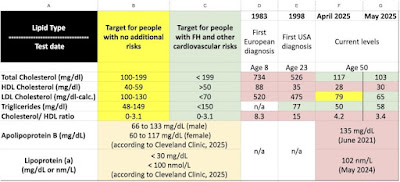


I have to literally pinch myself every time I get the new values after my infusion treatment that shows my LDL in the two-digit range. As you can see, I come from a (“natural”) LDL of 520! I still cannot believe the LDL of 65 mg/dl is mine! I wonder every month if they got my blood mixed up with someone else’s. 


I cannot thank medical research enough for the advancements they have made during my lifetime. This disease that was nothing but a death sentence to me, when diagnosed at 8, has become something I can manage now. This is why it is so paramount that we encourage medical research going forward. It gives not only hope, but literal life to people!


The hope is that I am not adding more damage to my arteries by adding more cholesterol to what has already accumulated there for the past 45+ years. But there is plenty of damage done already and with an aging body and inevitable hormonal changes, I must still continue to stay vigilant and repeat these yearly routine tests, just to understand what is still going on and to have a chance to plan, if faced with an ultimatum. And as I have known several times in my life - ultimatums do happen ...


In this scope, regardless of doctors’ orders, I will continue to fight to know more and not less; to stay on top of every change and progression, such as it will be. 


Thursday, November 18, 2021

A Mixed Bag: Some Good Things, Some Bad, and a Whole Bunch of Guessing, as Usual

Today was an odd appointment with my cardiologist, to say the least. It was my 3-month appointment (this is routine for me), where we were supposed to discuss the recent tests that he had ordered (a heart echo, a carotid ultrasound, recent blood work, and the results of my neurological tests) and, as always, assess if there are any changes needed in medication.

Right off the bat, he admitted that he didn’t review my tests before he walked in the room. He said he did see them when they were done (in September), but he had not reviewed them this morning before he walked in the room (intern in tow) to see me. So, he needed a minute. (My appointment was at 8:40 AM and he was already an hour late, so I guess: busy morning!)

My cholesterol went up slightly, as you can see below, but he said he will consider it a “lab error”. Well, which one was the error: the last one that showed it the lowest I have ever had it? Or this time, which is more in line with everything else we’ve done for the past year? No answer.


My AST (a liver enzyme) is elevated but only slightly (43 U/L and it’s normal between 15-41 U/L). But I have had it as low as 26, so … there is some reason for concern there. He said to repeat it in 3 months before our next appointment. We repeat the same tests before every appointment: a lipid panel, a liver and renal panel, a uric acid (because of the Nexletol/ bempedoic acid which elevates the uric acid and because in my 20’s I used to have gout attacks frequently).
 The AST is part of the liver panel. He asked me if I want to do an extra measurement at 6 weeks but he said “he didn’t care; it was up to me”. OK, then … let’s just do them all at the same time which is in 3 months. (I love when he says “he doesn’t care” or “to him it’s six of this or half a dozen of the other”. Sounds so reassuring!)

My heart echo write-up mentioned for the first time “diastolic disfunction”. I asked him about this and he explained that what this means is when the heart fills up with blood, it increases in volume but it should not increase in pressure. In my case, there is some pressure that is measurable, but that it is “mild”. He said this is “normal” and “almost expected” in my case, having had a heart attack, open-heart surgery, and coronary vascular disease for many years. He said he is not extra concerned about it, as long as my aortic valve is clear (which it is) and my ejection fraction is good, which at 55% it is.

The narrowing of all my carotid arteries is increased compared to the measurements of two years ago, but the percentage is all the same – between 50-69%. This seems like a huge range to me, but that’s where they place my numbers.

For those more curious, here are my measurements for both the right (first) and the left (second) carotid arteries:

MEASUREMENTS – Right/ Left
------------------ -------------- --------------

Central Carotid Artery
CCA Proximal 249/ 19 cm/sec - 216/ 23 cm/sec
CCA Mid 168/ 21 cm/sec - 230/ 23 cm/sec
CCA Distal 141/ 19 cm/sec - 199/ 24 cm/sec

Internal Carotid Artery
ICA Proximal 136/ 24 cm/sec - 191/ 22 cm/sec
ICA Mid 189/ 36 cm/sec - 134/ 21 cm/sec
ICA Distal 160/ 30 cm/sec - 157/ 22 cm/sec

CCA/ICA Ratios 1.340 - 0.960

External Carotid Artery
ECA 550 - 260
Vertebral 93/ 16 cm/sec - 115/ 15 cm/sec
Subclavian 305 - 327

He said that the worst narrowing is in my External Carotid which is of least concern, because it’s the one that vascularizes the face which gets blood supplies from a “million other places” (his words), so there is no concern for no blood supply there.

I have an appointment with a vascular surgeon and he asked me to follow up with him for a second opinion on the carotid findings.

If it were not for me to mention the neurological test that he ordered to diagnose peripheral neuropathy, he would not have discussed it. I told him that the test showed that I did not have peripheral neuropathy. He was glad about that. He had suspected there was something neurologically wrong because my dizzy spells. Well, not sure what worked, but my dizzy spells are very mild now and very infrequent, and my muscle spasms and cramps are also much better, too. The dizziness definitely does not last for a whole day anymore. I started taking CoQ10 (my decision) which I guess must have made my muscle cramps less frequent, but I don’t think that it had anything to do with fixing the dizzy spells. In addition, my primary doctor diagnosed me with possibly anemia (low red cell count) and a B12 deficiency, so I started taking B12 vitamin supplements at about the same time as the CoQ10 – about 2-3 months ago. He agreed that this deficiency and the anemia could have caused the dizziness for sure. So, we’ll just continue with this treatment and the regular doctor is planning to check the B12 levels again at our 6 month follow-up.

We also talked about the heart symptoms: how’s the blood pressure, how’s the chest pain, how is the shortness of breath? How do I get along with the newest drug he put me on to treat all these (Amlodipine). I told him that the chest pain and shortness of breath are stationary, but I have more stamina when I walk (I can go further and on steeper inclines through the shortness of breath and the angina because I feel like my heart is getting enough blood supply). My neck still cramps, but after a longer walk. The blood pressure is medium-high (in the yellow-orange range on the machine) a lot more often than mostly high (red range), like it was before the Amlodipine. My gums are still very sensitive because of the Amlodipine but I am working with the dentist to use softer brushes, better paste to not irritate them too much.

After the physical consult, he said he thinks “I have more fluid than what he would like for me to have” and to back off the salt. This is the first time in my “heart-patient career” that anyone has said anything about salt, because typically my fluid is under control. He said my legs look fine but that my chest shows signs of too much fluid. He gave no reason as to why all of a sudden my fluid retention is higher, and no recommendation on what to stop or start doing (other than salt intake) to help with this.

As for the FH treatment, he said he would like to try the “twice a year siRNA PCSK9 inhibitor which might come out in the US sometimes next year” – his guess -  (he was referring to Inclisiran - https://www.novartis.com/news/media-releases/novartis-receives-eu-approval-leqvio-inclisiran-first-class-sirna-lower-cholesterol-two-doses-year) to replace the twice-weekly Praluent injections that I take now. I have asked him again (http://livingwithfh.blogspot.com/2021/07/who-knows-more-about-fh-you-or-your.html) about adding Evkeeza to the current treatment and he said “that would be another option as well”, but he made no recommendations about it. About this, I am puzzled: my LDL is nowhere near the “target” number of 70 mg/dl or lower, but he did not recommend adding anything else to my current drug regimen.

So, a mix of findings and if I were to summarize, I would say:

-          Heart function is stationary (no idea what the coronary arteries are doing because we would need a cath angiogram for that)

-          Arteries are showing advancing disease

-          Cholesterol (LDL) is still elevated, not at ideal levels for my disease and my history

-          Liver function a bit modified

-          Quality of life/ symptoms (dizziness, muscle cramps, chest pain and shortness of breath) somewhat improved.

I walk gently towards The Holidays with kind of a mixed bag and lots of unanswered questions. But … it’s better than six years ago when I was walking in with “you must have open-heart surgery in one to three months at the longest.” So, I’ll take it.

Friday, September 24, 2021

The Faces of My FH

 FH has many faces and many stories. I have homozygous FH (HoFH) which means that I inherited it from both my parents. As a matter of fact, both genes that came from them are the same exact gene, although my parents are not related, in any way, by blood.

My grandparents all came from huge families (think 10+ children). My parents have so many cousins they have not met all of them. This also means I have a lot of people on both sides of my family who have FH. And every one of them has a different story. A different story of their diagnosis, of their treatment, or lack thereof, of what the disease ultimately leads to. There are no two stories alike, and there are no two people that chose the same path in managing this disease (or not).

I see a lot of people with FH who are asking good questions about what to do when they are diagnosed; people who display all sorts of emotions, from sheer panic and depression to a nonchalance that I envy, in some ways, although I know that is not the proper course for a healthy and good-quality life when you have FH.

FH has been in my family’s life for generations – no one is shocked when they are diagnosed anymore. We’re all pretty much aware of what it is and what it can do to us: many of our aunts and uncles have suffered heart attacks, strokes, angioplasties, complications from diabetes and fat liver disease. Although we know all these things all too well, not all of us choose to receive treatment. More in the notes I drew below about my immediate family and their individual, unique stories.

My grandfather

Current age: deceased at age 65

Diagnosis age: as a young adult, after several of his older relatives and brothers and sisters were formally diagnosed with FH. At that time, they just spoke of “familial hypercholesterolemia” and did not dissociate between the HeFH and HoFH types. We believe he had heterozygous FH (HeFH).

Cholesterol levels: no one remembers for sure, but my parents think the total cholesterol stayed between 300-400 mg/dl.

Treatment: reduced fat diet; no drug treatment was available for cholesterol in Romania before 1990 when he died.

Complications: first stroke at 48, major stroke at 50 which left him paralyzed in one half of his body. He died at 65 after a massive stroke after having lived bed-ridden since he was 50 with the effects of the stroke and complications from diabetes. He also had coronary artery disease and high blood pressure.

My aunt

Current age: 71

Diagnosis age: as a young adult. At that time, they just spoke of “familial hypercholesterolemia” and did not dissociate between the HeFH and HoFH types. We believe she has HeFH.

Cholesterol levels: currently, the total cholesterol is between 200-300 mg/dl.

Treatment: no special diet, no treatment, by choice.

Complications: angioplasty (stent placement) in her thigh and upper-leg arteries in her 50’s; massive small-brain stroke at 67; high blood pressure, a-fibrillation, tachycardia.

My father

Current age: 69

Diagnosis age: in childhood, due to the fact that his father already knew about his diagnosis, my father was a sickly kid, and his mother (my grandmother) was a registered nurse who tested him for everything. At that time, they just spoke of “familial hypercholesterolemia” and did not dissociate between the HeFH and HoFH types. We believe he has HeFH.

Cholesterol levels: currently, his total cholesterol is 326 mg/dl.

Treatment: no special diet, no treatment, by choice.

Complications: several mini-strokes starting in his 40’s. High blood pressure in his 40’s. Diagnosed with coronary artery disease, peripheral atherosclerosis, peripheral neuropathy in his 50’s. His condition is further complicated by diabetes.

My mother

Current age: 68

Diagnosis age: 63. My mom’s cholesterol levels were in the upper 200’s all the way into her 50’s. She maintained that her cholesterol is not genetic, like my dad’s and it’s caused simply by bad eating habits. When she was 63, I had a genetic test that confirmed that I had Homozygous FH (HoFH). This was the clear indication that she, too, must also have FH. She suspects she inherited it from her father who died when she was 7. She had no further relationships with his surviving family, so the knowledge on her side of the family is very limited.

Cholesterol levels: currently, her total cholesterol is 313 mg/dl.

Treatment: no special diet, no treatment, by choice.

Complications: aortic valve stenosis, coronary artery disease, stroke at the age of 67. The cause for the stroke was unclear as she was also undergoing chemo treatment for lung cancer at the time. The doctor could not determine the cause of the stroke for sure – whether it was vascular or a complication of the chemo. She suspected it could be either one.  

Myself

Current age: 46

Diagnosis age: 8. My pediatrician felt an enlarged liver when I complained of pain in my upper abdomen. She sent me to get a complete liver and lipid profile, also knowing my family’s history of FH at the time. My mother found out the cholesterol level, as a hospital biochemist. At that time, they just spoke of “familial hypercholesterolemia” and did not dissociate between the HeFH and HoFH types.

At age 40, following a genetic test, I was diagnosed with HoFH.

Cholesterol levels: currently, my LDL is 107 mg/dl (the lowest it’s ever been). Before I started drug therapy at the age of 23, my LDL was 475 mg/dl. My total cholesterol was 526 mg/dl.

Treatment: no fat, vegan + fish diet, Lipitor, Zetia, Praluent, Nexletol.

Complications: diagnosed with tachycardia and arrythmia in my early 20’s; coronary and carotid artery disease at age 30; aortic valve stenosis at age 36. Open-heart surgery at age 40 to replace the aortic valve, ascending aorta, repair the aortic arch and repair and bypass four main coronary arteries.  

My sister

Current age: 43

Diagnosis age: 38. Although she knew her cholesterol was elevated, my sister did not get officially diagnosed and treated until this age. This was after my open-heart surgery which rang a bell of alarm for everyone in the family, I think.

Cholesterol levels: currently, her LDL is 108 mg/dl (total cholesterol is 201 mg/dl).

Treatment: low fat, white meat and fish diet, intense jogging (she is the runner in our family as she has been spared heart disease so far), Lipitor.  

Complications: no complications so far.   

My nephew

Current age: 10

Diagnosis age: 7.  

Cholesterol levels: last test showed an LDL of 170 mg/dl.

Treatment: all-inclusive diet, with less fried foods and lower fat, white meat.   

Complications: no complications so far.   

Whatever your story may be, what I believe firmly is this: it all starts with awareness: knowledge is power. You may choose not to do anything at all, but at least you know about the train that’ll be coming rather than one day be caught completely by surprise, way too late, when there might not be anything left to do or know anymore.


To honor the FH Awareness Day, these are the faces and stories of my FH family. What are yours? Do you know?!

Happy health, you all!


Sunday, June 20, 2021

A Visit to the Lipidologist

It’s pretty unusual that I have had a rare lipid disorder all my life and although I have had more doctors and specialists than I can count, none of them was technically a lipidologist. I have seen cardiologists, endocrinologists, cardiac surgeons, vascular specialists and vascular surgeons who could manage lipids, but never a lipidologist.

Because I am constantly trying to learn more about my specific type of HoFH and because I have some concerns that some people on my current heart team have some gaps in understanding the risk factors for cardiovascular disease when it comes to FH, I wanted to get an expert’s opinion about my case and to confirm that the plan of action we have is appropriate.

The new doctor was a great combination of informed-aware-familiar-with-FH, as well as empathetic and down-to-earth. I felt like he listened, he followed my history closely, and he gave me his opinion about things I have tried in the past, things I am doing now, and painted a tentative picture of what he thinks my future might hold, if one can get so close as to predict that.

To make a very long (the appointment took two whole hours! Longer with new blood tests.) story short, these are some of the learnings from this visit:

  • He agrees that given my cardiovascular history and the fact that I still have progressing disease (in the form of increasing stenosis) at least in one area of my arterial system (abdominal aorta), I need to do more to lower my LDL number as well as my apolipoprotein B number (which goes hand-in-hand with the LDL number). Lowering the numbers to the lowest possible for me (we’re shooting for under 70 mg/dl for the LDL) should hopefully stop the progression of atherosclerosis. He very clearly said he is in the business of “preventing and diffusing the bomb” and not in the business of “cleaning up the mess” after the bomb (usually a heart attack or a stroke) has gone off - which sometimes is the business cardiologists and vascular specialists are in. He advised to rather not wait for new symptoms be them in my heart or carotids, or abdominal aorta, but to be proactive about bringing my LDL (currently 125 mg/dl) down more. My vascular specialist believes that we need to wait for an abdominal aneurysm or inability to eat before we can address the stenosis in the abdominal aorta.
  • He thinks I am on the right combination of drugs at this point in time. He thinks I am on everything that is on the market and successful for HoFH and as a bonus, I seem to respond well to this cocktail (Lipitor, Zetia, Praluent, Nexletol). He would add Juxtapid, which I have denied accepting due to severe side effects (https://en.wikipedia.org/wiki/Lomitapide) and possibly a new drug that’s coming out of Regeneron, approved earlier this year (https://www.evkeezahcp.com/). We'll wait to see about this last one for a bit, because no one seems to know what the process for administering it and approving it seems to be right now.
  • He explained that I am somewhat of an anomaly:
    • According to the genetic test I had done, I have a pair of the same exact bad gene to account for my HoFH (https://livingwithfh.blogspot.com/2017/08/the-long-journey-to-hofh.html) . He said more common, you see two bad genes that are different and both “bad”, but mine are two identical bad ones which makes me a “true homozygous as opposed to a complex heterozygous case.” Apparently my case is much rarer than the “one in 250,000 people” which is what the frequency of HoFH is estimated at.
    • Because of this profile, I should not (research shows) respond as well to statins or any other medications as I do. It is strange/ unusual that I respond as well as I do, but obviously, this is my lucky card in the bad hand I drew at birth.
  • He is puzzled as to why I don’t show a corneal arcus which is common for people with HoFH and with higher level of cholesterol (https://en.wikipedia.org/wiki/Arcus_senilis). I have never had one. He did find Achile’s tendon xanthomas and a xanthoma on my left eyelid which are on par with the manifestations of the disease.
  • He explained the importance of the Lipoprotein (a) and apolipoprotein B in the cholesterol profile and his opinion is that these particles are as important as the level of LDL in understanding the cholesterol profile as well as the level of risk for cardiovascular disease. He repeated the tests to measure both – just to get a baseline. He advised that we should always measure the Lipoprotein (a) in nmol/ l instead of mg/dl, as the first unit of measure is more today’s standard. He did say some labs (the one my cardiologist has been using included) are slow to follow the new standard (nm/l) and the conversion (from mg/dl) doesn’t always work.
  • He congratulated me for a lifetime of not smoking, saying that is one of the most common things people with heart disease do not understand: how dangerous smoking can be for CV disease. I told him that people in my own family with the disease don’t get it either.
  • He is also concerned about the inflammation that I have in my body, which no one seems to correctly diagnose. We know there is inflammation but we don’t know what kind. The tests are inconclusive, but the symptoms (rashes, hives, joint pain) are indicative of it. He said whatever I do to keep inflammation down is a sure benefit for CVD. For this, I mainly watch what I eat, am on a vegan diet with just occasional cold-water wild fish.
  • He ultimately did not change anything in my current regimen, but he underlined the importance of staying on top all the “vascular beds” (he called them) that show advanced disease (the heart, the carotids, the abdominal aorta, and the peripheral arteries in the legs). My cardiologist is monitoring the heart, legs, and carotids, and I am yet to find someone who can monitor my abdominal aorta which is stenotic.

The results of the tests he did when we visited came back a couple of days ago and the levels for the “other” lipids are both elevated:

  • Lipoprotein (a) = 88 nm/l (it is normal up to 73nm/l)
  • Apolipoprotein B = 134 mg/dl (it is normal up to 110 mg/dl, or up to 80 for people with additional risks for cardiovascular disease).

He admitted  that he expected at the very least that the apolipoprotein B to be elevated because that usually goes hand-in-hand with the levels of LDL and we already know that is elevated. It made me wonder if this is the reason why a regular doctor (like my PCP or cardiologist) never checks this fraction of cholesterol. The fact that my Lipoprotein(a) is also elevated adds yet another risk factor (in addition to elevated LDL) to my CVD. The drugs I am on should affect the numbers of the LDL and apolipoprotein (B), but there is no known therapy for lowering the Lipoprotein(a) yet. A regular doctor would never order these cholesterol fractions as a routine. I have had them checked before when someone suspected FH, but not as a routine blood check that you do when you have your physical once a year. From everything I have read and from what the lipidologist said, it is important to know the level of Lipoprotein (a) as this is a standalone risk factor for cardiovascular disease, just as important as elevated LDL which is something checked routinely.

As a conclusion – I did get some new learnings from this visit, even if it was just a new perspective and a new way to look at the numbers. I always strive to learn as much as I can from as many specialists as I have access to, to ensure I have the best possible plan of action in place. I have said it before and it is a platitude nowadays, but … knowledge is power. Not just the knowledge one can find on Google, but that of a person who dedicated their research and professional life to bettering the lives of people with a disease such as ours.

In the end, I made the decision to stay with the current cardiologist as it seemed that the course of action the lipidologist would follow would be identical to the one I am following now. Transferring the drug management which includes at least a couple of preapproval processes (for now, maybe more than two in the future) for drugs that I am on is a bit of a pain in the American medical system. My cardiologist has the preapproval process down to a science, and this offers some peace of mind, for sure. Of course, validating that he’s on the right track with the current regimen he’s had me on by comparing his course of action to that a lipidologist would follow, is also reassuring. With my heart history, I could never give up the cardiologist, either – so, this way, I feel like I get good care in both lipid and heart management.

I am still looking for a specialist who can monitor my progressing disease in my abdominal aorta. Even with lowered numbers (granted, not ideal), the stenosis seems to be advancing (https://livingwithfh.blogspot.com/2021/04/educating-doctors-visit-to-my-vascular.html) from one year to another. So, onward we go.


Monday, September 21, 2020

What Being Cholesterol and FH Aware Means to Me

Those of you who follow this blog should already know my story (http://livingwithfh.blogspot.com/2011/03/my-story.html). Just in case you don’t, here’s a short summary: 

My parents knew that my dad’s side of the family had FH long before I was born. Dad had it, and his father had it, as well as most of his uncles and aunts on his father’s side. When I was 8, my pediatrician recommended that my parents would check my cholesterol level as well, because my liver was enlarged. My LDL was 525 mg/dl and my total cholesterol was 734 mg/dl. 

My mom fainted when she found these numbers, as she was the lab tech that actually read them for the first time. They didn’t have much hope that I would survive my teens. No one had ever seen such levels in a small child in 1983 Romania and with no medication or procedures on the market, they had little hope that I’d make it very long. Even in Communist Romania, with virtually no access to cholesterol-lowering drugs, they did know one important thing about FH: that it leads to premature heart disease or strokes at an early age. My grandfather had his first stroke at 48 and then, two years later, another massive one which left him bedridden. Even at my fragile age of 8, I had grown up to see my grandfather decay fast and I understood so much. 

My parents kept giving him as an example to me, of what will, for sure, happen to me, only much, much earlier in life because my cholesterol levels were so much higher than his. Even at that age, I learned what cholesterol meant (a white, fat substance that clings on to your blood vessels and organs and prevents them from working right), and what one can do about it: extremely severe diet (at the time, my parents would try anything so I was on a no-meat, no-fat, no-oil diet for about two years before they gave up on that because it was not really working for my numbers), and medication (in the beginning they gave me a white powder-drug called Cholestyramine which is a binder drug, but that didn’t help much either). I think I was 9 or 10 when I could tell you very eloquently what atherosclerosis,  dyslipidemia, and familial hypercholesterolemia meant. Google them, please! 

I went from doctor to doctor, from specialist to specialist till I was about 14 or 15. Everyone shrugged. No one knew what else to do. When I was in my late teens (19 and in college), I started to have heart symptoms: mainly tachycardia and arrhythmia so they put me on a beta blocker. They also did my first echo at that time and they saw modifications then, although I am not remembering exactly what kind. All they told me was “this is perfectly normal given your disease, but it’s serious.” 

I moved to the US when I was 23 and my first priority was to get on a treatment. Since then, I have tried every statin there is, and added much more to my regimen of drugs. Even with everything I have been throwing at this disease (http://livingwithfh.blogspot.com/2016/07/my-current-drug-regimen-and-diet.html), my LDL cholesterol has only recently (this month) been within normal ranges but  still not at my ideal target (below 70 mg/dl). 

Even with much access to medication and specialists in the United States, my heart problems have increased over the years: my aortic valve and my aorta replaced, my aortic arch repaired for an aneurysm and four by-pass grafts of the major arteries of my heart. I also had a heart attack following my surgery. All this before my 41st birthday. It was then when I had access to genetic testing and finally my “very severe case of FH” had its own name: Homozygous FH, which is the rarer and more severe form of FH. This meant that my mom also has the disease. Because her levels had always been in the upper 200’s and because she doesn’t have much knowledge about her family history she never suspected it when she compared her levels with dad’s and mine. In her late 60’s now, she has just been diagnosed with a slew of heart problems, among which a stenotic aortic valve and severe atherosclerosis of most major arteries of her heart. 

In addition to my heart problem, I have moderate to severe stenosis in my carotid arteries and at least one instance of severe stenosis in one branch of my abdominal aorta. For now, we are keeping a close watch on these areas, with yearly exams and visits to a vascular specialist. 

I would not be sitting here writing this for you all today if it were not for the fact that I have been aware early in my life about what cholesterol means and what FH can lead to. I have taken every treatment that seemed to match my body and my needs and have made choices in my life that allowed me to stay as healthy as I can. Sometimes those choices went against the popular expectations, like choosing to not have children because I simply didn’t want to pass this legacy on, and I didn’t know if I was going to be around for them. 

However, I have had a full life otherwise.  I am proud of my family and their support, and proud of my marriage, my travels and my work. I would have had a different story, or not been here to tell you a story at all if it were not for the fact that very early on, I knew what this means and how to manage it and I started doing that as soon as it became possible. By then, I knew exactly what specialists I needed to see and what questions to ask. Awareness is key, with FH. 

September is cholesterol awareness month and September 24th this year is FH awareness day. If you know a little bit about your family history and you know you have people in your family either with high cholesterol (especially when they lead an otherwise healthy life) or with heart disease or stroke, urge your doctor to check your cholesterol and know what the numbers are and what they mean (http://livingwithfh.blogspot.com/2016/07/my-current-cholesterol-numbers.html) . Do this especially if you have children or think you might have them one day. Knowing early will allow you to start treatment early and slow the progression of atherosclerosis. Your life is worth so much more! 

Stay healthy and stay aware. 

Sunday, January 17, 2016

The Long List of Questions

I've been spending tons of time researching this valve replacement surgery online. I am ever so grateful for the wealth of information we have out there, today, but I am also very confused and very torn. 

To recap: my cardiologist strongly recommends my aortic valve be replaced by a mechanical valve, and most specifically by an On-X valve. I won't attach links here, as I trust you all can find them online, by just googling the terms you find in this blog. My various doctor friends strongly recommend this valve as well. The research online also mentions that "for my age group", the On-X valve is the best solution right now. 

I have one friend who has had the bio valve for five years now, and he's mostly a fan of that, since there is no medication management after it, virtually. Another friend of my husband's has had the On-X one, and he manages that quite well. Lots of input!

I personally am leaning heavier towards the prospect of the On-X valve, too, from what I have read, except for the blood thinners. But my husband has a friend who has been on coumadin for this valve (he was a very early recipient of the On-X, before it was even approved by the FDA) for 18 years, and he explained to me life on coumadin. It does not sound much worse than a diabetic patient monitoring their insulin. In case of a bleeding episode, however, is much worse than that, of course. But I try not to live my life for what might be, you know ... Sure, I might fall and bump my head and bleed from my brain, but then again, I might not. 

Anywhoo, I digress. The management of it is not so daunting to me, as it is the interaction of blood thinners with either my current medications or with my existent risk factors, for clotting, stroke and heart attack. 

I spent lots of hours and days researching, signing up for chat groups, etc, to hear first hand stories of patients like me. And I find everything very helpful and fascinating - and I am endlessly grateful for people who take the time to share their story. It's greatly helpful and inspiring for all of us who will follow into the same footsteps one day. 

Each journey will be unique, no doubt, as we are all so different, but some things we will all share - the fears and the questions we are faced with will bear some similarities. 

I have also spent most of the past month jotting down my questions for my surgeon and my cardiologist. Some of them are questions, some of them are mostly just asking for confirmations that what I have read is not quack. 

In my list "for the docs", I started outlining my current health: part of my jitters is the fact that my heart, my circulation has already been so damaged by my FH. I am already at an increased risk for heart attack and strokes, because of my various stenoses, and this surgery as well as the life after it, scares me double with all that to consider in the picture. 

So, the first part of my list is "this is who I am today. Do you (doctors) perceive this state to be a risk factor during and after surgery, and how do you plan on monitoring this?". 

Then, I gave them my list of current  meds and cholesterol numbers - to show that even on high levels of statins + zetia + OTC my FH is not peachy. 

And then, they will get a list of all my questions - screen shot below. Note that this is a very personal list - this will just reflect my questions, my fears, my unique case of what can/ cannot affect my own health - they are very specific to me. 

However, I trust that if you read them, and one day you'll be found in the same situation as me now, they'll trigger questions you might not think about at the time. They came from my research - everything you'll see noted is something that someone else either experienced or some health sites mentioned as a possibility - I just need to run some of these by my doctors and find out what they think about all the ones that I am nervous about. After all, I am leaving them in charge of not only my heart, but my well-being and life "after".

In my list for them, I have also included a comparative list for all the three kinds of valves: tissue valve, traditional mechanical (like St. Jude's) and On-X valve. I used this list online as a guide for my questions there. It's pretty clear and easy to understand. I do get it, that it's on the site of the people who make the On-X valve, but it's a good guide for questions and I want some confirmations from the surgeon's experience to see if these guidelines check out. 


This is my list of questions. In bold are the most important ones to me. The one highlighted in gray is of utmost importance to me. 


Thursday, December 31, 2015

And Now We Wait ...

I am sure that  the title could repeat itself 100 times in the days to come. After a diagnosis comes, there are long days of waiting, for insurance approvals, medical opinions to factor in, planning on the patient's part - and waiting and planning are, really, a luxury! Some people don't have that choice. Especially, with heart disease, most people get rushed in and under the knife to stay alive. So, this is really, just good. 

We repeated the echo-cardiogram on Christmas Eve, and the readings are right: my aortic velocity is 4.86 m/s (it's normal lower than 2.5 m/s - see this article for values), and the aortic opening is 0.5 cm square. So, all measurements point to one thing only: severe aortic stenosis which requires the aortic valve to be replaced. I guess I could cheat fate for only 40 years before I succumb to heart surgery. I will try my darnest not to "succumb", however, but to come out of it stronger and better. 

Right now, I made an appointment just with my cardiologist, to understand better of how soon we need to do something about this, and possibly to understand what kind of valve it's fitting for me to get. He will also recommend the heart surgeon on that appointment. 

I am a conundrum of questions and doubts, as there are no clear "winning" options for a stress free and doctor free and worry free valve: if we go with a tissue (animal or human) valve, it will require re-operation withinin 10-15 years, if we go with a mechanical (artificial) valve, it will require coumadin daily, which has a ton of side effects and many other health concerns because of heavy bleeding. Not something to take lightly. I am reading and researching all I can, but will know more on the 5th, when the next appointment is. I hope.

It's been a blessing to have some time off during the holidays, just to spend it with my husband and to really wrap our heads around this, but it's also given me much time to worry about things too - which is, of course, premature. 

I hope you all walk into the new year healthy, happy and if not, at least with a heart full of hope that miracles are possible! 

Happy 2016 to all! 

Tuesday, June 30, 2015

Of (Good) Food and (Not So Good) Doctors


First thing, first – the doctor’s visits. I think I would just bleed from my fingers if I type in one more time how much I hate all my doctors’ appointments. I have never been fond of medical staff, but since I moved to this God forsaken state with practically failed medical school, almost not graduates, it’s been even worse. Just hours and days of wasted time and no results, no new insight.

Mind you, I know that my disease is chronic and without cure. I don’t worry about finding an alternative solution for that. But since my new “food allergies” have started,  I have found not one doctor that knows, or cares enough to find out why my rashes and all my GI troubles are happening. They all wave it as “food allergies” and when I ask them “WHAT FOOD, then?!” They shrug and say “test all of them and see which one”. Really. Honestly.

I can buy that there is no conclusive food test that would rule out everything else (you gotta know what you’re looking for), but at the same time: could it be something different? Do they want to eliminate everything else, first?! Everything else that is testable and diagnosable?!  For the allergies, they need to trust that I have tried to stay away from pretty much everything and the symptoms are not much better. They are spotty at best, but definitely not gone.

I read a lot about my symptoms, and they can be allergies or any amount of immune deficiencies, for instance. One test was done for the Complement System proteins  and one of them was at the very lower end of the “normal” range, which, in some literature, can be a concern. Not for the GI doctor that ordered the test. I am not a doctor, but I would take that wild guess and just make sure I checked everything in here, to rule out an immune system problem and maybe temper down all the symptoms that have wreaked havoc in my daily life since last year. But hey, again: not a doctor, right?!

Speaking of doctors, the only one I sort of like is my cardiologist. He is very open, honest and thorough. He teaches me how to read my symptoms and my test results, and he offers me all the medical options, whether he knows I will nix them (like participating in studies or apheresis) or try them out (like diets, pills, reading books, etc). But, as my luck would have it, he is retiring. So, there I am again, starting with a new one (one of his co-workers), whose second specialty is, apparently, lipidology. Bonus for me, of course, but why didn’t I know this 5 years ago when I first moved here, that they have a lipidologist on staff?! Ah, well! Like I said – I’ve only sort of liked the one I have had. I am meeting my new guy in a couple of weeks. The office staff was supposed to call me with a stress test appointment (which I have not done since 4 years ago, but my symptoms have not changed, so this should just be routine) but it’s been 2 weeks since I have seen them and they have not called yet. So, we shall see.

The second point I wanted to make was the one good thing that came from all the crazy “food allergies”. Like I said it here before – it’s the vegan and virtually fat free diet I am on. The March numbers spoke for themselves as to what this diet is doing to my cholesterol. But the way I feel is even better, I think. I still wish I would exercise more, but that is my own fault: I get dragged into chores, and gardening and surfing online just to rest my overloaded brain from work that the days just rush past me! But the energy level is incredible, my skin feels better, my hair even looks better, and my acid reflux is very rare nowadays!

My mom cannot understand how I survive without meat and animal products, and she thinks I probably just eat carrots every day. Here are just a couple of pictures of some foods I made lately, both for dinner. 

One is oven fries (no oil, just organic Pam for coating the tray) with fresh tomato and onion salad and garlic roasted Brussels sprouts. The bread is homemade vegan bread, made by my husband:


The second dish is vegan burgers. These burgers have everything but the kitchen sink in them and they are delicious: black beans, corn, brown jasmine rice, onions, peppers, mushrooms, cornmeal. I ate them with the vegan bread and mustard. So amazingly flavorful. And no, I never feel hungry after these vegan foods. I only feel hungry if I don’t eat enough. If I eat just a grape, or just a carrot, I promise you I will be hungry. But that doesn’t happen! 


I still refuse to label myself. I just eat food, is what I say about my diet. I never say “never” so who knows what kind of food I’ll be eating tomorrow, but right now, it’s mostly veggies, starches and grains, and very limited oil, if any. And I mean very limited any oils (none of these: avocado, coconut milk, seeds, nuts). We shall see new numbers in about 2 months (August). Till then, I’ll keep fighting the new cardiologist and they newly ordered tests.