Showing posts with label carotid stenosis. Show all posts

Thursday, November 18, 2021

A Mixed Bag: Some Good Things, Some Bad, and a Whole Bunch of Guessing, as Usual

Today was an odd appointment with my cardiologist, to say the least. It was my 3-month appointment (this is routine for me), where we were supposed to discuss the recent tests that he had ordered (a heart echo, a carotid ultrasound, recent blood work, and the results of my neurological tests) and, as always, assess if there are any changes needed in medication.

Right off the bat, he admitted that he didn’t review my tests before he walked in the room. He said he did see them when they were done (in September), but he had not reviewed them this morning before he walked in the room (intern in tow) to see me. So, he needed a minute. (My appointment was at 8:40 AM and he was already an hour late, so I guess: busy morning!)

My cholesterol went up slightly, as you can see below, but he said he will consider it a “lab error”. Well, which one was the error: the last one that showed it the lowest I have ever had it? Or this time, which is more in line with everything else we’ve done for the past year? No answer.


My AST (a liver enzyme) is elevated but only slightly (43 U/L and it’s normal between 15-41 U/L). But I have had it as low as 26, so … there is some reason for concern there. He said to repeat it in 3 months before our next appointment. We repeat the same tests before every appointment: a lipid panel, a liver and renal panel, a uric acid (because of the Nexletol/ bempedoic acid which elevates the uric acid and because in my 20’s I used to have gout attacks frequently).
 The AST is part of the liver panel. He asked me if I want to do an extra measurement at 6 weeks but he said “he didn’t care; it was up to me”. OK, then … let’s just do them all at the same time which is in 3 months. (I love when he says “he doesn’t care” or “to him it’s six of this or half a dozen of the other”. Sounds so reassuring!)

My heart echo write-up mentioned for the first time “diastolic disfunction”. I asked him about this and he explained that what this means is when the heart fills up with blood, it increases in volume but it should not increase in pressure. In my case, there is some pressure that is measurable, but that it is “mild”. He said this is “normal” and “almost expected” in my case, having had a heart attack, open-heart surgery, and coronary vascular disease for many years. He said he is not extra concerned about it, as long as my aortic valve is clear (which it is) and my ejection fraction is good, which at 55% it is.

The narrowing of all my carotid arteries is increased compared to the measurements of two years ago, but the percentage is all the same – between 50-69%. This seems like a huge range to me, but that’s where they place my numbers.

For those more curious, here are my measurements for both the right (first) and the left (second) carotid arteries:

MEASUREMENTS – Right/ Left
------------------ -------------- --------------

Central Carotid Artery
CCA Proximal 249/ 19 cm/sec - 216/ 23 cm/sec
CCA Mid 168/ 21 cm/sec - 230/ 23 cm/sec
CCA Distal 141/ 19 cm/sec - 199/ 24 cm/sec

Internal Carotid Artery
ICA Proximal 136/ 24 cm/sec - 191/ 22 cm/sec
ICA Mid 189/ 36 cm/sec - 134/ 21 cm/sec
ICA Distal 160/ 30 cm/sec - 157/ 22 cm/sec

CCA/ICA Ratios 1.340 - 0.960

External Carotid Artery
ECA 550 - 260
Vertebral 93/ 16 cm/sec - 115/ 15 cm/sec
Subclavian 305 - 327

He said that the worst narrowing is in my External Carotid which is of least concern, because it’s the one that vascularizes the face which gets blood supplies from a “million other places” (his words), so there is no concern for no blood supply there.

I have an appointment with a vascular surgeon and he asked me to follow up with him for a second opinion on the carotid findings.

If it were not for me to mention the neurological test that he ordered to diagnose peripheral neuropathy, he would not have discussed it. I told him that the test showed that I did not have peripheral neuropathy. He was glad about that. He had suspected there was something neurologically wrong because my dizzy spells. Well, not sure what worked, but my dizzy spells are very mild now and very infrequent, and my muscle spasms and cramps are also much better, too. The dizziness definitely does not last for a whole day anymore. I started taking CoQ10 (my decision) which I guess must have made my muscle cramps less frequent, but I don’t think that it had anything to do with fixing the dizzy spells. In addition, my primary doctor diagnosed me with possibly anemia (low red cell count) and a B12 deficiency, so I started taking B12 vitamin supplements at about the same time as the CoQ10 – about 2-3 months ago. He agreed that this deficiency and the anemia could have caused the dizziness for sure. So, we’ll just continue with this treatment and the regular doctor is planning to check the B12 levels again at our 6 month follow-up.

We also talked about the heart symptoms: how’s the blood pressure, how’s the chest pain, how is the shortness of breath? How do I get along with the newest drug he put me on to treat all these (Amlodipine). I told him that the chest pain and shortness of breath are stationary, but I have more stamina when I walk (I can go further and on steeper inclines through the shortness of breath and the angina because I feel like my heart is getting enough blood supply). My neck still cramps, but after a longer walk. The blood pressure is medium-high (in the yellow-orange range on the machine) a lot more often than mostly high (red range), like it was before the Amlodipine. My gums are still very sensitive because of the Amlodipine but I am working with the dentist to use softer brushes, better paste to not irritate them too much.

After the physical consult, he said he thinks “I have more fluid than what he would like for me to have” and to back off the salt. This is the first time in my “heart-patient career” that anyone has said anything about salt, because typically my fluid is under control. He said my legs look fine but that my chest shows signs of too much fluid. He gave no reason as to why all of a sudden my fluid retention is higher, and no recommendation on what to stop or start doing (other than salt intake) to help with this.

As for the FH treatment, he said he would like to try the “twice a year siRNA PCSK9 inhibitor which might come out in the US sometimes next year” – his guess -  (he was referring to Inclisiran - https://www.novartis.com/news/media-releases/novartis-receives-eu-approval-leqvio-inclisiran-first-class-sirna-lower-cholesterol-two-doses-year) to replace the twice-weekly Praluent injections that I take now. I have asked him again (http://livingwithfh.blogspot.com/2021/07/who-knows-more-about-fh-you-or-your.html) about adding Evkeeza to the current treatment and he said “that would be another option as well”, but he made no recommendations about it. About this, I am puzzled: my LDL is nowhere near the “target” number of 70 mg/dl or lower, but he did not recommend adding anything else to my current drug regimen.

So, a mix of findings and if I were to summarize, I would say:

-          Heart function is stationary (no idea what the coronary arteries are doing because we would need a cath angiogram for that)

-          Arteries are showing advancing disease

-          Cholesterol (LDL) is still elevated, not at ideal levels for my disease and my history

-          Liver function a bit modified

-          Quality of life/ symptoms (dizziness, muscle cramps, chest pain and shortness of breath) somewhat improved.

I walk gently towards The Holidays with kind of a mixed bag and lots of unanswered questions. But … it’s better than six years ago when I was walking in with “you must have open-heart surgery in one to three months at the longest.” So, I’ll take it.

Friday, September 24, 2021

The Faces of My FH

 FH has many faces and many stories. I have homozygous FH (HoFH) which means that I inherited it from both my parents. As a matter of fact, both genes that came from them are the same exact gene, although my parents are not related, in any way, by blood.

My grandparents all came from huge families (think 10+ children). My parents have so many cousins they have not met all of them. This also means I have a lot of people on both sides of my family who have FH. And every one of them has a different story. A different story of their diagnosis, of their treatment, or lack thereof, of what the disease ultimately leads to. There are no two stories alike, and there are no two people that chose the same path in managing this disease (or not).

I see a lot of people with FH who are asking good questions about what to do when they are diagnosed; people who display all sorts of emotions, from sheer panic and depression to a nonchalance that I envy, in some ways, although I know that is not the proper course for a healthy and good-quality life when you have FH.

FH has been in my family’s life for generations – no one is shocked when they are diagnosed anymore. We’re all pretty much aware of what it is and what it can do to us: many of our aunts and uncles have suffered heart attacks, strokes, angioplasties, complications from diabetes and fat liver disease. Although we know all these things all too well, not all of us choose to receive treatment. More in the notes I drew below about my immediate family and their individual, unique stories.

My grandfather

Current age: deceased at age 65

Diagnosis age: as a young adult, after several of his older relatives and brothers and sisters were formally diagnosed with FH. At that time, they just spoke of “familial hypercholesterolemia” and did not dissociate between the HeFH and HoFH types. We believe he had heterozygous FH (HeFH).

Cholesterol levels: no one remembers for sure, but my parents think the total cholesterol stayed between 300-400 mg/dl.

Treatment: reduced fat diet; no drug treatment was available for cholesterol in Romania before 1990 when he died.

Complications: first stroke at 48, major stroke at 50 which left him paralyzed in one half of his body. He died at 65 after a massive stroke after having lived bed-ridden since he was 50 with the effects of the stroke and complications from diabetes. He also had coronary artery disease and high blood pressure.

My aunt

Current age: 71

Diagnosis age: as a young adult. At that time, they just spoke of “familial hypercholesterolemia” and did not dissociate between the HeFH and HoFH types. We believe she has HeFH.

Cholesterol levels: currently, the total cholesterol is between 200-300 mg/dl.

Treatment: no special diet, no treatment, by choice.

Complications: angioplasty (stent placement) in her thigh and upper-leg arteries in her 50’s; massive small-brain stroke at 67; high blood pressure, a-fibrillation, tachycardia.

My father

Current age: 69

Diagnosis age: in childhood, due to the fact that his father already knew about his diagnosis, my father was a sickly kid, and his mother (my grandmother) was a registered nurse who tested him for everything. At that time, they just spoke of “familial hypercholesterolemia” and did not dissociate between the HeFH and HoFH types. We believe he has HeFH.

Cholesterol levels: currently, his total cholesterol is 326 mg/dl.

Treatment: no special diet, no treatment, by choice.

Complications: several mini-strokes starting in his 40’s. High blood pressure in his 40’s. Diagnosed with coronary artery disease, peripheral atherosclerosis, peripheral neuropathy in his 50’s. His condition is further complicated by diabetes.

My mother

Current age: 68

Diagnosis age: 63. My mom’s cholesterol levels were in the upper 200’s all the way into her 50’s. She maintained that her cholesterol is not genetic, like my dad’s and it’s caused simply by bad eating habits. When she was 63, I had a genetic test that confirmed that I had Homozygous FH (HoFH). This was the clear indication that she, too, must also have FH. She suspects she inherited it from her father who died when she was 7. She had no further relationships with his surviving family, so the knowledge on her side of the family is very limited.

Cholesterol levels: currently, her total cholesterol is 313 mg/dl.

Treatment: no special diet, no treatment, by choice.

Complications: aortic valve stenosis, coronary artery disease, stroke at the age of 67. The cause for the stroke was unclear as she was also undergoing chemo treatment for lung cancer at the time. The doctor could not determine the cause of the stroke for sure – whether it was vascular or a complication of the chemo. She suspected it could be either one.  

Myself

Current age: 46

Diagnosis age: 8. My pediatrician felt an enlarged liver when I complained of pain in my upper abdomen. She sent me to get a complete liver and lipid profile, also knowing my family’s history of FH at the time. My mother found out the cholesterol level, as a hospital biochemist. At that time, they just spoke of “familial hypercholesterolemia” and did not dissociate between the HeFH and HoFH types.

At age 40, following a genetic test, I was diagnosed with HoFH.

Cholesterol levels: currently, my LDL is 107 mg/dl (the lowest it’s ever been). Before I started drug therapy at the age of 23, my LDL was 475 mg/dl. My total cholesterol was 526 mg/dl.

Treatment: no fat, vegan + fish diet, Lipitor, Zetia, Praluent, Nexletol.

Complications: diagnosed with tachycardia and arrythmia in my early 20’s; coronary and carotid artery disease at age 30; aortic valve stenosis at age 36. Open-heart surgery at age 40 to replace the aortic valve, ascending aorta, repair the aortic arch and repair and bypass four main coronary arteries.  

My sister

Current age: 43

Diagnosis age: 38. Although she knew her cholesterol was elevated, my sister did not get officially diagnosed and treated until this age. This was after my open-heart surgery which rang a bell of alarm for everyone in the family, I think.

Cholesterol levels: currently, her LDL is 108 mg/dl (total cholesterol is 201 mg/dl).

Treatment: low fat, white meat and fish diet, intense jogging (she is the runner in our family as she has been spared heart disease so far), Lipitor.  

Complications: no complications so far.   

My nephew

Current age: 10

Diagnosis age: 7.  

Cholesterol levels: last test showed an LDL of 170 mg/dl.

Treatment: all-inclusive diet, with less fried foods and lower fat, white meat.   

Complications: no complications so far.   

Whatever your story may be, what I believe firmly is this: it all starts with awareness: knowledge is power. You may choose not to do anything at all, but at least you know about the train that’ll be coming rather than one day be caught completely by surprise, way too late, when there might not be anything left to do or know anymore.


To honor the FH Awareness Day, these are the faces and stories of my FH family. What are yours? Do you know?!

Happy health, you all!


Saturday, June 10, 2017

Carotid Stenosis Improvement. Say What?!

To see the history of my carotid stenosis, all you will have to do is click the “carotid stenosis” label to the right of this blog. That should pull up all my previous posts on what the findings were in my many carotid ultrasounds, over the years. You will notice that since 2011, when I started documenting this, they have been worse every year. I believe I started with a 40-60% stenosis, which moved to 60-70% after a couple of years, and all the way close to a 90% blockage last year, before my heart surgery.

This week, I had my annual carotid ultrasound and vascular surgeon appointment, and for the first time ever, there is no progress in my stenosis. The narrowings are at the same percentage as last year, according to the PA. The vascular surgeon agrees, and even said “I will call them the same, because I am too nervous to really say they are a little better.” What?! “Better”?! They did not even bring up the one spot that had a 90% blockage last year. After 40+ years of clogging up my arteries and living with high cholesterol that has not been anywhere near normal limits, is there such a thing as an improvement or even a lack of change in my narrowings?! I am still in shock, and unsure whether to be thrilled about it or ask “what's next?!”

The only thing that is different this year is the fact that I have been taking a pcsk9 inhibitor drug (mine is 150 mg of Praluent every 2 weeks. I am not endorsing it, it is just what was prescribed to me). Drugs in this class promise to do wonders not only in our cholesterol levels, but also in reversing atherosclerosis. So, I guess the conclusion is: they are working.

I was told that the earliest you can see a change or reversal in the deposits on your arteries is after about 70 weeks since starting the pcsk9i drugs. I have about 61 weeks of Praluent behind me, and the verdict is that there has not been more damage added to my carotid arteries during this time. I will take that as a cautious win, of course, but I am still in shock.

Of course, I am still wondering what else (bad) is this drug doing to me besides improving my cardiovascular life, but I cannot dwell in fear of that. I am making the best decision with the information I have now, and will hope for the best.

There is still the risk of the carotid plaque having hardened the carotid wall, and continuing to do so, but at this time they said the blood velocity is good, so they are not suggesting surgery or repairs. Unless I develop an aneurysm, there is no surgery to be done, and because the narrowings are around 65%, they suggest no stents to be placed, either.

For now, I am just trying to let this bit of news sink in, because I am not used to ever getting good news about FH.

I hope everyone is healthy and having a good beginning of summer.


Sunday, July 17, 2016

First ER Visit Ever

I am not quite sure what happened this past Friday, but whatever it was landed me in the ER, for the first time in my life. Not many answers there, though, just a lot of “it's not that”, but what it “was” is still a mystery.

On Friday, I went to work and it was planned to be just another boring day: I had a customer call, I chatted with some co-workers about how my recovery is going, and I had a team meeting. Right before the meeting, as I stood up from my desk to head to the meeting room, I fell back in my chair, with a very, very heavy head, and the very distinct feeling that I will faint. My vision was blurry and all colors in front of me turned gray. I felt like my eyes were rolling back in my head. I felt a huge head rush come up my spine, and instantly, I got a headache, in the back of my head. Then, the rush was slowly draining down through my spine, into my legs and feet, and it was dragging all my energy down with it.

My breath was shallow and scarce. My chest was in huge cramps, and the left side of my ribs too. For a minute I thought my bra was too tight, and I pulled at it, but the cramps were deeper than that. My tongue was very heavy in my mouth, I had to speak very, very slowly, and my voice got very quiet – which usually happens lately, when my chest is in pain.

At its worst, the whole thing lasted about 5 minutes. But after that, I was extremely dizzy, and my speech was still not right. I felt like I just took 15 percocet pills and I was sooo druggy, dizzy, disoriented, and lethargic.

I went to my meeting and sat in it for an hour through extreme dizziness. I did text my husband that I am not well, thinking that if I will faint, at least he'll know to call my work and ask about me. I told a co-worker that I am not feeling well and I told him how to contact my husband, if need be.

I have been dizzy before, since my surgery, but this was different. I have not felt druggy and slow, like this was going to be, ever, and never for this long. After an hour in the meeting and another half hour after it, after not being able to walk on my own feet, and having to hold on to walls and desks to find my desk again, I felt like this might be bad, after all, so I texted my husband to come and get me to my ER. I was thinking, if I need to get in touch with my cardiologist and my surgeon, I'd rather be at their hospital.

So, off we went. The dizziness continued through the ride to the hospital (another half hour). By the time I made it there, it had been two hours where my chest and left side ribs were cramping, the back of my head (also left side) was in massive migraine-like pain, my voice was quiet and slow, and I was dizzy. Very, very, unstably dizzy.

We went in and they put me in a room and hooked me up to machines and an IV in less than 15 minutes, I think. They did blood work, and then an EKG, a CT scan of my brain and (stenotic) carotid arteries, as well as an X-ray to rule out any fluid buildup around my heart. Everything came back normal: the heart enzymes were clear suggesting there was no heart attack, the CT scan showed no brain hemorrhage, and there was no fluid in the chest.

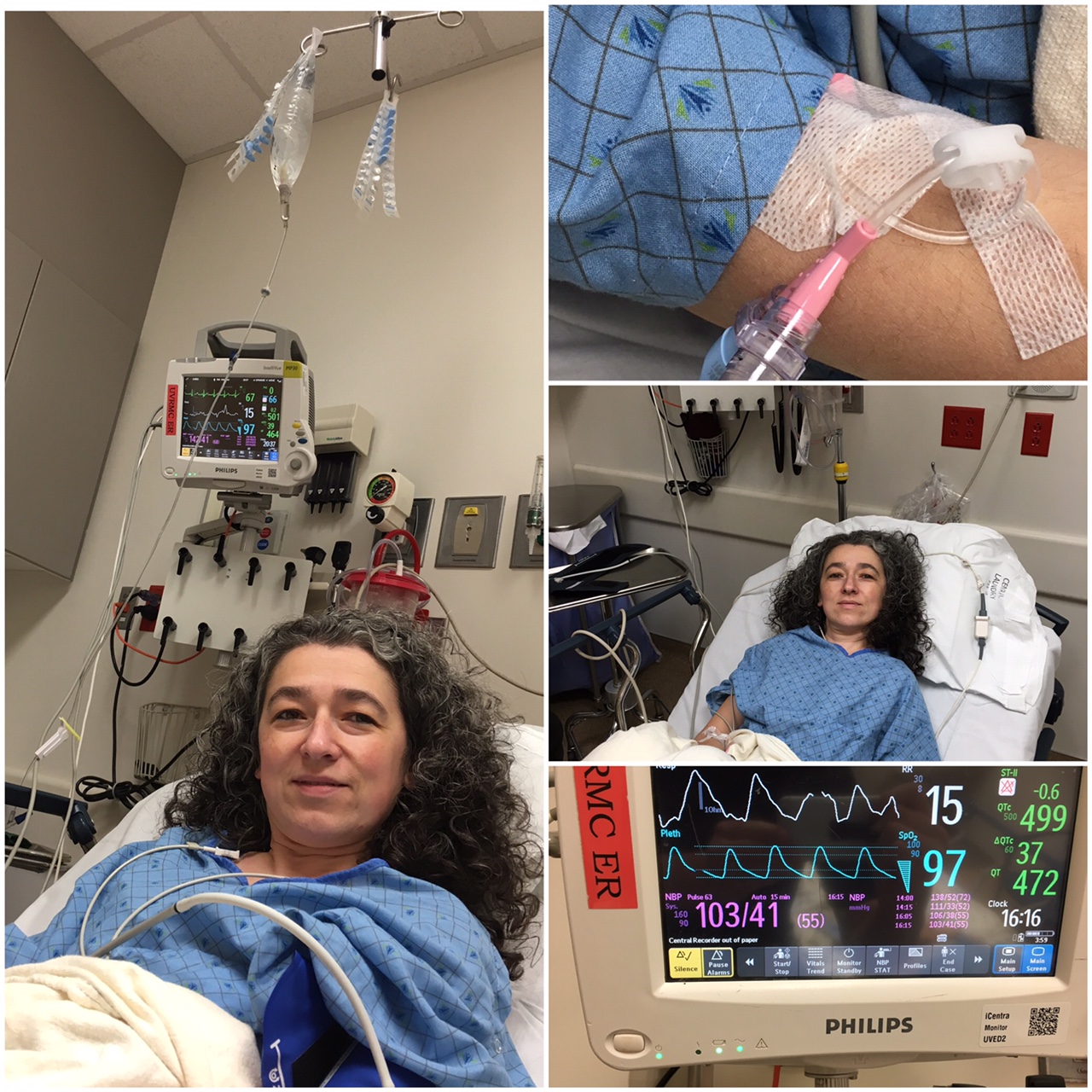
But my heart numbers were bad. My blood pressure was yo-yo-ing between 89/40 and 140/50. If I stood up, I could not find my feet, I had to hold on to something to be stable, and my blood pressure was lowest. I didn't know what it meant then and the ER doctor didn't look concerned, but this number on the heart machine (the QTc number) was 520 almost the entire time I was there, and the machine was beeping the whole time, flashing “QTc too high”. I found out after ER that the normal QTc (or QT Interval) in women should not be higher than 450, and 470 is borderline high. Well, mine was 520. For a definition of what this number shows, visit this site: https://en.wikipedia.org/wiki/QT_interval

The ER doctor said the number I see on the machine is not accurate, and the number on the EKG is more accurate. Well, that number for the QTc was 485, so still high. As I said, he did not seem concerned. He said I didn't have a stroke, nor a heart attack and whatever it was, to follow up with my cardiologist for further investigation.

When the QT interval is too high, I found, the symptoms are exactly what I felt, and it means your heart is severely arrhythmic. I also have arrhythmia, but I thought this was controlled by my beta-blocker, which I have taken for more than 20 years now. I guess this time my arrhythmia was more pronounced than others?!

The ER staff was great and I was grateful that they did eliminate the more severe diagnoses, but I was a little bummed they still did not give me a reason for my symptoms.

After waiting for the results of all the tests for about 6-7 hours, and having confirmed that it's all clear of a “major” accident, they decided to give me a liter of fluids, to see if that will make my blood pressure rise. I was also very hungry, by that time, but with the kitchen closed (at 9 PM) they just gave me a bag of chips (salt rises blood pressure too) to eat. My blood pressure started creeping slowly up, after the fluids were all in. When I finally took a walk around the ward, I felt much better. Still a little groggy, but I could walk without holding on to the walls.

They sent me home, and this has not happened since (48 hours now after the first symptom on Friday). I did work (lightly) in the garden for 10-15 minutes yesterday and I started getting dizzy, again, but my usual dizzy, nothing like the syncope-like feeling I had on Friday.

The next step is to follow up with my cardiologist who will have all the tests they did and see what could have caused this. So far, I am just trying to take it as easy as I can (I still have to go to work), and trying to stay overly hydrated, since the one liter of water seemed to do the trick of lifting up my blood pressure. I normally do drink a lot of water, so I am not sure if dehydration was the cause for this.

Every new day is not like another one past, still. Anything can happen, I guess, and this tells me that even after 5 months I am still not “in the clear”. It also tells me that my heart is still very fragile, and that I may never feel like I will ever be truly “ in the clear”. I know they didn't say for sure that my heart caused all this, but I have a good feeling that it was my heart. My blood pressure and the QT interval numbers, along with the chest pressure I had all tell me it's my heart. And by now, I know.

I don't know what caused my heart to go into such a shock, so suddenly, with no change in routine, diet, medication, or any other external factors. I'll update more when I see my cardiologist and hopefully he'll have some answers for me.

Good health to all, and as little surprises as possible. 

 In the ER - notice the blood pressure is 103/41 and my QTc is 499. Not sure why I was smiling, as I was pretty scared ... 

Sunday, May 22, 2016

First Week Back at Work and Meeting the Vascular Surgeon

I made it!! I cannot believe I made it in one piece, but I did - I lived through my first week back at work, after being away for 3 months to recover for open heart surgery. 

My cardiologist wrote me a note, to not work more than 4 hours a day for the first 1-2 months. Well, I am not one person to watch the clock, really. So, this first week, I did anywhere between 4 hours a day to as much as 7 hours a day. It turns out, HR doesn't know how to manage a part time schedule for a full time employee, so ... I'll try to stay closer to a full time day of work if I can. However, I am incredibly lucky to be able to work from home some, too, and this way I can  cut my commute a little during this time of adjustment. 

First week was much as any other week in the recent past: good days and bad. Some days, I could pull through with not much thought about it, and some days, I felt like I got hit by that truck again. One of the days, I lost my peripheral vision for some time (hours), but it came back. That same day my blood pressure was yo-yo-ing all over the place: from 95/40 to 155/50 in the same hour, and all at rest. The pulse was high, too ... No idea why, other than being tired. 

It's been hard to maneuver my "luggage" for work - I have a dolly that carries my bags but putting it in the car and taking it out is working my every muscle, and my chest, most of all, and it's making everything pop and painful. Driving has been a challenge, too, just the sheer tenseness of it, and the tiredness that comes with the adrenaline pumping with every cowboy passing me at 100 mph.

Mentally, I think this is been a good change of pace. I can feel I am useful to some people, again, and not totally reliant on everyone around me. I am taking it easily, though - walking slower, using my handicap sticker to park closer to the building, and taking naps every day once I get home. I do try to leave the house and my office after rush hours are passed, to avoid the stress from driving 30+ minutes on an open highway. 

This week I have also met with a vascular surgeon for the first time ever. I have always known I have carotid stenosis, of various degrees. But I have never had this evaluated by a vascular surgeon. Given the dire state my aorta was in once they opened my up for heart surgery, I wanted to make sure that a similar operation is not needed for my carotids, given the history of multiple strokes in my family. He did an ultrasound right then and there, and he also did a doppler for the circulation in my legs. He qualified my carotid stenosis as a 50% overall, which does not require intervention (surgery or stents) at this time. Those will be options we'll discuss if the percentage goes anywhere around 75. However, he was hopeful that now with Praluent, I will be able to stop the progression of the plaque and I won't need surgery/ stents for a very long time. For now, just keeping an eye on it (with repeat ultrasounds) every year will suffice. My leg blood flow is also good, he said. 

I take all the good news I can get right now. 

I'll have to say, moving about, although with big pauses, slowly and still relying on others for carrying weights, makes me feel almost normal again. I am excited to plan our summer with my husband and get out of house a little. Despite all the "crunchiness" still in my chest, my heart numbers all over the map, my INR still up and down, my numbness in half of my body almost, I am lucky and grateful I am here and somewhat mobile. Looking forward to slipping little by little into a new life, closer to what I had before. I am aware that exactly what I had before is no longer possible. That life is long lost in my rear-view mirror. But the road looks wide open ahead. I'll tread gently. 

Hope everyone is healthy and having a good spring so far. 

My dolly loaded with my work bag and lunch bag


Thursday, March 17, 2016

Not a Bicuspid Valve, After All

So, here’s the story: about 6 years ago I lived in North Carolina. I had seen this cardiologist for about 10 years at that point and I absolutely worshiped him. He took good care of me, and, to my knowledge, he took good care of my heart. He did all the right tests, kept me on the right meds, sent me to a doctor in pharmacy to manage my nutrition and drug regimen, the works. 
But he never ever said once (after doing an echo of my heart almost every year) that I had a bicuspid aortic valve (which should be there since you were born). 

About 6 years ago, I moved to Utah. I had to get a new cardiologist. About the second year I saw him, he said for sure I have a bicuspid aortic valve that is shrinking and at some point I’d need surgery. I started doubting my long time worshiped North Carolina cardiologist, because how in the world did he ever not see my congenitally modified and bad valve?! He did tell me about the heart murmur, and bruits in my carotid arteries, but never about this anomaly of my valve. Why?! How could he miss it for 10 years?! He went to Harvard, for crying out loud?! 

In the past 6 years, my so called bicuspid aortic valve continued to get bad, until this year, when you know what happened (http://livingwithfh.blogspot.com/2015/12/and-now-we-wait.html). 
Fast forward a few months later, till yesterday when I met with my heart surgeon, after a month from surgery. 

My pushy and annoying curiosity kept asking the surgeon very specific questions about my surgery - just tactical, specific ones. So, he finally printed my entire operative report and gave it to me, to easily answer my morbid curiosity. 

And to my huge surprise, it’s written quite clearly all over it that what the surgeon replaced inside my heart was a “tricuspid aortic valve with two leaflets joined together with severe calcification”. He writes there how only one leaflet was working, and the other two were glued together and immobile. 

So many things and questions came through my head:
First off, my North Carolina doc was not wrong - probably, at that time, my valve was visible as a tricuspid valve (which is normal), so no reason to alert me of anything
Then, how can so many echos done here in Utah, for 5 years now been wrong? They did MRIs and CT scans and even an angiogram. Not ONE of them could show the difference between a bicuspid valve and a atherosclerotic tricuspid one? 
How can these very advanced tests that we trust so much not be able to tell the difference? 
Well they didn’t. 

Sure, the final outcome was good - we got the valve repaired (regardless of the reason of how we got there), along with everything else, but the final diagnosis was just: CAD caused by FH. All the damage, whether in my valve, my aorta, or three of the coronary arteries were all caused by what I knew since I was 6 that it’s killing me slowly: cholesterol.  

You know, almost 35 years after being diagnosed with FH, there is not one year without surprises in this disease. Either good ones, or bad - they’re all there. You’re always on your toes and always learning something new about your body. 


Monday, January 25, 2016

Pre-Angiogram Appointment

There is a continuous series of appointments that would precede my upcoming open heart surgery, and this is pretty much what I have been busy with lately. Today, I had an appointment with my cardiologist to follow up on some of these tests and order yet more, before my upcoming angiogram this Friday.

About a week ago, I had an ultrasound of my carotids done. Because of my FH, I have developed plaque buildup in several arteries and veins of my body and one of the more significant areas is my carotid. They've done this ultrasound about every two years for many years now.

Right now, it seems that I am at about 70% blockage on my common right carotid, and almost a complete blockage on my right external carotid. I am told that we have one common carotid going from our chest towards our brain, on either side of our head (those are the 2 common carotids). Then, they each split into the external carotid (goes to your face) and the internal carotid (goes to your brain).

Although my blockages are not affecting my internal carotids at this time, my cardiologist is still concerned about the size of the blockages and he doesn't want to "walk into open heart surgery before a vascular surgeon looks at this" (in his words). So, he will meet with the vascular surgeon and he will call me with what he recommends. He said he "needs to get this resolved before we proceed with surgery". Any blockage, especially around a vital organ like the brain can be dangerous with the surgery and the coumadin treatment coming up, he said. Especially if we do go with the ON-X valve and I'll require coumadin for a lifetime.

After this, he and I went over all my questions I was mentioning about (http://livingwithfh.blogspot.com/2016/01/the-long-list-of-questions.html) a while back. He answered most of them, and some of them I am leaving for the surgeon. 

He, then, listened to my heart again (routine) and I told him about my cough that would not go away. He sent me to get a chest X-ray today, so I did that, as well as he sent me to get blood drawn in preparation for the Friday angiogram. 

And that was that. 

He did throw a kink in the road, when he mentioned another surgeon's name rather than the one he's been recommending for a month now. We 'argued' a bit back and forth, I told him lots of people said the first surgeon he picked is the best one, and I have gotten comfortable with the thought of the first one. And he gave in and said "Ok, we'll keep the first one, they're both equal in skills". Not 100% sure what changed his mind, but of course now I am paranoid that I picked the wrong one. We'll see after we actually meet with the first one, which should be either this Friday, while I am in the hospital for my test, or shortly after this week. I suppose I can change my mind and go to the other one if the first meet-and-greet with the first surgeon is a total flop. 

That's about all for today. The test and appointment chain continue.

He was also a bit confused about the day of my angiogram, because he originally scheduled it for February. I called his scheduling nurse and she moved it up for me (she said she could and he's free) to January, but somehow, he didn't get that memo. He called the hospital himself and straightened his schedule up, and we're good for Friday. 

Anyway, the reason I bring this up is that literally anything can happen. Schedules can change. Referrals can change, tests can be ordered last minute. I think the important lesson here is that you must be flexible. All in all, these people are paid to make your life better and keep you comfortable. It's kinda easy to forget this when they make simple mistakes like these. But I try to be flexible and a little less harsh on them. It's not easy for my over-perfectionist self, but I try. It can't be good for my heart to stress over every detail, I guess... Like I said: it's not easy to let go ... 


Tuesday, January 5, 2016

More Tests

Today, we met with my cardiologist. Since my pending open heart surgery, my husband came with me as well. It was great comfort to me to see that he likes and trusts my cardiologist. Just feels good to have that extra confirmation that my confidence is not wrongly placed, too. 

The doctor was amazing. He took over an hour and half of time (an eternity in today's medical world!) to answer all my questions, fears, insecurities, paranoia, and to share the pictures of my echocardiogram and dissect them with me, bit by bit. 

In his early estimation, it looks like he would vote for a mechanical valve to replace my stenotic aortic valve, instead of a tissue one - just because I do not want to repeat the surgery. His vote would be for this very new (only approved since last year) type of valve called an "On-X aortic valve" (read about it here) which does not require that much coumadin (a blood thinner and anticoagulant) for the rest of my life, which is definitely a plus. The decision is not final, yet - that will come later, after speaking with the surgeon who will actually perform the surgery and after seeing the results of more tests. 

Based on my long FH history and on my previous tests that showed any amount of atherosclerosis in my veins from 50 to 80%, including in my heart, the cardiologist wants to get some new results on my carotids and my heart. So, I am scheduled for a carotid ultrasound and an angiogram to check out the level of atherosclerotic damage I have so far. This will be important especially for the heart findings: if a bypass or a stent needs to be considered for my heart, this could be done at the same time as replacing the valve. This will complicate the surgery, but it would make more sense to do it all in one trauma than wait. 

So, the next steps are really just more tests, more cardiologist appointments and more waiting, for a couple of months or so. I am fine with this, knowing that it's not an emergency procedure we're addressing here (yet) and I have the luxury of a couple of months to prep for it, both mentally, and work-wise, family-wise, etc. 

It's January now, and we're shooting for a March surgery, potentially, if the surgeon we pick is available at that time. 

In the meantime, I am trying to figure out if my mother will travel all the way from Romania to be here, with me, during my recovery time. I'd rather her not, since she has heart issues, too, and I am afraid of what all this emotion will do to her, but she insists. So, logistics, you can say. 

Health to all, in the meantime! 


Friday, December 6, 2013

Of Ulcers, Stenoses and Cool Apps


I have talked about the annoying pain I have had all year under my right rib. The investigations they’ve done so far to find out what causes it were an abdomen CT scan and an H. Pylori blood test. The first one is an annoying hour being stuck in a metal tube that shakes like an everlasting earthquake (God only knows how closer to cancer I am now – I have had 3 such scans done so far this year for various things!!), the second one is self explanatory – just draw blood, send to lab and wait.

The CT scan looked for something to be wrong with any internal organs, but especially the liver and the gallbladder. They both turned out peachy. The blood test came back … positive and then some. The normal range stops at 1. Mine came back an 8. As always, in blood levels of badness, an overachiever. This site will explain what the infection with this bacteria does, how you get it and how it can damage your stomach.

So, I took two kinds of antibiotic for 10 days and hoped the bacteria was killed. Not sure if this is standard or not, but in the state I live now (which is very removed from anything “standard”) they won’t repeat the blood test to make sure the bacteria is killed. I had my new current doctor tell me that “the bacteria is probably still there”. Thing is, you don’t know if you have this, unless it’s bad enough that it made ulcers in your stomach which will start hurting – which they figured is where my right under rib pain comes from.

So, after the antibiotic, switching doctors and two more extra months, they scheduled me for an endoscopy , today. I have done this once before, and I dreaded it, because the general anesthesia made me incredibly loopy for 3 days and gave me tons of nausea. But I went ahead with it, because on top of the stomach damaging bacteria, I also have a long history of GERD with esophagitis , presumably from the years and years of medication and especially aspirin which I have taken for FH.

So, I wanted to know if there is even more damage to my stomach now, in addition to my esophagus, and that’s where the pain comes from.

Well, it was not an ulcer, after all, or at least not yet. They took a piece of the stomach lining and sent it to have a biopsy on it, so that they will find out if there is any damage yet, that might not be seen on the pictures the camera inserted in my throat today took.

So, the good news is: no ulcer. The bad news is: they don’t know, for certain, what causes my pain. But … if it is just my esophagitis, then (and this is more bad news) … I must take my acid reducing  pills religiously every day. Forever. The really good news, though, is that unlike the first time when I did this test, this time, the recovery has been pretty smooth. No nausea at all, and outside of some sleepiness, nothing really bothers me. I have eaten normal food, and I am now writing this blog – so, this is good stuff.

No more tests scheduled yet, to see if the pain might be from elsewhere other than my inflammation,  but both the GI doctor who did the test today and my general doctor suggested looking more into the gallbladder, with more topical tests (ultrasound vs CT scan). But nothing scheduled further, for now.

But the verdict today is: more meds, in the form of prilosec, or anything like it, that cuts the production of acid in my stomach, so that my esophagus can heal and not hurt so much. Of course, I sigh. One more thing to add to the cocktail.

And as I have said before: I would not mind this disease so much, if it stuck to its cholesterol values and its blood vessels. When the side effects from drugs and other symptoms spill into other organs, it kind of … makes my day. Not.

Another thing I realize now I forgot to mention so far this year is this new cool site/ app that I have signed up for that allows me to look into all of the test results and investigation that I have done over the years that I have seen the doctors in the state I live now. Pretty handy. Well, only, I am so flabbergasted at how much “stuff” doctors just don’t tell you … Maybe most patients just rely on doctors to tell them the bare minimum and trust that, but I am one of those people that wants to know details, and chemistry, and anatomy and whys and hows and  all the gory details. I think it helps me understand my body better and it helps me make better decisions. So, reading through the tests on my own, I found tons of new things, tests that show something is wrong somewhere else in my body that I didn’t know about (like a bone spur in my spine …). So, one word of advice, in the words of my mother: don’t leave the office without your own results and transcripts in hand, if you want to know it all and not just have of it.

One important such test is that I have a complete stenosis into the carotid artery that irrigates the front of my face (I forget which side, but I think it’s the right side). My new doctor is shocked (not new to me) that at 36 (which is when this test was done, 2 years ago) I had such an advanced atherosclerosis in one pretty large and major artery. He said there are no symptoms yet, because the front of our faces is extremely well supplied with blood by many, many other smaller vessels, but it’s still something to watch.

Of course, with the history of strokes in my family, this is pretty serious to me.

But at least, for now, no ulcer to explain my abdominal pain. And on that initial note: I am asking my husband to get tested for the H. Pylori bacteria, too, because – just a word of caution there: it is transferable from human to human. If you read the wiki article you’ll see it can wreak havoc on your stomach and other digestive tract pieces.


Sunday, September 23, 2012

Numbers. Tests. Plans


It’s been an understated while since I came by, but I am finally here! It’s been a busy year and a busy summer, or so it feels – although, if you want me to give you the laundry list of what we did, I feel like it’s a pretty short one!
 
We ate up two weeks of vacation by going to Romania in the spring, so we had little to no time off left. Thus, we tried to stay close to home and enjoy what’s here, at hand.

I am not sure whether it’s the fresh veggies diet of the summer again, or the fresh, ripe tomatoes, or the increased amount of kale we have been eating – your guess is as good as mine, but my new numbers are amazing. My total cholesterol is at an all time low – 244! I could hardly believe my doctor in August, when she announced that to me, with a raised eyebrow, and a chuckle: “I hope this is yours!” – she said. Indeed, I hope so too. The LDL is 199 – still high, but low for me, of course. The HDL is very low, not a good thing – at 35. The triglycerides are normal again , and that also shows that my diet might have something to do with it all. There was no change in the medication. All the same stuff: Lipitor, zetia, fish oil, atenolol and aspirin. There was a major hike in the stress level, too - more about it in a sec.

It was time for a repeat carotid CT scan – something they do every 2 years, just to make sure my plaque is not “bad enough” where they must do something about it – a stint, balloon, or some other type of surgery, that is. This year, instead of the regular ultrasound of my carotids, they did a full blown CT Scan. My insurance didn’t like this so much, so now, I have a $700 “this is not a bill but it’s the patient’s responsibility” on my desk! I am waiting to see if they really are not paying this. If I have a heart attack, we now know that cholesterol won’t be the reason.

The scan was a bit more “invasive” than the usual ultrasound. Instead of just the goopy gel smeared on your neck, you had to undress from the waist up, get an IV, get some saline (which makes you cold) and then some contrast dye (which makes you hot and feel like you peed on yourself), lay on a table and be pushed in the “turbo tunnel” for the scan to happen. It was not that bad, with the exception of the dye which did make me check my pants just to make sure I didn’t have an accident, and which flushed my face for most of the rest of the day. And of course, without the exception that … I hate IV’s – especially the unannounced ones.

They did an ultrasound of the arteries and veins in my legs, as well, because lately I have had a long, deep pain in my legs. My veins look swollen almost all the time, and with a history of varicose veins, and with a couple of hour commute each day and with a sit down job, I was fearing something might be happening down there. The result for the legs came back as “normal”. The carotid scan showed that the plaque is worse than last time (two years ago), but “the doctor will talk to me about her recommendations of what to do next on my next appointment”. That is in … February. So, it must not be that bad!

Other than the fact that I have noticed my BP higher than normal and more often so, I feel OK. I have been promoted twice at work this year, and life at the office is more and more hectic. More responsibility, more people to be responsible for, bigger “fish to fry”, so to speak, all give me no time for much else, including being actively involved in my physical and mental health!I have not even had a cardio appointment this year. And I put off my regular doctor's appointment for months, till I finally got to it last month!

We have not been camping or even hiking this year. We went for a hike once this year, and fall is here now, so that will be it. I am trying to make the right choices, as always, in what I eat, but we have been eating out and have eaten “quick foods” more than usual lately, too – because there is no time for cooking! I am not proud of that, of course, and I will try to fit some kind of plan in my new, busy life – it requires a complete restructuring of my time in my new “manager” life. But it will happen. It will have to, if I want to live some more.

I have gardened a lot all summer, and that has been the most actively full part of my life. We have had a dry-dry-dry season! I had to water my veggies and flowers virtually every night. Here, in the desert, the water just gets sucked away the minute you sprinkle it! There is no shade! Just scorching sun for 12 hours a day, or more! I am looking for ways to preserve kale and cabbage for the winter, as both have generously produced this summer, and I would rather use every green, beautiful leaf they have given me. We also built a patio and several flower beds loaded with bushes and mulch, all around the house – those were all a labor of love. We were sore for weeks. More proof that I am so out of shape. So, we have not quite been couch potatoes, but we could have done more.

I keep saying “we”, because my husband needs the exercise and the healthy eating too for almost the same reasons as me. I must say that the low numbers do boost my spirit. I think they are a great victory, but I do wonder where they came from, so I can keep doing it.

I am making some grape preserves this week, and freezing up the first batch of tomatoes, too. I already made several batches of basil, cilantro and Italian parsley pesto, too. The herbs were wild this year!

It’s fall now. The air is cooler, and the days are shorter. It not high time to plan to get active, as you can imagine, but some changes will have to happen.  I will have to use the treadmill more, now that the garden is slowing down. We had a good rain today, for the first time in a long, long time. We have rain in the forecast for a couple more days. So, my summer activities are slowly disappearing. 

I am looking forward to new opportunities, and new numbers, in the fall, winter and beyond. I hope I can keep them down, and I hope I can come by here more often. All these plans! Here’s to the burning desire of wanting to keep them!  I do hope, with all my heart, that I can materialize it. And I hope I can find time to see my cardiologist, too, for that buggy BP!