Showing posts with label aortic stenosis. Show all posts

Thursday, October 26, 2023

Abdominal Stenosis

As I mentioned in my previous post (https://livingwithfh.blogspot.com/2023/09/old-test-new-reaction.html), my cardiologist and the vascular surgeon ordered a CT scan with contrast of my abdominal aorta. This test was done in 2021 and it showed several areas of atherosclerosis of basically every branch of my abdominal aorta. 


Now, two years later, it shows the same areas of problems - some of the areas look stable (yay!), and some are slightly worse, or show new developments. For example, I have developed “collaterals”, which means additional (new) branches of the abdominal aorta that naturally grew to bypass the areas that are stenotic. So, the fact that the collaterals are there at all, to help with the proper irrigation of the gut area, is good, but the fact that they had to form at all says the original branches don’t provide proper circulation to the abdomen. 


In addition to the stenoses caused by the calcified plaque, because this is me, and I am not easy,  I also have a congenital defect of my celiac abdominal aorta called “median arcuate ligament compression“ (or MAL compression) which is rare condition in which the median arcuate ligament compresses the celiac artery which impairs blood flow to the liver, stomach and other organs. The median arcuate ligament  is the muscle and fibrous structure that wraps around the aorta at the diaphragmatic opening. So, this compression in addition to the atherosclerotic celiac artery causes a reduced flow to my abdomen. 


Here are the test results of the two scans, over the past two years: 


The December 2021 abdominal CT scan results show the following: 


  • Small caliber abdominal aorta with extensive soft and calcified plaque

  • Narrowing of the infrarenal abdominal aorta

  • Two areas of moderate to severe stenosis in the proximal celiac artery and atherosclerotic plaque at the ostium and compression from the median arcuate ligament (MAL) with mild poststenotic dilatation. 

  • Mild stenosis at the origin of the small mesenteric artery. 


The September 2023 abdominal CT scan results show the following:


  • Stable: Severe calcified and noncalcified atherosclerosis of the entire abdominal aorta which is overall small in caliber, unchanged.

  • Stable: There is mild to moderate relative narrowing of the infrarenal abdominal aorta at the inferior mesenteric artery, also unchanged.

  • Slightly worse: Severe stenosis and angulation of the proximal celiac artery likely owing to a combination of atherosclerotic plaque and the median arcuate ligament (MAL) compression. (previously: “moderate to severe”)

  • Slightly worse: Persistent moderate stenosis of the proximal superior mesenteric artery (previously: “mild”)


New (good and bad): 


  • The presence of arterial collaterals between the celiac-superior mesenteric artery and to a lesser extent the superior - inferior mesenteric arteries territories suggest the presence of long-standing, hemodynamically significant stenosis in at least one of these vascular territories. 


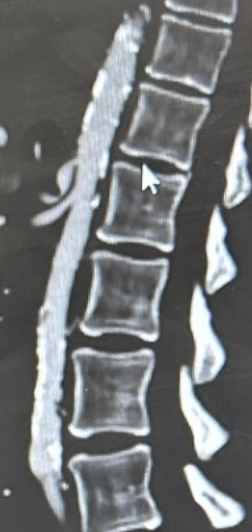
In this scan, the white part to the left of my spine is the calcified aorta. The smaller vessels springing from it are my celiac (the one in the shape of a backwards L which shows the MAL compression) and the mesenteric arteries


Although the tests seem virtually unchanged, I have new symptoms that could be related to the various stenoses in my abdominal aorta. Some of these symptoms are a fairly consistent upper-abdominal pain, which is worse after I eat; the feeling of being “full” even when I first wake up in the morning and I have an empty stomach; occasional nausea with even mild exercise, softer and more often stools. 


When I went in to the vascular surgeon this past week to review these results, the surgeon got called into emergency surgery and was not able to make our appointment. I spoke, instead, to one of the PAs (not his own PA, who I knew and who knew my case, but a new one), and having just seen me for the first time, he said that the new symptoms worry him and he will need to chat with the doctor and see what, if anything, needs to be done next. But he also said that in his opinion, the results are not much different than the ones from two years ago, so the symptoms might not be related to the stenoses. 


I also mentioned that I have been examined by a gastro-enterologist earlier this year, to ensure none of these new symptoms are GI related and they are not, according to those tests. He said he will follow up with them and then he and the vascular surgeon will follow up with a plan, if there is anything to be done differently. At the very least, he suggested that I’d move the scans to every 6 months rather than every year to keep a closer eye on the abdominal aorta. 


Because the risk of too much radiation during a year’s time is there, he suggested I’d alternate between an ultrasound and a CT scan, every 6 months. Although I dread all these different tests (I have another one for my carotid arteries and another one for my heart - both yearly), I know that keeping a close eye on these conditions is really the best way to catch some huge change in time, before having an event. If my annual heart echos taught me anything before I had my open-heart surgery, they taught me this. 


Friday, February 11, 2022

After 6 Years

It’s hard to believe that it’s been 6 years since my open-heart surgery. In some ways, that seems like a blink of an eye. A 6 year old would barely be even fit to start real school yet! But in the measurement of the time that open-heart surgeries recoveries are measured by, 6 years seems like a lifetime. 


February 11: 2016 (right before they rolled me into the OR) - 2022

I hated having such a huge surgery in February - my least favorite month. The month that, historically, has gotten people sick and killed among my loved  ones. A cruel, cold, dark (albeit short) month that’s not always been kind to me. But it had to be in February, because at the end of January, the month before, they found two arteries blocked in my heart (the LAD was at 99%, another one - an OM - was at 90%). The aortic valve was failing, in severe stenosis, and the aortic arch had an aneurysm. The cardiologist wanted the surgery done even sooner, if he could get me and the surgeon aligned on a date. 

I documented my surgery day, step by step, here: https://livingwithfh.blogspot.com/2016/02/open-heart-surgery-day-1-to-8.html.

And the day before the surgery (the “pre-op” day), here:

https://livingwithfh.blogspot.com/2016/02/the-day-before-open-heart-surgery.html

If you ever have time to read it all, you will see that what was said the day before, what they prepared me for, mostly came true, but there were a few surprises. When I came out of the surgery, everyone who came into my room, ICU nurses, several surgeons who assisted me during the actual surgery (12+ hours), all the three PAs, breathing and physical therapists, and even my rock, my husband - all of them reminded me that I “had just been hit by a Mack truck.” You cannot possibly be very well hit by a Mack truck and expect every single thing to go “according to plan”. You cannot be hit by a Mack truck and plan for it, step by step, then hold God and the world accountable for every one of those steps. You are bound to be surprised, and thrown off the rails, and, oh, yeah, even shocked. 

The day of the surgery was a pretty peaceful day for me, consciously. Yes, my body went through hell; yes, it got killed, drained from all the blood, frozen for more than half an hour, and was brought back to life. But, mercifully, I don’t remember any of it. Sometimes I hear about people remembering bright lights and seeing their lives flash before their eyes, or floating above their bodies in the OR, but I experienced none of this. 

As peaceful as that day was, the days in the hospital that followed were intense! Just full of emotions, but more than anything full of new sensations, of discovering new parts of my body I didn’t know I had or parts that I didn’t know could hurt - my skin hurt. I could not wear ribbed tees or feel the creases in my hospital bed sheet because my skin felt like it was completely burnt ... The two days after the surgery, it took all I had to just stand up, held up by the nurses, beside my bed. Forget walking and balancing on my own. That didn’t come till it was almost time to go home, more than a week later ... I don’t think I ever walked during the hospital stay without holding on to the back of a wheel chair. And the breathing! Oh, my word! I could not breathe! I could not speak, I’d whisper. They wanted me to blow into this plastic tube and felt like that was my last breath, there it went into that stupid tube. At the end of that effort they’d all look disappointed because I never could blow strong enough for them! It was horrible. My lungs took such a beating! Even after three months of recovery, when I went back to work finally, my coworkers were saying that they could never believe I could speak so quietly. I don’t have a big voice to begin with but after the surgery, it was nothing but a whisper. 

Once I got home, the life “after OHS”, the life on my own, without hospital care and around-the-clock medical staff explaining every new symptom, started. I was terrified! Again, I had to relearn my body! I had to learn how to sleep again because no position felt comfortable. No bed or chair. I had to learn how to cough and laugh and sneeze again so as not to let my chest come loose ... I had to build an appetite again although nothing sounded good. I had lost 10% of my body weight in that surgery and I didn’t have that much to lose to begin with: I was 95 lbs at my lightest. 

I went through ER scares when I became too dizzy and light-headed, or when I cut my finger chopping veggies and was scared that the Coumadin might make me bleed forever ... I went through years (not even sure that’s even over yet!) of being scared that my INR will be too high (I’ll bleed to death) or too low (my mechanical valve would clot and I’d die of an embolism or something). Although I manage it better than ever before now, it is still a challenge to keep it tightly in my range, especially when seasons change or when I travel and add unusual, unfamiliar stress to my daily life. 

I went to physical therapy twice, first to build strength in my upper body, right after surgery, and almost two years later to build stamina to be able to walk for a mile at a time without my chest hurting too much and without feeling like I was going to faint from light-headedness. 

I stopped traveling the year of the surgery because I was afraid of getting an infection on airplanes. That was when my immunity was still fighting to heal my heart. I stopped traveling again for the past two years because being a cardiac patient with very high cholesterol for the rest of my life puts me in the “high risk” group for people who might get more severe or possibly lethal Covid. 

I do get out some and I meet with friends and even saw family across the country and in Canada last year. But I limit who I see and if I can’t meet people mostly outside I put it off for later. I am still nervous to fly. Maybe this coming summer ... We’ll see ... 

As much as I hate putting my life on hold, going through that surgery to rebuild my heart, with all its complexities, and then going through years of recovery to function somewhat normally again and being rewarded with a good life, all things considered, seems like the most precious gift. I don’t want to throw myself willingly at risks that are not absolutely necessary for survival, to endanger this beautiful gift. So, I’d rather wait out the pandemic, or not expose myself to other sources of more sickness or things that could damage my heart (or valve) again. In the whole scheme of things, it’s a small sacrifice.

I’ll have to say this though: my journey has been more lucky, more blessed than I have ever hoped for. So much more blessed than others’ paths - although there is no comparing journeys here. Everyone’s path is different and everyone feels pain and blessings at different temperatures. However, I can say, I am lucky to not have had too many complications in these past 6 years of renewed life. 

I wish I can tell you that the minute you walk out of that hospital after your heart surgery you’ll never look back and you’ll be as good as new with not a worry in the world about your health. But I’d be lying.  You will never be the same person you were before. In some ways you’ll be worse and in some ways you’ll be better. In some other ways, you’ll be much, much better. In almost all the ways, you’ll just be different. A different “you” that you’ll need to get reacquainted with. You’ll maybe be more hopeful, more appreciative of your health, with more respect for what your body can do and for its ability to miraculously heal, even after being hit by that Mack truck! 

I can tell you, though, this, for myself: I have zero regrets for anything related to this surgery. There has been no question in my mind that I needed this surgery. This was not elective: this was a surgery to save my life. My aortic valve had only a 0.49 cm opening, it was almost closed. My arteries were stenotic. My chest pain was constant. My ability to walk and exercise was very much reduced. I am very grateful that for my condition there was a course of action. There are so many afflictions out there that have no cure. So many diseases that come with a stopwatch that is set to expire in months, some in weeks or days. This was not the case with my heart disease: there was something they could do. I am grateful for that. 

I am also grateful for my team of doctors in Provo, Utah, at the Utah Valley Regional Medical Center. My cardiologist and my surgeon are my heroes, my true soldiers who fought as hard as me to get me back to “normal”. But the other members of the team, the PAs, the other surgeons, the medical staff, the technicians, and then the cardiologist I have had in North Carolina, after I moved, not to mention my family, my husband first and foremost (who tied my shoes and put on my socks after I got out of the hospital and when I could not bend over; who clipped my nails because the neuropathy in my hands could not work the clippers), my sister who is my biggest cheerleader - they all made me who I am today, when it comes to my heart and overall health. 

I have noticed that I can walk further and faster than ever before and that my stamina has improved little by little every year. I can now walk even in cold temperatures (30s-40s) or hot ones (80s) and can go longer than before. I walked a mile and a quarter last night in low-50s temperatures (with wind in my face that made it feel like the 40s) without even breaking a sweat. I used to be out of breath walking from my car to my office in 40F temperature before my surgery. Inclines are still a challenge to this day. I live in NC now and boy, there is not one street that’s not on some sort of a hill. Day to day, the progress you notice might be imperceptible, but when you look back at all these years, and compare what you could do then and what you can now, it’s pretty amazing ... 

A month ago my INR was 3.1 (too high since my range stops at 2.5). This past weekend it was 1.7 (within range but a little too close to my bottom of 1.5 for comfort). But I have learned how to live with this ever-swinging pendulum. I have bought a CoaguChek machine that measures your INR and I check it myself as many times a week as I want to just to know how to adjust my food accordingly. I usually check it once a week if no changes in diet, exercise, or stress level have occurred. I take it with me when I travel because it’s harder to plan for your food when you’re not home. This brings me a lot of peace of mind.

I have never, not once, regretted my choice of valve. It took sleepless days of reading just about everything there was to read on the internet about all the possible valve options that I had and when I found the On-X mechanical valve and learned about the benefits and came to peace about living on Coumadin (if you ever do!), I never looked back. I love knowing that at least if everything goes according to plan and I avoid infections and clots, my valve will outlive me and I won’t have to have my chest cracked open again. At least not for the valve, anyway. 

I got all sorts of other “work” done with my OHS: I had a quadruple by-pass, as well as endarterectomy of all the four arteries that they bypassed, and a new, grafted, ascending aorta. I also had an aneurism repair and additional endarterectomy of my aortic arch ... I get a yearly echo for my heart and both the current cardiologist and the surgeon read it and so far it all checks out, thank goodness. My ejection fraction is lower than before the surgery, but at 55% is still pretty good, considering. I still have high blood pressure, but we try to keep it under control with medication and exercise. The coronary artery damage that I might still have in my heart is believed to be in my very small vessels (which cannot be properly diagnosed with an echo; an angiogram is required for that and I am not due for a new one for another 3 years or so, barring any new symptoms, like acute chest pain, dizziness, collapse, etc). As long as I keep active, the belief is that I’ll help my body create new blood vessels that would build a natural bypass for any vessel that might clog in the future ... So far, every year I have been able to exercise more and more ... I am not a marathon runner, far from it, but my stamina has improved so much!

I look back on every anniversary and thank God, life, and the universe for the inspiration they all had to keep me in the light that fateful (in a good way!) day of February 11, 2016. Every day on this day, it’s my “other” birthday and I am grateful when I add another one to my heart age. I think my sister once said: “you are almost 47 in human years, but your heart is only 6.” That’s right! My heart, the engine of my body, is barely even old enough to go to school! Oh, the possibilities! 

Maybe having my Heart Day during Heart Month (February) was not a coincidence after all. I have made peace with that. 

Happy Heart Month to all the heart warriors out there! Embrace your body, embrace your heart and keep fighting the good fight. It’s always a good one when you keep that engine running! 

Much health to everyone! 

If you’d like to see my journey in pictures from my heart surgery day to today, you can do so here: https://wanderworldpics.shutterfly.com/22602

Friday, September 24, 2021

The Faces of My FH

 FH has many faces and many stories. I have homozygous FH (HoFH) which means that I inherited it from both my parents. As a matter of fact, both genes that came from them are the same exact gene, although my parents are not related, in any way, by blood.

My grandparents all came from huge families (think 10+ children). My parents have so many cousins they have not met all of them. This also means I have a lot of people on both sides of my family who have FH. And every one of them has a different story. A different story of their diagnosis, of their treatment, or lack thereof, of what the disease ultimately leads to. There are no two stories alike, and there are no two people that chose the same path in managing this disease (or not).

I see a lot of people with FH who are asking good questions about what to do when they are diagnosed; people who display all sorts of emotions, from sheer panic and depression to a nonchalance that I envy, in some ways, although I know that is not the proper course for a healthy and good-quality life when you have FH.

FH has been in my family’s life for generations – no one is shocked when they are diagnosed anymore. We’re all pretty much aware of what it is and what it can do to us: many of our aunts and uncles have suffered heart attacks, strokes, angioplasties, complications from diabetes and fat liver disease. Although we know all these things all too well, not all of us choose to receive treatment. More in the notes I drew below about my immediate family and their individual, unique stories.

My grandfather

Current age: deceased at age 65

Diagnosis age: as a young adult, after several of his older relatives and brothers and sisters were formally diagnosed with FH. At that time, they just spoke of “familial hypercholesterolemia” and did not dissociate between the HeFH and HoFH types. We believe he had heterozygous FH (HeFH).

Cholesterol levels: no one remembers for sure, but my parents think the total cholesterol stayed between 300-400 mg/dl.

Treatment: reduced fat diet; no drug treatment was available for cholesterol in Romania before 1990 when he died.

Complications: first stroke at 48, major stroke at 50 which left him paralyzed in one half of his body. He died at 65 after a massive stroke after having lived bed-ridden since he was 50 with the effects of the stroke and complications from diabetes. He also had coronary artery disease and high blood pressure.

My aunt

Current age: 71

Diagnosis age: as a young adult. At that time, they just spoke of “familial hypercholesterolemia” and did not dissociate between the HeFH and HoFH types. We believe she has HeFH.

Cholesterol levels: currently, the total cholesterol is between 200-300 mg/dl.

Treatment: no special diet, no treatment, by choice.

Complications: angioplasty (stent placement) in her thigh and upper-leg arteries in her 50’s; massive small-brain stroke at 67; high blood pressure, a-fibrillation, tachycardia.

My father

Current age: 69

Diagnosis age: in childhood, due to the fact that his father already knew about his diagnosis, my father was a sickly kid, and his mother (my grandmother) was a registered nurse who tested him for everything. At that time, they just spoke of “familial hypercholesterolemia” and did not dissociate between the HeFH and HoFH types. We believe he has HeFH.

Cholesterol levels: currently, his total cholesterol is 326 mg/dl.

Treatment: no special diet, no treatment, by choice.

Complications: several mini-strokes starting in his 40’s. High blood pressure in his 40’s. Diagnosed with coronary artery disease, peripheral atherosclerosis, peripheral neuropathy in his 50’s. His condition is further complicated by diabetes.

My mother

Current age: 68

Diagnosis age: 63. My mom’s cholesterol levels were in the upper 200’s all the way into her 50’s. She maintained that her cholesterol is not genetic, like my dad’s and it’s caused simply by bad eating habits. When she was 63, I had a genetic test that confirmed that I had Homozygous FH (HoFH). This was the clear indication that she, too, must also have FH. She suspects she inherited it from her father who died when she was 7. She had no further relationships with his surviving family, so the knowledge on her side of the family is very limited.

Cholesterol levels: currently, her total cholesterol is 313 mg/dl.

Treatment: no special diet, no treatment, by choice.

Complications: aortic valve stenosis, coronary artery disease, stroke at the age of 67. The cause for the stroke was unclear as she was also undergoing chemo treatment for lung cancer at the time. The doctor could not determine the cause of the stroke for sure – whether it was vascular or a complication of the chemo. She suspected it could be either one.  

Myself

Current age: 46

Diagnosis age: 8. My pediatrician felt an enlarged liver when I complained of pain in my upper abdomen. She sent me to get a complete liver and lipid profile, also knowing my family’s history of FH at the time. My mother found out the cholesterol level, as a hospital biochemist. At that time, they just spoke of “familial hypercholesterolemia” and did not dissociate between the HeFH and HoFH types.

At age 40, following a genetic test, I was diagnosed with HoFH.

Cholesterol levels: currently, my LDL is 107 mg/dl (the lowest it’s ever been). Before I started drug therapy at the age of 23, my LDL was 475 mg/dl. My total cholesterol was 526 mg/dl.

Treatment: no fat, vegan + fish diet, Lipitor, Zetia, Praluent, Nexletol.

Complications: diagnosed with tachycardia and arrythmia in my early 20’s; coronary and carotid artery disease at age 30; aortic valve stenosis at age 36. Open-heart surgery at age 40 to replace the aortic valve, ascending aorta, repair the aortic arch and repair and bypass four main coronary arteries.  

My sister

Current age: 43

Diagnosis age: 38. Although she knew her cholesterol was elevated, my sister did not get officially diagnosed and treated until this age. This was after my open-heart surgery which rang a bell of alarm for everyone in the family, I think.

Cholesterol levels: currently, her LDL is 108 mg/dl (total cholesterol is 201 mg/dl).

Treatment: low fat, white meat and fish diet, intense jogging (she is the runner in our family as she has been spared heart disease so far), Lipitor.  

Complications: no complications so far.   

My nephew

Current age: 10

Diagnosis age: 7.  

Cholesterol levels: last test showed an LDL of 170 mg/dl.

Treatment: all-inclusive diet, with less fried foods and lower fat, white meat.   

Complications: no complications so far.   

Whatever your story may be, what I believe firmly is this: it all starts with awareness: knowledge is power. You may choose not to do anything at all, but at least you know about the train that’ll be coming rather than one day be caught completely by surprise, way too late, when there might not be anything left to do or know anymore.


To honor the FH Awareness Day, these are the faces and stories of my FH family. What are yours? Do you know?!

Happy health, you all!


Saturday, April 3, 2021

Educating Doctors – A Visit to My Vascular “Specialist”

I find that for the most part, doctors are more and more knowledgeable and “educated” about Familial Hypercholesterolemia (FH). They seem to understand how it works, what to prescribe, what tests to perform, why keeping the cholesterol numbers down is important and what to expect the aftermath to be if they can’t keep those numbers low enough.

I am also pleasantly surprised when a doctor understands that age has nothing to do with this disease. I have lots of respect for doctors who understand that in cases of more severe FH (like the homozygous kind) you must be as aggressive as possible with what the medical world has to offer (drug therapy and interventions) as early in the life of the patient as possible to get ahead of the disease and ensure the patient does have a life ahead of them.

I love and have huge respect for doctors who have the courage to act before a so-called symptom kills you. Cardiovascular disease is one of the main complications from FH and with this disease a symptom can often be fatal. I have had the luck to work with doctors who had the courage to act before a symptom was too late for me … I am here today because of such doctors.

But then there is this other crowd of doctors who are not covered in the “for the most part” crowd. Doctors who are so disconnected from the patient in front of them and so stuck in the letter-of-the-book (not sure what else; I want to give them the benefit of the doubt that they have read a book and not just simply call them ignorant) that they got taught in probably an old medical school course book from 1970’s when the research was done all on a 60+ year old male population, or something. Such is my current (till now) vascular specialist.

A while back, my cardiologist decided to refer me to one of his colleagues (who happens to be a former resident of his) that specializes in vascular health to manage my vascular disease, while he can focus on my heart health and my cholesterol management. I didn’t oppose him because I felt like I did need better management of my else-where vascular disease that does not necessarily live in the heart and he already has his hands full with my heart and cholesterol. I have seen this new specialist three times. So far, he is vague at best when speaking about my disease and how he plans to “manage” it.

On my latest appointment last week, we had spent about 45 minutes talking about the various stenoses that I have in the abdominal arteries:

  • the main aortic trunk is more than 50% blocked (if I really do the math it is about 75% blocked based on what the normal lumen’s area is considered for me: the narrowest dimension of the aorta measures 0.6 x 0.4 cm when it’s supposed to be 1.2 x 1.2 cm); the transcript of the latest MRA notes “severe atherosclerosis of the abdominal aorta”;
  • there is significant stenosis at the origin of the celiac trunk of more than 75%;
  • there is mild proximal stenosis in the superior mesenteric of 50%;
  • there is mild stenosis at the ostium of the right renal artery (~50%).

The entire time we’re seeing each other, as he also has said in previous appointments, he says “you have lots of disease.” He acknowledges this, which is somewhat reassuring. But then there is the part where I say “what do we about this?” And he comes back with “nothing. We watch it.” He confesses that "they (meaning specialists like him) are not trained to manage stenosis, really, but only aneurysms," and I don't have an aneurysm yet. I am a little taken aback and nervous because it seems to me like waiting for an aneurysm to happen might be too late. I want to be ahead of this. His uncertainty about how to deal with my (what seems to me) advanced stenoses is not very comforting. 

He explains that his biggest worry is not the celiac, mesenteric, or renal arteries, but it is the aorta. I am “happy” to hear this because my heart surgeon who also saw these results agrees that that’s very tight. Now, I had an endarterectomy of my aortic arch when I had my open-heart surgery, and the ascending aorta was so severely diseased that they replaced it with a Bentall graft. Based on my history, I ask him if we don’t need to be more aggressive about addressing at least the aorta if nothing else. He says no, because “there is not as much action through the aorta in your abdomen as it is in your heart”. So, we wait, because the disease in your heart aorta does not compare with the one in the abdominal aorta, so the threshold should not compare either. I am circumspect, but …  

He also offers that even with a bigger blockage he will be reluctant to have me see a vascular surgeon because I am “too young to have this kind of intervention.” He continues that “we really need to wait for more symptoms before we act. If you stop eating because of pain and you lose weight, then we can think about intervention.”

At this point, I sorta lose it. For full disclosure, I do not seek surgeries for the sake of surgeries. But in the past surgeries seemed to be the only option to save my life. And these findings scare me more than another bypass or graft. All I keep thinking about is my surgeon describing the amount of disease in my ascending aorta that he had never seen before. I was 40 when I had my heart surgery.  So, I remind him that age has absolutely nothing to do with the amount of disease in my arteries. I remind him that I have FH. That I have Homozygous FH and for the first half of my life my cholesterol was 600 mg/dl! I also remind him that my cholesterol now, although normal by healthy people’s standards – finally, just in the past few months!) is by far not “normal” for someone with a history of FH, heart attack and cardiovascular disease. So the disease in my arteries will likely continue. I also remind him that I am aging which will make the arteries even more stiff. So, shouldn’t we be a little more mindful about my particular situation and forget about what some book says about when such a surgery would be appropriate?

He back-tracks a little and he nods “yeah, that’s all true, but we also have to consider the risks of surgery. You realize that they would have to sever that aorta and by pass it with another blood vessel?” And I just chuckle: “You obviously don’t remember or don’t understand what I had done to my heart five years ago, if you think this scares me.” I also tell him that I do not want to “wait till I can’t eat anymore and start losing weight”. That seems more than irresponsible to me.

And then we talk about blood pressure. Usually, this is something I manage with my cardiologist and he has been trying to stabilize it for over a year with no success. But after doing some reading on my own and after talking with my surgeon, there are indications that stenosis particularly in the renal arteries can cause hard-to-manage blood pressure. So, I run this by him. He says, and this is an exact quote: “Well, your vascular disease has nothing to do with your blood pressure. You have just a regular, garden-variety blood pressure which is probably OK.”

I am almost speechless, but I find my voice, just barely to ask him to explain this “garden-variety blood pressure” of which I have not heard before. And he says “well, just a blood pressure that normally comes with age. You and I are the same age, so we normally get a bit of an elevated blood pressure as we age. That’s all. Easily managed with drugs.”

I remind him that mine is not easily managed with drugs. I also say, defeated, but wanted to give him one last “education” if I could, if not for me, for those people who will likely and unfortunately come after me: “So, we just got done talking about my history of severe FH, heart disease, massive surgery for 99% blockages in all main branches of the heart, and a trashed aorta; we got done talking about my abdominal stenoses and how my aortic trunk is so tight that, in your words, ‘scares you’, and you don’t think any of these findings have absolutely anything to do with my blood pressure? You think what I have is a ‘garden-variety’ blood pressure?!”

He pauses as he realizes the corner he painted himself into and says: “Well, no. That’s probably true. Those are some good points. All the stenoses probably have something to do with it, yes. But let’s leave it to the cardiologist for now.” Which is all fine and dandy, but ... is he considering these points in outlining his plan or is he not? He seems to me like he is not sure ... 

I was shaking so badly, I didn’t feel like I had the strength to argue anymore. We said our good-byes, I made the next appointment and he agreed to move my “watching tests” to 6 months rather than space them out to a year.

I am reconsidering ever going back, truly. I didn’t feel for one second that he actually saw me. I never felt like he really understood the risk of FH, the status of the vascular disease I have or whether he had a plan for it all. It would feel irresponsible of me to place my life in his hands. So, I probably won’t. Not anymore.

I wrote this blog mostly to share that you will need to be alert to ensure you are indeed getting the best care. I am probably a little bit too far on the end of educating my doctors rather than looking at them as the absolute authority for truth when it comes to this disease, but that is mostly because I have spent my life in this body and I have lived with this disease, I have seen it act in people in my family – most of the time watching doctors shrugging and not knowing where to find the answers. If you have just been diagnosed, you probably don’t have this perspective, so what I can tell you is: stay alert. Read, inform yourself, and yes, educate your doctor if you need to. It’s all part of your care.

I also wrote this blog for those doctors, medical professionals, medical journal writers who have told me in the past that “no, doctors don’t speak like this!” when I would quote doctors with some off-the-cuff statement that would render me more lost than when I first came to their offices. And I am telling you – yes, they do speak like this. To be in front of a clearly demonstrated cardiac and cardiovascular patient and to diagnose them with “garden-variety blood pressure” takes guts. And some doctors obviously go there …

Monday, September 21, 2020

What Being Cholesterol and FH Aware Means to Me

Those of you who follow this blog should already know my story (http://livingwithfh.blogspot.com/2011/03/my-story.html). Just in case you don’t, here’s a short summary: 

My parents knew that my dad’s side of the family had FH long before I was born. Dad had it, and his father had it, as well as most of his uncles and aunts on his father’s side. When I was 8, my pediatrician recommended that my parents would check my cholesterol level as well, because my liver was enlarged. My LDL was 525 mg/dl and my total cholesterol was 734 mg/dl. 

My mom fainted when she found these numbers, as she was the lab tech that actually read them for the first time. They didn’t have much hope that I would survive my teens. No one had ever seen such levels in a small child in 1983 Romania and with no medication or procedures on the market, they had little hope that I’d make it very long. Even in Communist Romania, with virtually no access to cholesterol-lowering drugs, they did know one important thing about FH: that it leads to premature heart disease or strokes at an early age. My grandfather had his first stroke at 48 and then, two years later, another massive one which left him bedridden. Even at my fragile age of 8, I had grown up to see my grandfather decay fast and I understood so much. 

My parents kept giving him as an example to me, of what will, for sure, happen to me, only much, much earlier in life because my cholesterol levels were so much higher than his. Even at that age, I learned what cholesterol meant (a white, fat substance that clings on to your blood vessels and organs and prevents them from working right), and what one can do about it: extremely severe diet (at the time, my parents would try anything so I was on a no-meat, no-fat, no-oil diet for about two years before they gave up on that because it was not really working for my numbers), and medication (in the beginning they gave me a white powder-drug called Cholestyramine which is a binder drug, but that didn’t help much either). I think I was 9 or 10 when I could tell you very eloquently what atherosclerosis,  dyslipidemia, and familial hypercholesterolemia meant. Google them, please! 

I went from doctor to doctor, from specialist to specialist till I was about 14 or 15. Everyone shrugged. No one knew what else to do. When I was in my late teens (19 and in college), I started to have heart symptoms: mainly tachycardia and arrhythmia so they put me on a beta blocker. They also did my first echo at that time and they saw modifications then, although I am not remembering exactly what kind. All they told me was “this is perfectly normal given your disease, but it’s serious.” 

I moved to the US when I was 23 and my first priority was to get on a treatment. Since then, I have tried every statin there is, and added much more to my regimen of drugs. Even with everything I have been throwing at this disease (http://livingwithfh.blogspot.com/2016/07/my-current-drug-regimen-and-diet.html), my LDL cholesterol has only recently (this month) been within normal ranges but  still not at my ideal target (below 70 mg/dl). 

Even with much access to medication and specialists in the United States, my heart problems have increased over the years: my aortic valve and my aorta replaced, my aortic arch repaired for an aneurysm and four by-pass grafts of the major arteries of my heart. I also had a heart attack following my surgery. All this before my 41st birthday. It was then when I had access to genetic testing and finally my “very severe case of FH” had its own name: Homozygous FH, which is the rarer and more severe form of FH. This meant that my mom also has the disease. Because her levels had always been in the upper 200’s and because she doesn’t have much knowledge about her family history she never suspected it when she compared her levels with dad’s and mine. In her late 60’s now, she has just been diagnosed with a slew of heart problems, among which a stenotic aortic valve and severe atherosclerosis of most major arteries of her heart. 

In addition to my heart problem, I have moderate to severe stenosis in my carotid arteries and at least one instance of severe stenosis in one branch of my abdominal aorta. For now, we are keeping a close watch on these areas, with yearly exams and visits to a vascular specialist. 

I would not be sitting here writing this for you all today if it were not for the fact that I have been aware early in my life about what cholesterol means and what FH can lead to. I have taken every treatment that seemed to match my body and my needs and have made choices in my life that allowed me to stay as healthy as I can. Sometimes those choices went against the popular expectations, like choosing to not have children because I simply didn’t want to pass this legacy on, and I didn’t know if I was going to be around for them. 

However, I have had a full life otherwise.  I am proud of my family and their support, and proud of my marriage, my travels and my work. I would have had a different story, or not been here to tell you a story at all if it were not for the fact that very early on, I knew what this means and how to manage it and I started doing that as soon as it became possible. By then, I knew exactly what specialists I needed to see and what questions to ask. Awareness is key, with FH. 

September is cholesterol awareness month and September 24th this year is FH awareness day. If you know a little bit about your family history and you know you have people in your family either with high cholesterol (especially when they lead an otherwise healthy life) or with heart disease or stroke, urge your doctor to check your cholesterol and know what the numbers are and what they mean (http://livingwithfh.blogspot.com/2016/07/my-current-cholesterol-numbers.html) . Do this especially if you have children or think you might have them one day. Knowing early will allow you to start treatment early and slow the progression of atherosclerosis. Your life is worth so much more! 

Stay healthy and stay aware. 

Monday, March 9, 2020

A New Member of my Health-care Team – a Vascular Specialist

You will learn fast that when it comes to FH you very often don't take just one medication. You take several. You don't follow up with just one test. You follow up with multiple tests (blood tests, imaging, etc). Very often, you don't see one specialist, but you see several, as a routine. This is a story about all that. 

Following up on my January appointment with my cardiologist (http://livingwithfh.blogspot.com/2020/01/the-en-garde-life-of-fh-patient.html), I got an MRI of my abdominal aorta in February. The list of findings was long, but the most important ones are the following:
  1. There is a significant stenosis at the origin of the celiac trunk (>75%).
  2. There is moderate proximal stenosis in the superior mesenteric (~50-75%)
  3. The right renal artery has an acute take off. There is moderate stenosis (eccentric in shape) at the ostium of the right renal artery (~50%).
These are the most important concerning areas that this latest MRI revealed.
I will also have to add that for the first time in … I am not sure how long of a time, the MRI tech chased me down the hallway after the test was over and after the nurse took out my IV to ask me about my history. He, of course, did not say anything about the findings, as they never do, but he had a cheat-sheet with hand-written notes in his hand and he wanted to understand my history, my background, and why I had such an involved surgery four years ago (https://livingwithfh.blogspot.com/2016/02/open-heart-surgery-day-1-to-8.html). I wondered when he did that what he found or whether what he found was unexpectedly worse than what he was hoping for… Maybe this is why no techs ever talk with you when you have these tests – because if they do, you start wondering and worrying. I wondered, but not worried. With my history, you take pretty much each day as it comes and try not to expect too much.

A couple of days later, I got an email from my cardiologist saying something to the effect that “it all looks good. Abdominal aorta unchanged from the ultrasound we did in December.” I pulled my December results and the findings then were quite different than what this MRI showed. Then, they noted the following:

Mild to moderate calcified plaque was identified in the proximal to distal segment of aorta. Elevated velocities were recorded in proximal to distal segment of aorta,
suggesting a greater than 50% stenosis by velocity criteria. The
bilateral common iliac arteries were visualized (…)  with mild to
moderate calcified plaque identified. Elevated velocities with biphasic
waveforms were recorded in proximal segment of common iliac arteries
bilaterally, suggesting a greater than 50% stenosis by velocity criteria.
(…) Elevated velocities were recorded in the proximal segment of celiac axis artery and superior mesenteric artery, suggesting a greater than 50% stenosis by velocity criteria. Decreased diameters in caliber were identified throughout
.

As you can see, the findings were quite different. So, I questioned him. He insisted that the findings are “the same, but the tests are different, so we can’t compare apples-to-apples: one was an ultrasound, one was an MRI, so the measurements are different but the diagnoses is the same: I have disease, but there is nothing they want to do now because it’s not near 90%, so I need to just wait it out.” (pretty much an actual quote from the cardiologist).

I did not feel comfortable about his answer. I do like the work he is doing for my heart, but I felt like he was taking my aorta findings quite lightly. I pulled out my operative report and started to highlight all the references the surgeon had made to my “porcelainized aorta” and the “severe stenoses” he had found in multiple arteries. The aortic valve was so calcified only one leaflet (out of three) was functional. And I wanted to sit down with a vascular specialist to understand exactly what kind of a risk my arteries are facing. From my annual heart echo, I have a pretty good understanding of my heart, I think, but I feel like I need a “watch” plan for my arteries just the same, in addition to my heart.

When I had my surgeries, the three surgeons that were in the OR all told me the state of my arteries was one of the worst they had ever seen and my own surgeon repeatedly told me that I need to monitor them closely, not only in my heart but everywhere else in my body.

So, I pushed for more answers. I asked the cardiologist for a referral to a vascular specialist and apologized if he thought I didn’t trust him – I do, but I need someone more specialized in arteries the way he is in the heart. He didn’t take it the wrong way (I hope) and he made an appointment himself with one of the interventional cardiologists and vascular specialists in the same clinic. I met with this new doctor last week and it was quite a different conversation than I had with the cardiologist.

He does manage hearts, but his specialty is all “the other” arteries, outside of the coronary ones. He agrees that I should be equally concerned about my arteries as I am with my heart. He explained that the difference between the ultrasound and the MRI is that the tests are indeed different and the level of detail is higher on the MRI.

He would like to monitor me, and get on a yearly monitoring plan, probably a CT – Angiogram scan every year to all the arteries between my jaw and my knees. Although he agreed that the most accurate test would be an MRI (and with the least amount of radiation), he would need to order three MRIs to capture the length of the arteries he wants monitored, whereas with a CT-A, he can order one test. The MRI, although the most accurate, would triple the cost. 

The main area of concern is my abdominal aorta and especially my celiac trunk, but also the mesenteric and renal arteries, as well as the subclavian arteries which come up as stenotic in the carotid ultrasounds.

Now, I add one more test to my yearly plan: in addition to a heart echo, we will add a CT-Angiogram scan which will probably also replace the yearly carotid ultrasound that I normally do.

The vascular specialist will work together with the cardiologist to follow the development of my disease closely, both for my heart and for my other areas of my arteries. 

I’ll have to say, I feel better about having a plan. The cardiologist was maybe going to repeat the tests, but the thing with him is: he keeps doing a different test every time – an ultrasound, an MRI, a CT scan. I felt like we need some consistency, to build a baseline, and to see a clear progression from where we started, over time. This is what I did for the heart and this is how I knew when things were bad enough in the heart that I needed to have surgery. The vascular specialist agrees. He also “promised” me that I will probably have more surgeries in my lifetime to correct some of these areas as the disease in them looks pretty advanced for a person my age. So, watching this closely is that much more important, so we know when we need to act, hopefully before some major event should happen.

I guess, the moral of this story is like always: if you have doubts, if you need more answers, ask, explore, push and get them. There is no shame and no guilt in wanting to be in the know about your own body. It is your life, after all!

Happy health, you all! And I wish you all answered questions, and answered prayers!