Showing posts with label drugs. Show all posts

Saturday, March 21, 2026

Stroke Diagnosis, Increasing Numbers, New Research, as Life Moves on ...

It’s been a long year already, and a busy couple of months. As the world turns elsewhere and everywhere around us, our journey through it continues. There is no other way. I don’t know of any other way ... 


What the past two months have taught me (again) is that time waits for no one. It moves, and brings news and new developments, both bad and good, new findings, progress, and a few steps back. But regardless of how you label them, your march should continue onward to a new day, maybe in a new world, but hopefully with a renewed perspective. You live and you learn. And this is what these months have been for me: new lessons, more concentrated than usual, but not different than any other timeframe. 


On Valentine’s Day, my husband and I traveled to Charlotte, NC to assist The Family Heart Foundation with a screening drive. They are invited or organize on their own these events where people come to learn about why it is important to keep your LDL-C and your Lp(a) in a normal range and to educate how both these can be driven up by genetic factors. They offer free screenings of both tests, or you can take home information to order your free screening kit through their Cholesterol Connect (https://familyheart.org/cholesterol-connect) program. I really enjoyed not only giving back to a foundation that has done so much for people like me, but also chatting with people and seeing how their lights go off when you speak to them about the danger of high cholesterol and the heightened risks high cholesterol brings for heart attacks and strokes. I had a large number of individuals approach me with “heart disease (or stroke) runs in my family, and I wonder what my numbers are?” - I was glad that more and more people do make this connection. 


Charlotte, NC - February 14, 2026


A personal bonus gained from this event was that I, too, checked my levels, especially because my cardiologist doesn’t repeat the Lp(a) test, so I was curious to see if it is indeed relatively stable as it is believed. I have seen mine changing over time, and I never got a straight answer as to why that is. Some doctors say it’s because of other diseases, or conditions that might be present at the time of the test, and some others say that some of the medications I am taking for lowering LDL do have some effect on the Lp(a), as well. 


In May 2024, my Lp(a) was 102 nmol/ L; this time (February 2026) it came in at 44.63 nmol/L. The normal is up to 100 nmol/L. I used to tell people that my Lp(a) is borderline (slightly) elevated, but now it is perfectly normal, with this test. From what I read online both Repatha and Evkeeza (I take both) have been proven to lower Lp(a), although they are not specifically prescribed for this. I will follow up with my cardiologist, of course, to understand more, but I also know that he presents himself as an LDL specialist, so he might not be familiar with Lp(a)?! That is one thing that I find very confusing - the minute level of specialization of doctors nowadays is overwhelming.


But the cherry on top was when I read the news on March 13, 2026 that the American Heart Association (https://familyheart.org/2026-dyslipidemia-guidelines) released their new guidelines where they emphasize the importance of more often and earlier screenings of Lp(a), in addition to that of LDL-C. When I first heard about this blood test and how high LP(a) can pose an additional risk for heart disease (early 2000s), there was one lab in the whole state of North Carolina that performed the test; my doctor’s office had to send my blood out to get it tested elsewhere and it was not covered by insurance. A sign that progress is happening, despite the world’s best efforts. 


On a strictly personal health level, this time has also been a time of progressive discovery and struggles ... We took a trip to Nashville, TN for a few days for my husband’s birthday. We love to be active when we travel - we usually have a limited time to visit any place but we always want to get the most out of that short time. We usually park in a central place and walk all over just to get the feel for a destination (a park, a beach, a city etc). I am currently on four medications for my heart: Atenolol (for tachycardia and arrhythmia), Amlodipine (for high blood pressure), Isosorbide (to relax my arteries which are severely plaqued) and Furosemide (a diuretic, for heart failure). It took months, if not years of trial-and-error regimens to come up with this cocktail that finally works for me - in the sense that it gives me both the relief of symptoms, and also better pulse and blood pressure numbers. 


Out of all these drugs, I absolutely hate Furosemide (Lasix) because it interferes the most with my life. You are pretty much tied to a bathroom for at least 4 hours after you take it. When I travel, especially when I am on my feet in the middle of a city with no access to a bathroom for half a day, I tend to skip it. But the Nashville trip proved that I can no longer have this luxury. When I skip it now, I simply cannot breathe. The shortness of breath and the fatigue sets in with a few steps. Forget “walk a mile before the symptoms set in” - there is no time for that ... I muddled through this trip but now I am working on trying to figure out a schedule that I can keep while traveling because stopping the travels is out of the question, at least at this point in my life ... So, this was a lesson for sure. 


Right before this trip, I asked my cardiologist to run a Pro-BNP test which measures the severity of heart failure. During his care, the BNP had gone down to 110 during 2024, but it now back up to 629 pg/ml (it is normal up to 190 pg/ml). This very much tracks with how I feel - the fatigue and shortness of breath are signs of heart failure too. He didn’t change my drugs at this time but he did double the amount of Atenolol and Furosemide for a few months, then we’ll see what the tests show and how I feel. I do see improvement from the small change he did in the drugs. The addition of the Isosorbide later last year also has given me relief from my angina (chest pain) symptoms. 


Of course, I worry that there is a bigger underlying cause of all these worsening symptoms, but so far, we are planning to continue treating the symptoms, running the tests, and repeating the imaging of major arteries and of the heart, and we’ll go from there, should there be any new findings. 


My health investigations continued during this time, as my cardiologist felt like I should check my lungs just to make sure there is no underlying lung condition that would contribute to my shortness of breath. After 2 lung studies of various kinds and visits with two pulmonologists, the verdict was that my lungs are fine and whatever shortness of breath and fatigue I feel is from my heart and most specifically from the fluid build-up from heart disease. They suggested I continue treating the heart and I will see improvements in my symptoms, and this has proven to be mostly true. 


For years, also, I have felt increased dizziness and also for years I have tried with more doctors that I care to count to diagnose where this dizziness comes from. In my heart, because I know my body better than anyone, and because I know what FH does to the arteries, and also because I have seen so many people in my family struggling with this condition and watched them over the years navigating new symptoms and the aftermath of new events, I just knew the dizziness must come from some vascular problem. I always feel like my entire body is in a straight jacket (especially with effort) and I just know there is no “give” in my artery walls. I kept begging all the doctors to look at vasculature and see a relation between FH and what it can lead to cause dizziness. But doctors have their own agenda sometimes and they all shrugged and said: no, we need to look at your peripheral circulation (which is, quite amazingly, good), at your balance, and your ear, this is not from your heart or your severe stenosis in your carotids and abdominal arteries. I was not convinced.  


About 5 years after I started looking for answers to my dizziness, a kind ear-nose-and-throat doctor said simply - when I finally was sent to her to check my balance one more time and my ear canal, in a last effort to diagnose my dizziness (I cannot call it “vertigo” because times and again many doctors agreed that what I feel is not vertigo; the physical therapist that specialized in treating vertigo also said this is not it) - that she is shocked that with my history of vascular disease no one has done an MRI of my brain yet. But no one indeed has. So, she sent me to get one. This revealed that at some point in the recent past I had a stroke across both hemispheres of my cerebellum (the small brain). She concluded that this could very well have been 5 years ago when I first felt the symptoms and she referred me to a stroke-specialist neurologist which I am due to see in May. So far, the radiologist who read the scan, classified my stroke as a chronic cerebellar stroke, which means there is damage from a previous acute stroke but it is not “active” anymore. This means the scarring is still there but there is no active cause of it at this moment. Among the many symptoms I have had over the years (changes in speech, difficulty remembering words, poor coordination of extremities - which I assumed were a result from my open-heart surgery, or maybe some medications too, like statins, maybe others), dizziness is one of the main symptoms of a cerebellar stroke. And I have my dad’s sister as an example of this, too. 


I know a lot of people are shocked and fear for their lives when they are faced with a stroke diagnosis, but for me, it was really a sigh of relief. Since I was 8 and they diagnosed me with FH, I was told I would have both heart events and strokes early in life, I have seen my dad  and his dad killed by massive strokes, and many aunts and uncles either maimed or killed by strokes, so it was kind of expected that my time has, too, come - a lot later actually in life than I was originally told. I am sure that the fact that I started medications in my early 20s bought me 20+ years of somewhat a full life (whatever “full” means to me). 


So, reading the result of this MRI was somewhat of a relief: I now have a diagnosis that I can follow with a specialist and understand more about it, and what the next steps are. 


I remember that all the people touched by strokes in my family worked closely with neurologists, just like I have worked with cardiologists and lipidologists all my life, so this is an expected development of our disease, I would say - or, it is for me. As I always say: knowledge is power and knowing what to call something you feel puts you on the right path to managing it. 


Now, I am not sure what other special care the neurologist will suggest to prevent strokes, because from what I know the same guidelines for preventing heart attacks (which I have followed all my life) are also beneficial to preventing strokes. But I would like to monitor my brain closely, just like I do my heart, to understand the pace of disease progression and to try to ensure as much as possible a symptom-free or less-symptom-full life. The stroke, as sad as it sounds, was a welcome step in the right direction. It was freeing in a way. 


Back on the cholesterol-level front, my LDL-C keeps going up. Despite the combined therapy I am following (all maximum strengths of Lipitor, Zetia, Repatha, and Exkeeza), my numbers have gone up progressively, a little bit each month, from 58 mg/dl in June 2025 (when I was taking Praluent as my PCSK9, in addition to Lipitor, Zetia and Evkeeza)  to 100 mg/dl in March 2026 (I have taken Repatha since July 2025).


My latest numbers - March 2026

I noticed the increasing trend right after I switched to Repatha. The cardiologist also noticed and we tried to get it switched back to Praluent, but my health insurance prefers Repatha and we have applied twice (applied once and then appealed) and we have gotten denied twice. I spoke with the insurance to plead my cause but they said that unless the doctor personally calls and speaks with their medical advisor, there is little chance they will approve the switch back to Praluent. And it’s been taking a long time to get through to the doctor and his office to persuade them to get involved. The only switch in my medications was from Praluent (which I was taking from 2016 until 2025) to Repatha - and the switch also coincided with the increase in numbers ... 


I know people who swear by Repatha, and insist that they see better results on it than on Praluent. It is clearly not the same for me. After our attempt in 2025 to switch back to Praluent, the pharmacy on the doctor’s side canceled Repatha altogether from our system for me, so now we will need to reapprove it with Aetna and with the pharmacy which is a little ridiculous, but such are the bureaucratic ways of our medical system. Of course, there is no giving up and there is only one way forward - insist, push, convince, argue, and finally succeed to get on the right path with treatment. This has, unfortunately, been the battle I have waged for 28 years now, since I have come to this country. But all in all, I know nothing good comes without effort and I am incredibly grateful that I have had the opportunity to be here and have good jobs that pay for my health insurance so I can have access to care, albeit delayed and not without strife. 


I have encountered many defeats in my life as a patient but one thing I know for sure: I am not one to give up. There are infinite trips I still plan to take and infinite things I still want to be around for, and without my health nothing is possible. Not possible for me nor for anyone around me that I would still like to be here for. So, I try to learn every day what is new with my body, and what is new in the world, so I can adapt and move forward. Forward is the only way. 


Much health, everyone! A happy spring! 


Wednesday, December 31, 2025

Looking Back at 2025


With every year, I learn something new. One of the few good things about having this rare condition called HoFH is that as science evolves, there is so much more to learn every year. I have known this my entire life, since I was diagnosed at 8, and nothing has changed. If anything, things have accelerated rather than stopped. For now, anyway. 


I am so grateful that in a world such as ours, of so much war and senseless brutality, there are still pockets of humanity, of science and interest to develop something new, and find cure and hope for people like me. 


I have said before that at various points in my life, I thought “all right, I know everything there is to know about FH and there are no tricks left to teach me” and yet, life and reality proves me wrong and I am ever so grateful for it, too! 


Some of the lessons I have learned this year were not always intrinsically  beneficial to my journey but I am happy they happened, because now I know more. 


I find that what we, as long-term, chronic patients, manage is not just our own disease, but a complex mix of several things: we become savvy not only in our own disease, how it manifests and where it all started, but we also become pros at navigating the intricate world of medicine, with medical guidelines, pharmaceutical discoveries, insurance availability or lack thereof, and more. 


There is a tangled web of multiple resources that are in the end controlling our life, and we become experts in it all, whether we like it or not. 


I will list a few of the highlights of this year. My LDL numbers continued to be some of the best in my entire life, for some of the time. In June, my LDL dipped to 58 mg/dl! At the time, I was on a combination of Statin+Ezetimibe+Praluent+Evkeeza and that proved to be the magic cocktail for me. That is the lowest I have ever seen my LDL. However, my insurance (Aetna) switched gears mid-year and now does not allow me to take Praluent anymore. They switched me, completely without my consent or my doctor’s approval, to Repatha. The logic there is that it’s “the same drug”. But as it turns out, it might not be the “same drug for me” once I started taking Repatha, in July, my LDL started climbing again. In November of 2025, my LDL was up again, at 108. 


I work with an Aetna nurse care coordinator that has been trying to help me advocate for switching back to Praluent again. My doctor also believes that I should switch back to Praluent. We have requested the switch and have been denied twice already this year. So, there you have it ... You are, I guess, at the mercy of either your medical team, or your insurance, or both, really ... It does upset me to know there are better, more efficient things out there, that are also clearly proven to work for me but that completely aleatory forces prevent me from accessing them, but this is the system. I met with a cardiologist this year who spoke at the HoFH Gathering I attended and he said “you always need the right doctor, the right medicine and the right system”. And it’s rare that they all align, from my experience. 108 is better than my “natural” 500 mg/dl number, so I’ll have to cheer for that! As a silver lining, the LDL level in December registered at 79 mg/dl ... So maybe November was an outlier?! 


I have met with a couple of genetic counselors this year which was a first. I have done genetic testing before (in 2016) but I have never met with a counselor. What I have learned from at least my meeting with them is that we, as patients, want to know more about how genetics affects us in our daily lives. They, as genetics specialists, can tell us how our genes got messed up (for lack of a clearer phrase) to give us the specific disease that we have. But their advice and interpretation does not go further than that. We would need to still take their research and findings to our clinicians to learn how to live with what our specific gene profile predisposes us to. I would have personally liked to know more about what exact treatments, drug-related, or not, I should take on, what remedies would benefit me, considering my unique genetic profile, but the genetic counselors did not provide that. 


The tests I took this year were provided by Helix and GeneDx. One certified a second time my diagnosis as a Homozygous FH individual. The other one ran what they called a Microarray test which analysed the whole genome chromosomal microarray (I hope to goodness I am not misquoting here) which looked at whether my parents were related. My type of HoFH shows that I have the same exact mutant LDLr gene duplicated, which might indicate that my parents are related to some degree. The GeneDx test proved that outside of that LDL receptor mutation that caused my HoFH, there are no other genes that are identical in my genome. This only makes my case that much more rare: it means that this very specific mutation which exists randomly in millions of people happened to be the ONE mutation BOTH of my parents had, independent from one another. And both of them shared it with me. 


One of the highlights of my genetic journey this year was meeting with a genetic counseling graduate student who had HoFH assigned as her genetic topic for a final research paper. It was great to speak about our disease, often so invisible, ignored, and discounted, to the next generation of scientists, if you will. During my lifetime, this disease went from being almost completely unknown to most doctors to now having its own ICD10 code (also achieved this year, in 2025), and being at the center of research and medical conferences. Teaching the new generations about our disease is one of the most rewarding accomplishments to me. 


In addition, I was happy to be the cochair of the Homozygous FH Gathering which was organized and sponsored by the Family Heart Foundation in October 2025, in Orlando, FL. I speak about it here (https://livingwithfh.blogspot.com/2025/12/2025-homozygous-fh-gathering.html) and I am still a little shocked that it happened at all ... That was another opportunity to learn from doctors, but mostly to learn from my community about the struggles and the achievements of people like me. It is a beautiful and meaningful event which I encourage everyone to attend, if they can. 


On a personal level, in addition to the ups and downs of my LDL and the treatment options for it, in addition to the many calls to the insurance company and Regeneron and navigating copay cards, and insurance changes, and all, I have also had an up-and-down year in my heart health. 


Although my artificial aortic valve seems to be doing well and my heart seems to be pumping strong (my ejection fraction sits at around 65 which is unbelievable considering the amount of damage my heart has had so far), my symptoms are preventing me from truly having a life as full as I would want it. The shortness of breath is almost debilitating some days and prevents me from the exercise and effort I would like to perform. My BNP number (that shows the severity of your heart failure) has gotten better, but the shortness of breath and even my chest pain has actually gotten slightly worse, or, at best, remained the same. My tachycardia which I thought was controlled well showed signs of worsening this year, as has my dizzy spells. I find it harder and harder to exercise for long periods of time and simple walking uphill feels impossible to do at times. 


I have been blessed though. This year, I have traveled on three continents, taken a total of 20 flights, visited a new country to me (South Africa), went on 5 road trips around our area (and many more day trips, too), and together with my husband managed three major house remodelling projects. All while working full time. One cannot possibly ask for more. 


I have seen one nephew graduate, go to junior college, get his driving permit, and open his first business, and the other get accepted in his school of choice after a fierce competition. My sister and I met at the HoFH Gathering and it was such a rewarding, bonding moment for us to be able to learn together about this disease we both have (she has HeFH and her youngest also does) and how to manage it. Caring for mom and spending one more Christmas with us has been the cherry on top. 


One of the greatest gifts of our time is to use technology to connect with people and stay in touch. When I take those connections into the real world, I find I build some of the most meaningful friendships. I thank my friends, you know who you are, that have been with me through the good and the bad days of my journey. Every one of you makes my days truly, and helps me be thankful for what I have and what brought you into my life ... Thank you for sharing yourselves and your own journeys with me. It truly means the world! 


As I close 2025 and end half of a century of  life, I step into 2026 with hope and courage that things are more possible now than ever before, that organizations like the Family Heart Foundation will continue to promote our cause and will help further research and knowledge of it. I can only hope and pray that truth will always prevail, that medicine will continue to be based on research and fact and that America will continue to keep its place at the front of it all ... I will do what I can to stay present and available for anyone that would like to hear my story. 


The sun never sets without the promise of another sunrise the next day. Looking forward to another day ... Hope for a happier, healthier, and more peaceful one for all!

2026 will mark 10 years since my open-heart surgery and I truly am in awe of how much I have learned in these 10 years, about myself, my heart, and about survival in general. I am grateful. 


I wish everyone a year of health and possibilities. Thank you for reading this blog and thank you for never giving up. There is no place to go but forward. Happy New Year! 


Saturday, July 26, 2025

The End of an Era: "Good Bye, Praluent. Hello, Repatha."

I have had a long, sinuous, adventuresome path with PCSK9 inhibitor drugs. 

A complete unknown when my FH was diagnosed 42 years ago, a dream or a vague promise for most of my adult life, they have become the drugs that probably extended my life, right along with my very invasive open-heart surgery 9 years ago. 


I remember around 2009 or so, the pharmacist that worked with my cardiologist at the time in Greensboro, NC, shared with me that there was this clinical trial on the horizon (not available yet) where they would test this new class of drugs, called PCSK9 inhibitors, and he thought that I would be a perfect candidate for signing up for it. But as a rule, I don’t want to participate in clinical trials. As a rule, I accept taking a treatment only when it’s been officially approved and only if there is no major impact on the quality of my life. 


Well, PCSK9 inhibitors were not approved, so I said no, however promising their clinical trials were at the time. Then, around 2011 or so, the same pharmacist went through some hoops to find my new information as I had moved to Utah and contacted me to share that they have a clinical trial in Salt Lake City that would allow me to participate. A couple of years or so later, he said they were seeing really good results with these new drugs for FH patients, and to please consider participating. He said he could contact the clinic in Utah on my behalf to give me a referral, but I politely declined again. 


At the time, my LDL levels were still dangerously high, going up and down between 250 and 300 mg/dl, although I was taking cholesterol-lowering drugs that were on the market at the time; but they were not enough. I still said no, I would not consider this but I was absolutely stunned that he remembered me and he went out of his way to find me and share this news with me. 


Fast-forward a couple of more years, and at the end of 2015 (the year when Praluent was finally approved), I was told that I needed pretty much emergency surgery to replace my severely stenotic aortic valve and to ultimately have several bypasses of blocked arteries. 


My surgery was performed in February 2016 and both the surgeon and the cardiologist sat me down very sternly and explained in great detail what intensive damage my very high cholesterol had done for the first 40 years of my life. They both encouraged me that if there is one thing I can do for myself, for a healthier life, and to ease the impact of cholesterol on my arteries, was to keep the cholesterol levels, particularly, the LDL, as low as possible through any therapy I can tolerate. 


My cardiologist at the time had been involved in the PCSK9 clinical trials in Utah, so he was very familiar with the drugs and with FH. He asked me to please consider these drugs as now they were approved and my LDL cholesterol was nowhere near normal. 


After seeing the results of my surgery and living through the really hard and lengthy recovery from it, as well as developing even more heart disease, I decided to start taking a PCSK9 inhibitor drug at least for 6 months or so to see if it truly would impact my levels so dramatically that it would be worth it in the long run. 


My cardiologist prescribed Praluent which I started taking in April 2016, about 2 months after my surgery. 


After the first month, my LDL dropped from 260 to 184. After 3 months, in July 2016, my LDL was 104. I was shocked! There were virtually no side effects. On the day of the injection and a couple of days after I had a runny nose like I was about to get a cold or like my allergies would act up. And then there was nothing else. I asked the cardiologist what made him choose Praluent over Repatha as both were available at the time. He quite simply said: “It was a coin toss! Either one would work. I just went with Praluent.” 


I have been happy with Praluent. Outside of the inconvenience of taking a painful injection every two weeks, worrying about keeping track of the schedule (easy to do with any calendar app), and ensuring I’d pack my injection pen when it would be due while I was traveling, it did wonders for my cholesterol levels - so all the challenges were small prices to pay to ensure my arteries would stay clean. 


My LDL target is 70 mg/dl. Praluent did not manage to lower my levels to lower than the low 100’s but it was better than walking about with 250-300 levels. So, I knew this would be a life-long drug for me. My artery disease, especially in my carotids, has stabilized. My carotid ultrasound used to be worse from year to year up until 2016. For the past 9 years, they have been mostly stable with no visible sign of worsening. 


In 2017, I was called upon to write an amicus brief to defend Regeneron’s lawsuit in court against the Repatha maker, Amgen, who was looking to push Praluent out of the market. I gave the perspective of the patient on Praluent and spoke about how important it was for people to still have access to Praluent, in addition to Repatha for various reasons. 


For me, I don’t like the fact that there is a chance of Repatha increasing your blood sugar levels. I don’t have diabetes, not even closely, but I do have a rich history of diabetes in my own family - virtually everyone with FH has eventually developed diabetes in my family. 


I have now been on Praluent for 9 years and I have managed it pretty well. In a way, I got very comfortable with it and it’s one of those instances of “you’re not afraid of what you know.” Even if there was not much thought, not more than “a coin toss”, in my doctor choosing it for me, it’s become my drug. What I am used to. What I know how it will affect me, for good or bad. That is a level of comfort that I struggle with letting go of. 


But in comes the year 2025 when my insurance company sent me a letter to notify me that starting with this year they will no longer pay for Praluent and I absolutely must switch to Repatha. I was very, very disappointed. I spoke to my cardiologist (I moved back to North Carolina so now I have a new cardiologist) and asked him if he could speak with the insurance company to persuade them to still continue covering my Praluent because I was afraid that my diabetes family history might catch up with me and I don’t want to risk adding another condition to my laundry list of issues. 


The doctor preemptively agreed to talk with them. He actually asked his nurse to call and see what she could find out. The nurse was not very empathetic about it. She called me and in no ambiguous terms said that “a family history of diabetes is not reason enough to not take Repatha and that only proving that elevated blood sugar while taking Repatha would be considered a reason to revise the insurance’s demand for switching to this drug.” It was not clear if this was her opinion, or something she was passing on from the insurance company. She encouraged me to try it and watch my sugar closely and we’ll react based on that, if necessary. 


I also spoke with my insurance company to ask them if I could please stay on Praluent, given my long-time record of it working fine for me, with virtually no side effects, and considering I have a history of diabetes in my family. They said those denying to pay for Praluent are actually not them, but my employer. They also said from what they had seen this year, my employer refused to pay for several other medications and from what they have seen from patients pushing back, they have not been too successful to make the employer eventually pay for a “non-approved” drug ... They said I was free to put in a complaint with the employer but they told me to be prepared to be told “no”. 


So, I conceded and accepted my fate ... Starting in August of this year, I will start taking Repatha and this last week was my last injection of Praluent. It’s like saying goodbye to an old and trusted friend. I have no idea what this new (to me) drug will do to me, but I know enough about how sensitive I am to changing drugs and how every drug is different, although it’s in “the same class” to be a little nervous about this switch. 


Of course, the recent lawsuit that found Amgen guilty of essentially bribing pharmacies to only prefer their product over Regeneron’s Praluent (https://www.fiercepharma.com/pharma/amgen-hook-pay-more-400m-after-regeneron-triumphs-cholesterol-drug-antitrust-suit) gives me additional pause. 


But what can one do? This is one of those cases, I feel, that what is good for the patient, or what the doctor recommends that might be good for the patient, does not always jive with what the money-making industries of pharmaceuticals and insurance companies are willing to make available for the patient. It’s one of the most frustrating parts about dealing with a disease that cannot be managed without medications. It’s adding the burden of unaffordability or muddling through preventable side effects to the burden of the disease itself. It never feels fair or compassionate, in any way. The “do no harm” is definitely overlooked in situations such as this. 


The (small) silver lining I have seen, from what I have read so far about Repatha, is that the drop in LDL levels seems to be higher than the drop with Praluent. But will it mean the same outcome to me? Only time (and trial) will tell. I will report back. 


Saturday, June 14, 2025

Yearly Carotid Ultrasound and New Numbers

Part of the FH and heart-disease journey is to familiarize yourself with a life peppered by doctors’ appointments. And yes, that is not a typo: there will be many doctors, many specialists, and many tests during a “normal” year of your life. 

Most of the time, I see these appointments as routine. I still chuckle when a coworker takes a whole day off for a stress test and is incredibly fearful when their doctor orders an EKG or a heart echo. There is no comparison in medical journeys, and I am going to be the first one to admit that.


But I only speak for me, now; and to me, these are “the easy” tests. In fact, I have met more doctors that agree that stress tests are a waste of time and money and they are seldom accurate or reliable. So, if they allow me the privilege to choose my test (which most of my doctors do, for whatever reason), I usually skip the stress test, and go for something more invasive even but hopefully more accurate. If, that is, my insurance also affords me this luxury. 


You will find sometimes that the insurance demands a lesser (even non-conclusive) test to be performed if it’s cheaper rather than approve a more costly but a more accurate test. No, the business of medical care, especially in this country, but we are not alone, is not a fair game. 


So, this month, it was time for my yearly carotid ultrasound. Ultrasounds are not invasive, by the way, and still believed to be the first in line for basic imaging.


The results of this test used to be a little worse every year back when my LDL cholesterol was hanging out around 250+ mg/dl. But since I started taking Praluent (in 2016) which brought my LDL down to 150 mg/dl (twice the target, but still much lower), the carotid ultrasound results have been pretty stable, or stationary, showing a buildup of plaque hovering around 50%. They have been so stable in fact, that some doctors argue that I don’t have to do this test every year anymore, that my plaque seems stable and with this amount, there are no interventions recommended. So, they say, we should move the test to every 2 or 3 years. 


So far, I have not been convinced that we should do that. I have seen cardiovascular disease go downhill in less than a year with FH, so I don’t trust my body that it will ever - regardless of how well the drugs perform - stabilize in such a way where I won’t have to watch what the disease is doing to me ... So, I insist we do the tests. 


Also, the impetus of my insistence on this particular test has been my symptoms. No amount of medical science and no amount of doctor “smarts” can convince me of something my own body flags as “not right”. 


For years, I have had numbness and tingling in both my arms, all the way down to my fingernails. It is worse with exercise and it is worse in my left arm. With exercise, my shoulder, and left arm, as well as the left side of my neck become numb, almost like a huge claw squeezes every bit of blood drop out of them! 


I bring these symptoms up with every cardiology (and vascular specialist) appointment and they take notes, but offer little in return. Others venture a guess of “well, that could be neurological”. And I did have neurological studies done to both my arms (I would not recommend them to my worst enemy) and although there were some findings (ulnar nerve neuropathy in my left arm and carpal tunnel in my right), the symptoms from these afflictions are different than what I feel when I exercise. The level and the place of the numbness is different, and the feeling of the “huge claw” only comes on with effort. 


Over the years, although my carotids have been more or less stable, some of my other arteries have started to see signs of more advanced atherosclerosis. Usually, they give me a percentage of the stenosis or plaque. This year, they spelled it in no ambiguous terms: “subclavian stenosis”. Not once, but several times in the test findings they emailed me. Some branches of the carotid artery (like the right external carotid) also appear stenotic, but the subclavian is pretty much stenotic, with no doubt. No other approximations or guesses of what the percentage might be. 


In full disclosure, these are the findings from the carotid ultrasound:

  1. Left subclavian artery flow appears stenotic.
  2. Right CCA demonstrates significant plaque.
  3. Right ECA appears stenotic.
  4. Right ICA stenosis less than 50%.
  5. Right subclavian artery appears stenotic.
  6. The Left ICA stenosis less than 50%.
  7. Flow in the right subclavian artery appears stenotic.
  8. Flow in the left subclavian artery appears stenotic.

**PSV is 125-180 cm/s & ICA/CCA ratio >2.0 is also consistent with 50-69% stenosis.

**Comments right side: PST noted throughout the CCA.


My doctor is yet to reply to all this. I will wait for another week or so and then reach out for more details from him, although I am not too hopeful he’ll recommend any course of action. I have been told time and again that without close to a 100% stenosis or an aneurism, there is not much they would want to do, regardless of the symptoms (which they are more than happy to just medicate, much to my dismay!), because there are too many risks involved in performing a bypass on the arteries or even more in adding stents. 


But this is why I insist on repeating the test every year: what if, from one year to the next, we go from "stable" to an aneurysm, or even a tear? What if, like this year, we go from “50% to stenotic”. 


In lieu of a doctor’s feedback, I, of course, turn to the internet. And this is what the Cleveland Clinic says about the symptoms for subclavian stenosis:

  • Muscle cramps when you use the affected arm.
  • Arm pain or tiredness when you use the affected arm.
  • Tingling or numbness (paresthesia) in the affected arm.
  • Dizziness
  • Fainting
  • Vertigo 

I have experienced all of them for years, except for the last 2. My dizziness occurs daily now. And most if not all of these are not related to ulnar or carpal tunnel neuropathy.


As I understand (and as I have lived) it, stenoses (many of them everywhere where there is an artery) are a byproduct of FH. Just the normal collateral damage that years of high cholesterol has done to your blood vessels. 


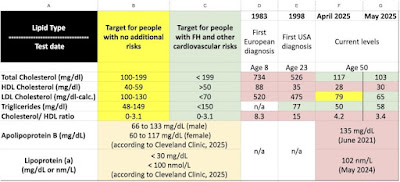
The little bit of a good news this month has been the continuing dropping LDL numbers (thanks to the new Evkeeza infusion which seems to be going well). 


I have to literally pinch myself every time I get the new values after my infusion treatment that shows my LDL in the two-digit range. As you can see, I come from a (“natural”) LDL of 520! I still cannot believe the LDL of 65 mg/dl is mine! I wonder every month if they got my blood mixed up with someone else’s. 


I cannot thank medical research enough for the advancements they have made during my lifetime. This disease that was nothing but a death sentence to me, when diagnosed at 8, has become something I can manage now. This is why it is so paramount that we encourage medical research going forward. It gives not only hope, but literal life to people!


The hope is that I am not adding more damage to my arteries by adding more cholesterol to what has already accumulated there for the past 45+ years. But there is plenty of damage done already and with an aging body and inevitable hormonal changes, I must still continue to stay vigilant and repeat these yearly routine tests, just to understand what is still going on and to have a chance to plan, if faced with an ultimatum. And as I have known several times in my life - ultimatums do happen ...


In this scope, regardless of doctors’ orders, I will continue to fight to know more and not less; to stay on top of every change and progression, such as it will be.