Thursday, May 12, 2016

Park City Main Street

I just wanted to stop by today and add a post where I celebrate a huge milestone, for me. I have moved to Utah 6 years and 2 days ago. Ever since, I have gone to Park City in every season. It did not matter whether it was too cold or too hot, or like today, just perfect, every time I'd walk the whole stretch of Main Street (which is all a huge hill), I was completely out of breath and feeling like my heart will be jumping out of my chest and beating itself to death on the ground!

Today, we took a slow stroll (which we normally did in the past, too), and initially I said "Oh, let's just do half the hill to see how I do". And we ended up parking in the middle of the hill, first going down to the bottom, then climbing all the way back up to the top of the hill and then climbing down another half of the hill, back to our car. I did not lose my breath once. My pulse was 107 at one point, sure, but I did not feel like my chest will explode for even one second of this whole short journey. 

When I first moved here, going to Park City alone would give me an instant migraine and my chest was heavy just because of the altitude (7000 ft), but today was another story. No migraine. Just beautiful spring weather and a nice, refreshing walk. Sure, I was pooped by the time I made it home, but I really do feel like this surgery changed something. I just hope it changed it all for the very much better and I hope, for a while to come. 


This is me at the top of that Main Street hill today. See?! No panting!

Monday, May 9, 2016

What the Last Three Months Have Taught Me

I cannot believe this week it'll be three months since my heart surgery. Where has time gone?! Apparently it flies by, even when you're NOT quite having so much fun.

I am starting work next week. Ready or not, I have to, lest I should lose my job. So … off I go. 
 
I have one more blood check this week (mostly for cholesterol and the effects of Praluent) and then one appointment with my cardiologist after that, to assess how many hours of work a day I am allowed to perform when I go back. He called me last week and he said he wants me to go in for at least one month of part time work before I start my regular schedule. Luckily, I can do that, and I have a reasonable team that will support me in this.

As far as I how I feel, I would say “fair” if I compare myself to the “before surgery me”. I do some things (light chores, laundry, with help, cooking, with help, light gardening, with lots of help, driving but not long distances, dusting, feeding my cat, small dishes, not heavy ones), but I am also limited in my abilities and also in my stamina. I still last for about 3-4 hours of slow to medium activity max, and if this time includes a drive, I last for a shorter time for “actual” active time. I still sleep in a funky position, propped up by 6 pillows and a thick folded duvet, to ensure my upper body is reclined. Still sleeping fully on my back, which is not my normal, but I sleep with less interruptions (1-2 compared to 3-5) during the night. So, comparing myself to 3 months ago, right after surgery, this is HUGE progress and I would say I feel great.

As far as the limitations in my body: I still can only lift about 3-4 lbs with no discomfort (my work purse is about 15 lbs, since it has my computer in it too). My right arm and right side of my chest are still numb (I cannot cut my nails, for instance, by myself, on my right hand). I still cannot open jars, or use my left arm to steer much, or to open heavy doors. I still type slower than normal and the left hand keys need help from the right hand to get them right, or capitalized. My chest still feels like a huge bottle of superglue has been spilled on it and it's holding my skin back from stretching properly. My left leg (from the knee down) is also still numb. 

The unbelievably great news is that no re-surgery is required or needed, or advised at all at this time. My surgeon reviewed the last echo with my cardiologist and said that my aortic valve will forever be leaking (given that I was given an aortic composite graft as opposed to just a valve), and the leaking is normal. However, it's sitting at "mild regurgitation" and it should stay there for the rest of my life. This is normal. When I heard the news that they won't call me back in to replace the valve, my legs cut from under me - I was so filled with joy and gratitude! What a huge favor!  

I am still playing with the Coumadin dose, especially since this week my INR range will go down from 2-3 to 1.5 to 2. So, I have to go in this week for a dose readjustment again, and play with the new range for another month or so, after weekly appointments. I am also still playing with my Atenolol dose, as my BP and pulse are still all over the map. After cutting off the Atenolol completely, I had to be back on it, at a smaller dose (25/ day rather than 100/day). This improved my diastolic pressure a bit (from 30-40 to mid to upper 50's), but my systolic is higher than before (upper 130's and 140's) and the pulse is also higher (70's and lower 80's, at rest, compared to 60's from before). We're still trying to figure out what dose works, or maybe change the beta-blocker.In the meantime, I will have to take things slow, no running, nothing to cause my heart to work extra, for the foreseeable future. I think I can do this. 

The other day, I tripped on my patio and fell on my left shin. It hurt like crazy and I felt this huge rush of blood in my shin. I got a bruise, instantly, and for a minute there I thought “holy hell, I am going to have internal bleeding in my shin and I'll lose my leg!”, or something. Coumadin paranoia kicked in, of course. I do still have a bruise, 2 days later, but nothing that I have not seen before on my body.
I have also had a throbbing tooth and I thought “oh, no, tooth infection! It'll go into my heart!”. I went to my dentist and then to an endodontist, to make sure there is no infection in the tooth, and there isn't. They don't know why sometimes my tooth throbs, but if it's not hurting and it doesn't look like it's cracked, or leaking, they will leave me be for now. They both said there is positively no infection, at this time. But it did scare me there for a bit.

All these (and then some) will be constant concerns going forward, so somehow I will need to incorporate these in my regular “go to work” routine from here out.

All in all, though, I am so incredibly grateful I am mobile and I can do the things I do today and that for the most part, all my other organs function well. This is NO small thing to be lucky to enjoy, as most heart patients will tell you!

I thank God, my team of doctors, this wonderful community of people on this site, and last but definitely not least my family, especially my husband for helping me get here. I took one day at a time and as you know, each day will bring new things you never thought about with it.

All I can say is that what helped for me is the fact that I stayed flexible. I keep telling myself this is what it is (if every day is a square, I don't wish for it to be round), and I deal with every day's new reality as it's given to me. I have no preconceived notions about anything anymore. I make no more plans, really. I know now that anything can happen and nothing, not even our own breath, or especially our breath, belongs to us to control. Whereas before I was more like a rock, strong, stubborn and unbreakable, I am now more like a willow – just very humbled and definitely bending, so I won't break.

I have no idea what tomorrow will bring, or a month, or a year from now, and this is not the purpose of this life, for me, anymore. I finally understand the meaning of “the journey is more important than the destination”, because I have no destination, all of a sudden. Every second is new and I cherish it with the most thirst and curiosity I can muster. In the end, looking back, the trail I leave will be what it will be. But I no longer can say I can see the end or care much about it. All I care about is right now and how I can bridge the breath I am taking now to the next one. This is as far as my eyes can see anymore.

I wish all of you out there, on either side of this, or in the middle, will find the strength and power to go on. I know it is in each one of us. Trust your teams, and love your support groups, and together you will build a wonderful life. Despite the fact that this is a disease of the heart, it is definitely not for the weak hearted, and we're all here to prove this.

Much health and strength on all your journeys.
Thinking especially of all of you who are in surgery this week, and who are struggling every day to find your new normal.

Thursday, May 5, 2016

In Search of a New PCP and New Numbers after One Shot of Praluent

I still remember the day back when I was in college when one of my medical school friends exclaimed “That is SUCH a cool disease!!” when I told him I had FH. He was studying to be a general practitioner, and he just thought this disease was so complex, that allowed him to know the human body like no other disease. He saw me as an opportunity to learn medicine and see the dependencies in the body as a whole, not just in a slice of reality.

Unfortunately, there are less and less people in the medical world that I come across with that find this disease “interesting” if they even bother to learn anything about it at all.

It's been years (at least 12 if not more) that I have found a general practitioner (PCP, family doctor, internist – call it what you will) that truly understands FH and tries to keep me healthy in its context. As of late, they take a step back and say “oh, you gotta see a cardiologist” and that is that. They don't even read my list of medications and they seldom ask about other problems. They treat me, at that point, as “whatever is wrong with me must be FH and they're not qualified to fix it”, or so it feels.

I say this because after about 3 years with the same PCP that never did one physical on me, or did any blood tests other than lipids and liver panels at my request, I have decided to switch my main doctor again. I asked around in the clinic that I go to for my heart and other specialists and they sent me to this other practice in town – huge inconvenience, because I wanted all my doctors to be in one clinic, and I chose the biggest one in town, but I failed to find a good internist or family doc there. So, I took the plunge and went to the recommended practice.

To the new doctor's defense, he did order a huge amount of blood tests, even before he saw me, for my physical. During my visit, he gave me a hard copy of the results and of course all my cholesterol numbers are high, so he had written a note next to them: “Tried diet? Exercise? If yes, what RX?”. Now, if he had bothered to read through the 10 page form I filled out, he would have seen my health history (it contains FH, as you'd expect), my family history (you guessed it again!), the complete list of medications I am on and the amounts for each, so he would have known right off the bat (I hope!!) that he's dealing with an FH patient. But that's about all they are trained to see for a high cholesterol patient: diet and exercise - which is fair, but for the love of life, read the whole profile on the patient before you walk in. With as many doctor's appointments as I have, I rarely understand the purpose of us filling out so many forms, and spending hours with the nurse going over our history. The doctor never uses those notes for anything at all.

He asked the same questions of me, as he scribbled on the blood results paper, and when I told him I have FH, he cut me off with “well, I am going to leave you be in the care of your cardiologist then”.
I had questions about other conditions, for him, like my low vitamin D, whether I should take CoQ10 or not, whether I should take any other supplements for my heart to stay healthy, also about my continuous hives – but I felt, just like I felt before, many a times with many a general practitioners, that since I uttered the words “FH”, he was going to screen save me and listen to nothing else. When you tell them about this disease, it's like the kiss of death to them – they stop having any other professional opinion about anything else. He had no opinion on the vitamin D nor anything else I asked. I had other concerns, but I decided to drop it.

Like I said: I did have, in the past, generalist practitioners that questioned my medications, they added more, they changed doses, and they were also checking for other potential risks of my medicine, they recommended tests, to see how much damage has been done from my cholesterol, etc. But I have not had this experience as of late. What's more, they never want to treat anything else, because … who knows, maybe everything else that is wrong with me is because of the FH and they let the cardiologist figure that out?! I have no answers here. Just a bitter taste.

So, it makes me wonder: what changed in the medical world for the general practitioner to be so terrified (or dare I say, unprepared) of treating a patient as a “full spectrum” of health concerns? I know they teach the whole body and its various afflictions in medical school, and I know some general doctors paid attention and have the ability to treat everything under the umbrella of an existent disease. But why are these people so rare nowadays?!

My cardiologists have always been top notch about FH and about the effects it has on my body as a whole, and my heart in particular. The fact that I got great heart doctors happened simply by luck, I had no personal referrals to them. I have always been pleased with the care I received from them. But they don't know everything, as their specialty is the heart. The generalist doctor, in my mind, is the “everything” doctor. But those have been a disappointment in my recent past.

I told my husband I'll give this new doctor a chance for at least another year, but I feel like that is even generous given the first visit. His goal at the end of my physical was to “recover from heart surgery and report back in 3 months”. Hmm... yes, that is the goal for my cardiologist, too, and for my surgeon, but … I exhaust my arguments.

I (and we) have no choice but to be tied to medical professionals to maintain my (our) health. But if I have one wish, one request from the medical “gods” out there, is more education. More education, and info sharing between all the specialties out there, about all the diseases (at least basic knowledge). I wish when they all get together for their yearly conferences, there was one forum where they would all share and get a deep understanding of drugs, lifestyle, family history as a composite spectrum of facts for each patient, and I wish this would render them to not be afraid to come to the healing chair with us, the patients, and share what they have learned. It would help us so.

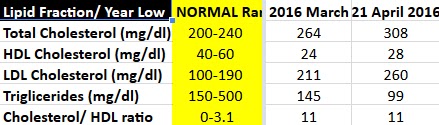
On another note … like I mentioned, he did do a very extensive list of blood tests. When he did these tests, I was after a week from my first shot of Praluent. I have read in many articles and even my cardiologist said that you can usually (he said it with caution) tell that the Praluent is working even after the first shot, “in most patients”. Well, here are the numbers from April (after Praluent – last column), and the before last column will show you the numbers from March (before Praluent). Evidently, it was not working for me, yet. 


I have since taken a second shot of the drug, and I am getting my values checked again in a week, prior to my appointment with the cardiologist, who of course was the one who put me on this therapy. I will report back with that finding, then. For now, insert your own disappointing tune here …

Hope everyone is finding true compassionate care and knowledgeable help out there. It makes all the difference in the world!


Tuesday, April 26, 2016

Back in That Roller Coaster: 2 Month Post-op Echo

... And I don't even like roller coasters. I guess God knows that, so He wants me to face my fears by continuously putting me on one!

I got my 2 month post-op echo done last week. The results were posted online, where I could read them earlier this week, and I had a feeling things were not "kosher", but today my cardiologist called me and confirmed. 

I have had low diastolic blood pressure since I left the hospital. Normally, they kept asking me if I am lightheaded and until about 2 weeks ago, I was not. However, since I started Phase 3 in rehab, and I have been pushing myself to do more, and last more on the treadmill, up my speed, etc, my blood pressure keeps staying low (average 100/30-something) and I have felt dizzy and light headed when I exercise. 

The echo shows aortic insufficiency, which basically means my new On-X valve is leaking. It's leaking enough, to maybe cause left ventricular insufficiency, perhaps (unless that's still left over from my heart attack while I was in the hospital healing from surgery), and could also cause low diastolic pressure, with the symptoms that I have when I work out. The echo shows left ventricular insufficiency as well as slight left atrium enlargement, as well as trivial mitral and tricuspid regurgitation. These last 2 are not of immediate concern to the cardiologist - just something to watch, but with my aortic valve history, they don't sit too well with me. 

The next step is to completely eliminate my beta blocker for a couple of weeks to see if the blood pressure comes back. If yes, that's what's causing the low BP. If no, then the aortic insufficiency is to blame. Right now, we have too many variables and we don't really know what's causing the symptoms.

In the meantime, I am not to push myself too hard. The cardiologist said to definitely keep active and move, but not to run or cause my heart to speed up. He wants to see if my diastolic pressure will come up in more normal ranges, of 50-60's and stop being in the 30's and 40's. 

I have an appointment with him in 2 weeks and then a repeat echo in another week from that. 

I am completely bummed because I was supposed to start working in 3 weeks, but with these many questions still in the air, I am not sure what will follow. 

I am of course VERY bummed that my aortic valve is still regurgitating, even after its replacement. Sure, it went from severe to mild regurgitation, but still enough to maybe cause havoc in the functioning of my "pump" (my left ventricle which pumps the blood out to the whole body). 

He did say that with this type of valve he often sees aortic regurgitation in the very beginning, which clears up after a while. He sometimes sees it not clearing up which will require re-surgery. 

My ejection fraction went way down from 70 pre-op to 55 now, but I did have an MI (myocardial infraction) on my left ventricle. Like I said: too many variables, right now. 

I can't even think about "the worst", because I feel like I don't know everything to even be there yet. The area of the aortic valve is definitely improved, so are the speeds through the valve. So, there are some pluses. However, the thickening of the atrium and ventricular insufficiency scare me, and the symptoms I feel when I exercise do too. 

I can only think of "what's next" and for now, I quit the beta blocker, take it easy and go about my days  calmly. The whole time since surgery has been somewhat stressful on a personal level, so that could have contributed to my heart not healing properly, as well. 

One day at a time, and never ever take any second for granted. 

Much health to all of you.  

Wednesday, April 20, 2016

10 Weeks Out from OHS and 1 Week of Praluent

Although I have been walking this OHS journey now for 10 weeks myself, I am still coming up against new things that my body is going through. I am amazed that symptoms are still coming up and I feel and experience new things. The doctors' appointments and lab visits are still a weekly necessity.This is kind of what this post is about as well as a short follow up on my Praluent side effects. 

Today was my follow up echo, the first one after the release from the hospital. As far as the tech could tell, it all looks good, but the official reading from the cardiologist has not come in yet. 

After that, I went to have my INR checked (my weekly appointment for now), and it's under the range. Again. Today was 1.9, which is just 0.1 lower than the lowest margin. Argh! For the fifth week now, I am under the lower limit. Somewhat unsettling. The only silver lining is that I have an ON-X valve, which should require less Coumadin, and accept a lower INR. 

My husband and I went to Home Depot for some spring shopping after my appointments, and although I was not pushing a cart, nor was I lifting anything at all, I got REALLY lightheaded for the first time almost since I left the hospital. I just felt like my knees were jell-o and they would just not support me. I had to sit down on a shelf right away, as I felt I was going to go down otherwise. After 5 minutes or so, I gained my balance again, but I felt drained. Just like all the energy depleted me. 

After lunch at home and a nap, I felt better. My chest hurt a lot today, too, but I blame my rehab stretches on that - they REALLY are engaging my torso. My blood pressure was low, again (100 over 40), today, but it's been low before, with no dizziness, so ... no idea what this was, but it came and went, so far. Just something to keep an eye on and see if it should happen as a norm. 

I took it easy this afternoon - everything I did was sitting down. I am still surprised that some of this "weirdness" kind of comes and goes even to this day, even after this many weeks. This makes me nervous, of course, especially with the starting of work looming ahead. 

Now, about the Praluent. My arm hurt for about 4 days after they gave me my shot last Wednesday, but only when I massaged my injection spot. The night I got the injection, I had a panic attack. I felt like my heart was pounding hard, and I felt just like I feel before a job interview, but multiplied by 20. I got cold sweats followed by really hot, dripping sweats. I didn't take anything for it, I seemed to sleep it off, in an agitated night sleep, and I was better by the morning. 

I also, for some reason, have a hoarse voice. I know that nasopharyngitis is a major side effect of Praluent, but I don't have congestion in my nose/ head, or flu-like symptoms, etc, but I have a very hoarse voice and I sneeze a lot. I think the jury is still out whether this is from Praluent, or just the pollen season being upon us. I will keep watching it and continue to report back on what else weird is happening. 

Much health to all of you, and I hope you have a beautiful spring to enjoy, like we do, here in The Rockies. 


Wednesday, April 13, 2016

Huge Milestone for Me: Cardiologist Visit and New Drug Therapy

Hard to believe that it's been two months since my heart surgery already (two days ago), but time is not asking us to pass. It takes its own liberty to do so.

Although I have seen tremendous progress for which I am immensely grateful, my body is still trying to adjust after getting hit by that proverbial truck, a name a lot of us, members of the cracked chest club, call OHS. Aside the progress I see in moving more freely and having less and less pain every day, the biggest benefit from this is that I feel that my heart is stronger. Even with the occasional palpitations and low blood pressure, I seldom run out of breath when I do my walks, or walk up the stairs – which was a constant in my previous life. So, so grateful for this!!

There are still a few things I am not able to do. Definitely the biggest complaints are the consistent pain, and the daily, hourly fatigue. I max out on energy after about 3 hours of any activity– which does not make me be in any position to restart work, not even part time. I wish my disability insurance would get this – I have been fighting with them for the past three weeks to make them understand that my body is not ready to return to work. My HR folks get it, but not my insurance. Go figure!

Apart from pain and tiredness, and the consistent numbness in my left arm, leg and left hand side of my chest, there are random “weird” things like seeing stars or dark patches sometimes, occasional, very loud ringing in my ears, dizziness – things that worry me if I were to drive on my own, with no one else in the car, like I would, for work.

I am also still anemic – with a low hemoglobin and still taking iron supplements. I am also still at 95 lbs, 10 lbs less than before the surgery – pounds I did not need to lose, but I can't seem to gain back, no matter what I eat.

I am told by all the medical staff that all this is normal, and all this is temporary. I am told that time will heal all this, and not to worry about the temporary discomfort. So, we wait.

Today was my 2 month follow up with my cardiologist. He tweaked more drugs, and made another laundry list of follow up and specialist appointments, too. In other words: the normal, for me.

Some drug changes: he half-ed my daily dose of beta-blocker, to try to stop my blood pressure from being so low (my diastolic pressure has been in the upper 30's, 40's and low 50's since the surgery). He is keeping me on zetia, too (more samples of that, since it's so insanely expensive, with everything else I take). He is adding a brand new drug, Praluent, to my anti-lipid cocktail (more about it below). 

This was the content of my bag after my appointment today. Got drugs, anyone?! 

In referral/ follow-up appointments area, he wants me to start seeing a vascular surgeon, for my blocked carotids – maybe I need surgical intervention there, too?! He also ordered my 2 month follow up heart echo for next week, to see the state of my valves and aorta. As you might remember, my mitral valve has trivial regurgitation now and a calcified leaflet. So in addition to keeping an eye on what has been fixed (ascending aorta, aortic valve/ root, the four bypasses), we need to continue to keep an eye on what's adjacent and has not been fixed (aortic arch, mitral valve, etc).

As I mentioned above, I have accepted (finally, some might say) to take the new drug for cholesterol, the PCSK9 inhibitor, Praluent. I have known about the research for this drug since around 2008-2009. I have been asked to be in the research for it since then, but I continued to be skeptical (still am), since little is known about its side effects. It was approved by the FDA only last year (July 2015), and here I am, not even a year later taking the bi-weekly shot. I am scared and nervous, but I do want to get those cholesterol numbers down to a normal range.

My cardiologist has been the head doctor for the research on Praluent since 2011 (5 years this year) for our state, so I feel in pretty good hands with him administering this to me and checking my progress.

After never having a normal reading of cholesterol ever, in my life, and after seeing the damage it has done to my heart in 41 years, I am willing and ready to try what is next, to avoid another OHS, or a stroke, or a stent in my carotids or elsewhere, you name it. So, here I am adding to my cocktail in hope that we can put a dent in the numbers for the very first time ever. (my latest numbers are here: http://livingwithfh.blogspot.com/2016/03/new-numbers-under-duress-sort-of.html).

It's like this at this point: although by living with FH you have heard all your life that that truck will hit you, now, in the post-OHS era of your life, you're actually conscious about it, so you see the emergency in trying to grasp at whatever options you have to avoid the collision. I am not oblivious to the risks, but I have seen first hand what the high numbers will do to your body. And a sudden death not to mention a miserable life from those is something I want to avoid going forward. I will still read, inform myself and research on my own as before, and I will continue to stay involved and ask the right questions from my doctor, as before. I am just opening up a new door to my healing, that is all.

As I explained before (here: http://livingwithfh.blogspot.com/2016/03/not-bicuspid-valve-after-all.html) the sole reason for my heart surgery was FH. The sole reason was living with this disease and allowing the cholesterol to muck up my valve, my aorta, my carotids, and God knows what other arteries in my whole body. The only measure we have at how bad the damage will be/ can be in our arteries is by looking at cholesterol numbers which are high, for me. The Praluent is a promise to keep those numbers low, and in consequence, allow for the damage to the arteries to be either delayed (some will still happen with aging), or non-existent. This is a personal choice, and in no way is this a recommendation to any one out there, reading this. This realization will have to come on your own, with the help of your medical team. This is where I am today, in my healing process.

I know, I am drinking the kool-aid, according to some, and trust me, I am very, very scared. I hope that my body will alert me before something does go terribly, irreversibly wrong in my system as a result of taking these new, potent drugs.

The drug is a shot, and it comes in a pen format – you give it to yourself every two weeks. It is very expensive (tens of a thousands for a year) and most insurances don't cover it, but talk with your doctor, and they have payment plans and samples they can help you with, if you can't pay for it yourself.

It is also important to know that they won't approve this unless nothing else worked before, pharmaceutically, to bring the numbers down. I have been on all the statins for 18 years now. None of them work, except for lipitor, which works partially, for me. Even being on lipitor, and with a number of other drugs added to it (niacin, zetia, cholestyramine to name a few) my numbers have never been normal.

My cardiologist believes we should see the numbers drop after 2 shots, even. I will definitely report here what the result was. So far, from taking my first shot today, it is not a big deal – the needle is very small and you can't even see it – it's like a blood sugar check needle, only the “pen” part is longer and thicker than that. I have seen reports of patients feeling soreness and swelling from the injection site, but so far (2 hours after the shot), I feel/ see neither one.

From having the very involved surgery I had recently (http://livingwithfh.blogspot.com/2016/02/open-heart-surgery-day-1-to-8.html) you learn a lot about self preservation and being proactive. I feel like I have always tried to be proactive in my life, but I have always been scared of the new therapies. Well, I guess that is over for me, as I am now embarking on this new journey. Hoping for only smooth sailing ahead, as I hope for every one of us.

Much health, all!


Sunday, March 27, 2016

Update on Recovering

Today, I am roughly at a month and 2 weeks from my heart surgery. In some ways, I am looking back and I cannot believe how far I have come (I am not in a hospital bed, wired and attached to machines with everyone doing everything for me), and in some ways, I cannot believe I am still recovering and re-learning to do the easiest things daily (like putting on my socks and shoes).

A month and two weeks is hardly enough to get back to who you were before – I have learned this every day since then. One of the Rehab Center techs told me my body “was assaulted like never before” during this surgery, and trust me – this is exactly how it feels.

I still go through the pictures of all the scars and wounds and bruises I left the hospital with, just to remind myself what I am pulling myself from and to encourage me that change is happening and I am doing better. Some days, the hard ones, it is hard to remember this.

I have found a routine for my recovering weeks, and it usually goes like this:

  • during the week, I wake up and after shower and breakfast, I go to rehab in the early morning – my husband is still driving me, because I am nervous to be on the highway with my upper body hurting from steering and with the seat belt not in the right place - I wear it under my left arm, because it hurts my chest;
  • I come home and I snack – those exercises take away all my breakfast;
  • Sometimes, I take a light nap or I catch up on email or the news;
  • Then, I either read, or do some sitting down work/ crafts (mostly something I can do with my right hand) or I do house chores; I can't do strenuous ones (like vacuuming and cooking pots of food, or taking the trash out), but I put (small) dishes away, I dust, I put away clothes that have been washed, or clean up the cat's corner, etc;
  • In the afternoon, after lunch, I either walk on my treadmill, or walk around the neighborhood, or lately, I have been going to a store and walking around there with my mom and my husband; my mom has gone back home now, so it will be harder to find excuses to go to the store often in the afternoon;
  • Then, it's dinner time, and watching some tv;
  • I try to stretch and do breathing and arm strengthening exercises all throughout the day; I am weak everywhere, but my arms feel it the most.

I have not been able to cook much yet. I made some hashbrowns in the oven the other day, and I reheat a lot of stuff, but I cannot peel a potato, or lift a pot of water of more than 1 qt from the sink.

I drove just around the neighborhood pretty much today, for the first time, and I was out of breath by the time I got to WalMart which is like 3 minutes away from my house. The steering wheel feels like it has no power steering at all, and it hurts my chest with every move. Plus, the “adjustment” I made to my seat belt does not hurt less, it just hurts in a different place – my left arm, instead, which is numb to begin with. I am definitely in no shape to start driving to work, which is at least 30 minutes away with no traffic, one way, all highway driving. I am not venturing on the highway yet.

Other than my weekly INR checking appointments, I have not had any other appointments lately. I am also blessed and every so grateful that I have not landed in ER or any other “unexpected” appointment yet.

The INR is a slippery, tricky beast, though, in itself. My target for now is 2-3. I have been fine … till last week when I decided to introduce leafy greens and broccoli to my diet, and boom! It tanked at 1.8. So, now, they increased a dose a little, only one day a week. I have no idea how it all works for them to decide which days to have 2 mg of Coumadin on and which days to have 1.5 mg, but this is what they do... They alternate the dose and spread the higher ones out through the week. It's OK for now to have the INR all over the place, because I am still learning what to eat, what affects it and how to be consistent about eating it, so I can balance the INR. Until then, weekly checks is what's needed.

I have gotten a phone call from my disability insurance to interview me and check whether “I am still sick”, basically. As much improvement as I have seen since leaving the hospital, I still cannot tell you that I have the stamina, and the strength in my body to resume work yet.

I am tired most of the time, even with a slightly easy schedule (above). I cannot muster more than 2 hours tops out of this house, and after that I must sleep and lay down for the rest of the day. I don't go out of breath from showering anymore, or washing my hair, but I still am completely done for the day after rehab in the morning (an hour or so) and a similar workout in the evening. And I don't trust myself to drive yet – which is a big part of my working life.
Another big part of my work life is typing – and with my numb and painful left hand, this is a challenge. I correct my misspellings all the time, because my typing is poor with my left hand.

My left arm is completely numb and very painful. All. The. Time. I can carry my purse, which is about 3 lbs, but I would not be able to even lift my work bag, which has my laptop in it, and my entire contents of my purse, not just the “abbreviated” ones I have now. I am thinking because of my upper body strength being so weak still, my back still hurting, my ribs, too, and because I am not gaining weight at all, I will have to use a dolly to carry my work bag and my lunch bag, when I do go back to work, for a long, long time.

I know you are wondering what can be so heavy to lift in a 2 qt pot and a 15 lbs (or maybe more?!) computer bag?! But I weigh 95 lbs right now. 15 lbs is more than 10% of my body weight, so to me, with no muscle mass to speak of, and just bones, and with the arms depending on the still cracked and healing sternum for support, this is a huge deal.

My incision is almost all healed, except for two spots which are still scabby. I still have a huge scab in the bend of my left knee, where they harvested the vein from. The left leg is numb but not as painful as my left arm.

I am getting there, albeit slowly. I am still paranoid about catching the flu or pink eye or something from the huge children population of my state, so I keep my visits to public places limited. I do have people visiting me, though, and I eat out maybe once a week – although I choose my restaurant carefully (cleaner, less kids, perhaps?!).

I am still uncomfortable sleeping – I don't see this changing any time soon. I am still learning a lot about Coumadin and my new life with it.

My blood pressure has been very low lately! Even with exercise, the last two times I went to rehab, it's been around the 108/35 range. Even after 40 minute 2.8 miles/ hour walk (I have small feet and short legs, so this is like running to me!), the blood pressure sits stubbornly at 110/45 or something crazy like this. I asked the rehab nurse and my cardiology nurse whether this is a problem, maybe my beta-blocker dose needs to be lowered, now that I have a “different” heart, but they insisted that if I am not lightheaded, then it's OK. So, I am keeping the 100 mg dose of atenolol that I have taken for 15+ years now.

I also asked about why being so tired all the time and why not assimilating anything I eat to gain some weight – they said all this is normal post-surgery fatigue, it will go away with time and patience and they said all that I am eating now goes to healing my body, and not to increasing my weight.

I am back on my vegan diet, because the animal protein I was trying to eat to increase my hemoglobin and address my anemia has made me sick (hives and GI issues). I am sticking just with fish (tuna and salmon mainly) and vegan meals. I do eat and the taste for food is mostly back, but for some reason assimilation of all I eat is the problem.

And that's what's new in the heart surgery recovery corner. Spring is slowly coming and I hope to move most of my exercise outdoors, whether I'll prune my roses or walk in the neighborhood to peek at neighbor's yard improvements. My sister and older nephew are coming to stay with us for a week, and I hope to take him to parks, to the aquarium, to a mall (not all of them in the same day, mind you!), so that will give me a reason to walk, too. One day at a time and one foot in front of the other is all I know, right now.

The short disability insurance person asked me how long do I think I will need before being completely ready for work – it's really just like asking someone how long do you think you're going to live. There is no telling. Days are sometimes good and some are really bad. Some days, I wake up in the middle of the night grabbing for a Tylenol, but wishing it was a Percocet, and some nights I can grind my teeth and end up just sleeping through the pain. I wish I knew what my body decides to do every minute, but it's like a crystal ball.